
The Beginner’s Edge: Turning Constraints into Creative Leap
In recent weeks, I have done some workshops with artists, and a question has come up a few times about limitations in music production. That question was:
How can I deal with the fact that my imagination and ideas are not following the technical capacity that I have?
In other words, the artist has a lot of imagination about what they would like to do with their music, but they feel that the learning curve, or the current skills they have in music production, are too limited to express what they think and envision. This is a common problem for beginners, but you might be surprised to learn that even experienced producers face it from time to time. It just appears in different forms depending on where they are in their development.
In past articles, I discussed how what we have in mind is often more or less a proof of concept of something that could be done. But extracting these ideas is not simple. Sometimes, those ideas are not even that interesting once they are translated into a technical context, even if they seemed exciting in our imagination. There is often a gap between the fantasy of the idea and the reality of executing it.
In this blog post, I want to explain how to deal with that situation. But beyond that, I also want to explain why limitations in music production can actually become a leverage for more creativity than you think. What many beginners see as a weakness can become a direction. What feels like a lack can become a framework. And what seems frustrating at first can end up being the exact thing that helps you build your skills, your taste, and even your artistic identity.
The Frustration of Not Knowing Enough
What I often see is artists who really connect with music and have good taste—or rather, a more refined taste. They listen carefully. They know what moves them. They hear things in tracks that excite them emotionally and aesthetically. But when they start making music themselves, they immediately find themselves in a position where they realize that, at first glance, whatever they do sounds amateurish to them.
That part is underwhelming for someone who sees their favourite artists making music and assumes that, after watching multiple YouTube tutorials, they can achieve similar results. The internet makes everything look accessible. It gives the impression that knowledge is available, so execution should be quick. But that is not how art works, nor how craft develops.
For many people, music is not just a hobby. It is a way to find validation in a community, but it is also a way to express emotions in their own language. They want to communicate something that they feel. They want to create something that sounds personal and meaningful. So when they try and the result does not match their taste, that gap feels painful.
Especially at the beginning, there is often this persistent inner voice saying, “I don’t know enough.” Then that voice nourishes another one that feels it must find a solution for this ongoing problem. Most of the time, people identify the solution as needing more plugins, more skills, more knowledge, more theory, more tutorials, more gear. Many believe that freedom will come from knowing everything.
This is not a new behaviour. People often respond to uncertainty by accumulating tools. In music production, that often becomes digital hoarding: collecting plugins, sample packs, courses, templates, YouTube videos, bookmarks, PDFs, and all the potential resources they might need someday.
It is a bit like going camping for the first time. Before you have ever done it, you go to the store and buy every possible thing you imagine you might need. Then you arrive at the camping site and realize you will probably use about 20% of what you bought. Music production works the same way. You often need less than what you have.
The problem is not limitation. The limitations are actually a direction for you to take.
See it as poetry. If you write poetry in a language that you do not really master, or if you read poetry from someone who is trying to express themselves in your language, you will quickly notice that the person may have limited grammar and vocabulary. But that does not stop them from expressing something real. It may not be as elaborate as what a professional poet can do, but it can still be touching, direct, and honest.
More than that, you also notice that when someone is trying too hard to say something beyond what they can really handle, it shows. There is strain. There is awkwardness. There is often a distance between the intention and the execution.
Music is often the same. If you remain within what you can do, you can sometimes sound more solid than if you try to accomplish something you do not yet master. That does not mean you should never challenge yourself. It means that trying to speak clearly with the vocabulary you have can often be more effective than trying to imitate fluency you do not yet possess.
This is one of the first lessons about limitations in music production: limitations not only reduce your options but can also protect the strength of your expression.
The Illusion of Unlimited Possibilities
As someone coming from the 90s, when resources and tools for music production were far more limited, today feels like the exact opposite. Now we have tutorials for almost everything we can imagine. There are music schools, online courses, coaching programs, sample libraries, synth plugins for every taste, AI assistants, and endless content explaining how to fix any problem.
For each challenge you run into, there are multiple possible solutions. On paper, that sounds ideal. It looks like abundance, and abundance gives the illusion of power.
But this abundance often creates a different problem: infinite choice.
An infinite number of choices can result in creative paralysis before someone even starts. People have loads of ideas, but they cannot manage to find a workflow. They struggle to finish projects. The exploration remains shallow. Even with all the assistance they have, they get lost in the details. Precious ideas that initially felt alive end up being scrapped because they were diluted by too many options.
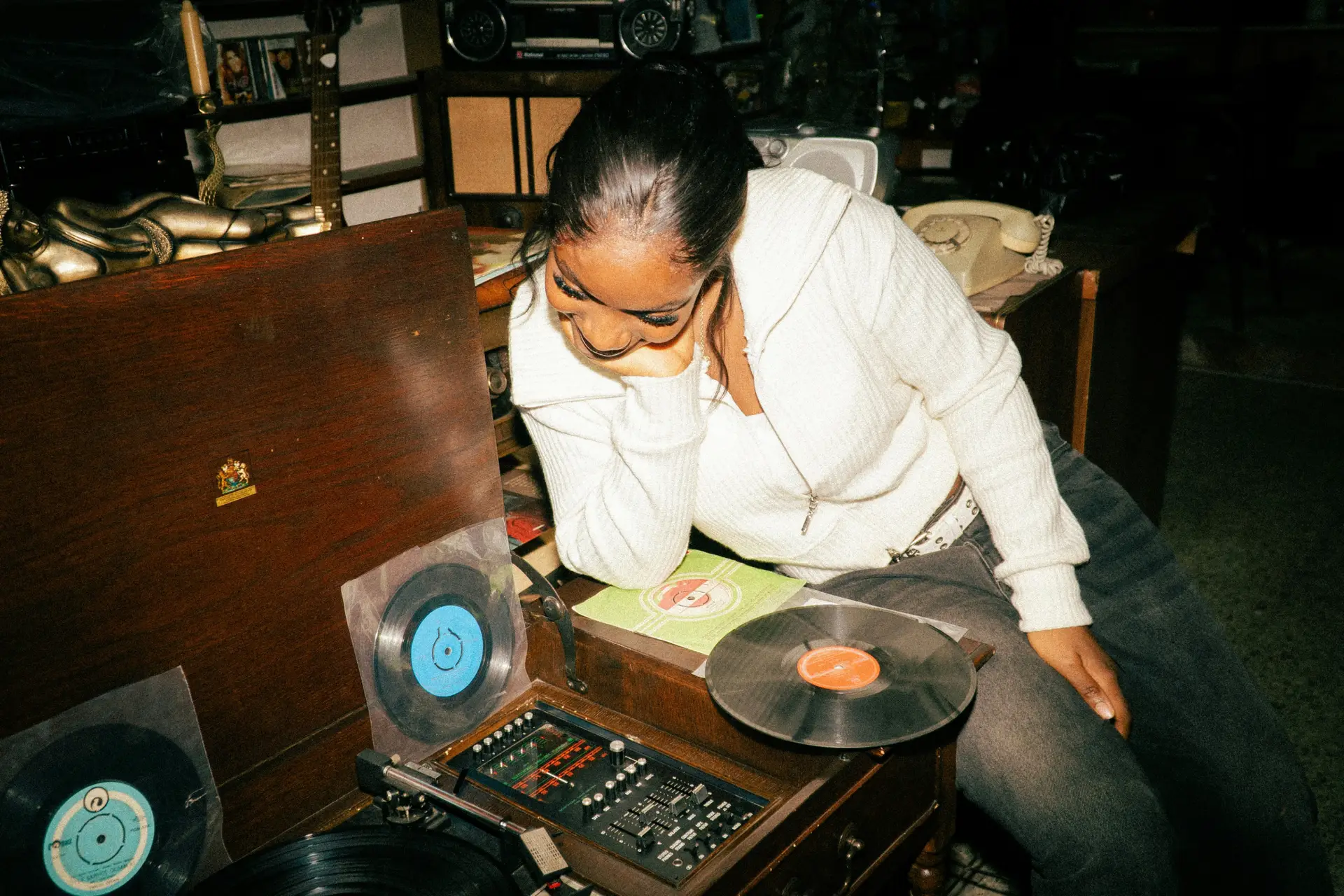
An example of limitations in music production using minimal tools – Music lovers feel underwhelmed when making their first song.
Too many options dilute intention.
This is one of the biggest hidden problems of our era. Beginners often believe the issue is that they do not have enough. But very often, the issue is that they are facing too much. Too many tools, too many possible directions, too many solutions, too many reference points, too many voices telling them what the “right” way is.
In my own technique of work, where I explain how a non-linear workflow can be used to produce music, one thing I insist on is that projects have to come from the same core or seed. It is important to have branches, yes, but it is equally important to keep them connected to a center. If everything branches endlessly, you lose the essence of the track.
That is why it is useful to limit yourself to a set of tools. For example, if you want a specific sound as an artist, choose one synth or one sound generator and work from there. It gives you enough material to explore without constantly shifting your foundation.
The main issue with unlimited possibilities is that they create the impression that you have everything under control because solutions are available. But having access to solutions is not the same thing as knowing how to express yourself. The tools do not automatically solve the problem of meaning. The tools do not express your idea for you. They are only there to help you shape it.
You still need to tie the knots and connect the dots yourself.
In other words, the tools do not express you; you express the ideas.
That is why limitations in music production can be so useful. They dispel the illusion that the answer lies elsewhere. They bring you back to what matters: taste, decisions, execution, and repetition.
What a Limitation Actually Does
A limitation can be a tool. It can even become a way of expressing yourself.
One of the first exercises in limitation that I give to students is to work with a reference track. Many people resist this idea at first because they think a reference will somehow remove originality. But once they start using one, they often realize that the reference itself gives them limitations on arbitrary decisions such as:
- the length of the track
- its energy
- its speed
- its tone
- the root key
All these things are what I call soft limitations. You can still move around them, but as a starting point, they give a direction. They help you avoid spending energy on superficial decisions that can otherwise drain your focus before the real work even begins.
This is one of the hidden strengths of constraints: they reduce decision fatigue. Instead of asking yourself a hundred open questions at once, you narrow the field and move.
A limitation also creates identity.
A good example is Detroit Techno or Acid House. In the early days, many artists had extremely limited studios. They bought gear they could afford, sometimes even things people discarded, and they made music using only two or three machines. Those limitations forged a sound. Even now, with all the plugins and possibilities we have, people still want to recreate music that comes from those same few ingredients: a TB-303, a Roland 909, a drum machine, a couple of synths, minimal effects, and a direct workflow.
That is a perfect example of how limitation can create an identity for an artist or for a whole genre. When you have fewer tools, you tend to use them more deeply. You learn their character. You repeat certain gestures. You build taste through habit. That consistency becomes style.
Another limitation beginners often resist, but that can be an excellent starting point, is limiting yourself to samples—or, preferably, loops and ideas made by someone else. Many people reject this because they think using someone else’s material is less creative. But it can actually be a powerful way to focus your learning.
If you use samples, you can spend more energy on arrangement, mixing, editing, chopping, and transformation. The creativity then comes from how you organize and reinterpret the material. There is nothing wrong with learning one layer of the craft at a time.
Personally, the kinds of limitations I like to set for an album or a series of tracks can be things like:
- one preset in a synth
- eight channels maximum
- one type of reverb
- one palette of drum sounds
- one sound source across multiple sketches
If I take one preset and make eight songs from it, they will all sound a bit similar. I can still change the mood, key, speed, density, or tweak some parameters, and each one will feel different. But there will be coherence.
This is something you hear often in Dub Techno. Producers use very similar sonic material from one track to another, but by changing timing, mood, layering, and space, they build variety. Dub Techno has sounded related to itself for decades, and yet people continue to love it because that consistency created a culture and a recognizable direction.
This is worth remembering: limitations in music production do not only help you finish tracks. They can also help you sound like yourself.
The Skill Loop: Why Constraints Make You Better Faster
When I host artists’ retreats, and people are impressed by some of the knowledge I have, they often tell me they wish they knew as much because they feel it would make them faster.
Then I tell them something that usually surprises them:
Sometimes, the more you know, the slower you get.
The more knowledge you have, the more details you become aware of. You hear more flaws. You notice more possibilities. You recognize more potential improvements. All that awareness can become a burden if it interrupts momentum. In some cases, knowing more means spending more time fixing things that a less experienced version of yourself might have simply let pass.
Sometimes, when you know less, you move faster because you pay less attention to all the little problems that could stop you. That can actually be an advantage. It can even create charm.
I remember that when I knew less than I do now, I would sometimes work much faster because I did not bother fixing certain things that, today, I might identify as mistakes. Yet some of those older imperfections had a beauty to them. They had spontaneity. They had life.
In a time where so much is moving toward artificial perfection—and now increasingly toward AI-generated smoothness—mistakes become one of the last visible traces of the human hand. Imperfection can create character. There is charm in a result that feels lived, unstable, slightly uneven, but expressive.
One of the biggest strengths of having a limitation is that you repeat the same tools more often. Because of that repetition, you begin to notice details faster. You refine instead of constantly restarting. You start building an internal map of what works and what does not.
This is why beginners should not underestimate the value of reuse. Saving your own presets, making your own macros, building your own templates—these are often more useful than learning a hundred scattered techniques. The things you reuse become part of your language. Technique matters, but reusable systems support consistency and speed.
Once you have a limitation and focus on certain details, this creates:
- deeper listening
- muscle memory
- faster decisions
- better pattern recognition
The basic cycle becomes simple:
Try → Repeat → Refine → Improve
That is the skill loop.
And that is one reason limitations in music production can accelerate growth. They keep you close to the same terrain long enough for you to actually learn it.
Without limitation, many beginners end up starting over all the time. New plugin, new genre, new workflow, new tutorial, new approach. They remain in exploration mode forever, but do not stay in one place long enough to develop depth.
With constraints, depth becomes almost unavoidable.
Expression Within Limits
Working with limitations is, to me, very similar to what happens in poetry. You accept that you cannot say certain things beyond a certain scale or spectrum. That forces you to become creative with the words you do have.
If I do not speak much Japanese and try to write a haiku, it might follow the rules of poetry, but the language I use will be limited. It might sound childish in places, but that does not mean it cannot still be touching or beautiful. I can still express something. The limitation might even create a form of sincerity.

Poets work within what they can express.
This is also how some classically trained musicians listen to very simple electronic music. Even if they understand that the complexity is low compared to classical forms, they can still appreciate that expression is happening at another level. The idea is not wrong simply because it is simple. There is still emotion, tension, personality, and intention in it.
Quite often, simplicity can take the artist very far because simplicity forces synthesis. You summarize your idea. You remove what is not needed. You retain what is essential.
When you only master certain concepts, that can actually work to your advantage because clarity becomes more important than complexity. And with music, that matters a lot. It is often easier to be complex than to be clear. Complexity can hide uncertainty. It can create the illusion of depth. But too much complexity can also create chaos, confusion, and a lack of impact.
Simple ideas, well expressed, often feel stronger than complex ideas that are poorly executed.
Execution is always possible, no matter what your technical level is. What becomes difficult is the impulse to impress. Many artists start adding complexity because they are worried they will not be taken seriously, or because they fear people will find their work boring. But what often makes music feel boring is not simplicity—it is a lack of conviction, a lack of movement, or a lack of spontaneity.
There is something powerful in fully owning the level you are at and expressing yourself clearly from there. That is another lesson beginners can learn from limitations in music production: having less can actually force stronger communication.
How Limitations Create Style
One thing that is often underestimated is that limitations can help create style long before an artist consciously “finds” their sound.
Many producers imagine that style appears once they have mastered enough tools to fully choose who they want to be. But often, style appears much earlier, through repetition under constraint.
When you use the same synth often, rely on the same group of samples, prefer a narrow BPM range, build tracks around similar kinds of contrast, or keep reaching for the same reverb or the same chord shapes, you are already forming a style. It may not be fully conscious yet, but it is there.
This is one reason so many artists who had limited means ended up sounding unique. They did not have the luxury of reinventing their entire setup every month. They learned their few tools deeply. Their recurring choices became a language.
And that is still true now.
A producer working with one instrument for six months may develop a far more recognizable voice than someone working with thirty plugins in a scattered way. The first person will accumulate behaviour. The second may accumulate options.
There is a tendency among beginners to think that identity comes after mastery. But identity often comes from adaptation. It emerges from the relationship between what you want to do and what you are currently able to do. That friction creates choices. Those choices repeat. Repetition creates a fingerprint.
So when you feel limited, remember that limitations may not only be helping you improve technically—they may also be shaping what others will eventually recognize as your sound.
Practical Ways to Use Limitations in the Studio
Coming back to the initial problem—when people feel their ideas are not matching their skills, or when they have a sound in their head that they cannot reproduce—there are different ways to work with that.
A simple way to reproduce a sound you hear in your mind is to first learn how to describe it. Try to vocalize how it is built:
- Is it short or long?
- Is it high-pitched or low-pitched?
- Is it stable or dynamic?
- Is it bright or dark?
- Is it dry or spacious?
Then you can go through the samples or presets and try to find something close. This may seem basic, but learning how to translate vague imagination into a few concrete characteristics is already a huge step forward.
Another way to deal with your limitations is through collaboration. Teaming up with a friend or fellow musician who has strengths where you feel weak can help you express yourself more clearly. Sometimes the gap between your idea and your current skill can be bridged by someone else’s practical knowledge. That is not cheating. That is one of the oldest ways artists learn.
But if you want to actively practice using limitations in music production in a creative way, here are a few suggestions you can explore today.
One Tool Only
Try making a track using only one synth, and that alone.
This can be surprisingly rich. Restricting yourself to one instrument forces you to learn sound design, arrangement, contrast, and variation from inside a single vocabulary instead of escaping into new tools each time you hit a wall.
Recently, during a retreat, I did an exercise in which I built an entire song from a single MIDI clip. It was challenging, but it turned out to be very interesting. More importantly, it led me to build other ideas quite fast afterward because it shifted my attention from hunting for material to transforming what was already there.
Use a Time Constraint
A second idea is a time constraint, which I practice almost every time I go to the studio. I impose a time limit on what I am going to do.
In my case, I often like sessions of around 20 minutes. I find that the quality of my ideas drops after that, and I prefer to keep the best of myself for each track rather than pushing through long sessions where the signal weakens.
Another indication that I need a break is when something starts to feel slightly difficult while I am in the flow. Friction is a very useful cue. Yes, sometimes you need to work through it, but sometimes it is simply a sign that the session has reached its natural end. After around 20 minutes, my tolerance to friction often diminishes, and it becomes harder to get the best out of my ideas.
Limit the Track Count
A third limitation you can explore is track count.
I personally like working with between four and eight tracks as a starting point. When clients send me projects with 70 or more stems, I often find it overwhelming. Most of my songs rarely have more than 20 or 30 channels, and even then, I usually feel some could be removed.
Reducing the track count forces organization. It makes you think in terms of function and priority. It also encourages habits and techniques that lead to unexpected results because you stop solving problems by adding more and more layers.
Use a Sound Source Rule
Another strong constraint is the sound source rule. You can decide to work only with samples and avoid MIDI entirely. Or you can decide all your samples must come from one record, one field recording session, one drum machine, one synthesizer, or one pack.
In hip-hop, producers have long made entire worlds out of one sampled record. Sometimes even the drums come from that same source. That kind of minimalism often creates a richness that a huge pile of unrelated samples cannot provide.
Separate Intentions by Session
This one is not exactly a limitation but rather an approach that functions like one.
Try to have one intention per session.
One thing I like to do is prepare sessions in the morning without trying to make music. I just set things up. I choose samples, presets, instruments, and templates, fix routing issues, and remove anything that could cause technical problems later.
Then, later in the day, I reopen the project. At that point, my mind is not in problem-solving mode anymore. It is available for expression.
Sometimes I even dedicate an entire session to choosing material for a future track. I will pick all the sounds and tools I want to use, but I will not compose yet. I will compose later with what I prepared.
This is a very useful discipline because it prevents you from trying to be both a technician and an artist at the same time. You are limiting yourself to one action. And as I explain in my non-linear technique, you can divide studio work into phases such as:
- R&D
- hook finding
- mock-up
- arrangement
Then you limit yourself to one phase at a time.
That kind of structure is deeply helpful for beginners because it gives their minds something realistic to do. It narrows the scope and removes the pressure to solve everything at once.
The Paradox: Freedom Comes After Constraint
Beginners and professional producers both want freedom. But freedom without control often brings chaos. Constraint, on the other hand, builds control, taste, and confidence. Once those are in place, freedom becomes meaningful.
This is the paradox: what first appears to reduce your possibilities is often what gives your creativity shape.
You do not need more tools or more tutorials as much as you need to use what you already know more deeply. You need intimacy with a smaller set of possibilities. You need repetition. You need to practice expression inside a narrower frame until that frame becomes second nature.
Your limitations are not a wall. They are a path.
The more you embrace limitations in music production, the clearer you begin to see how to express yourself within your current vocabulary. From there, your vocabulary expands naturally—not because you forced it, but because practice made it grow.
There is also something deeply reassuring in this. You do not have to wait until you are “ready” to make meaningful music. You do not need perfect fluency to say something worth hearing. You can work with what you have now. You can focus on what you can do, and by doing so, you become better at it. Over time, that focused practice increases your capacity.
And that is really the beginner’s edge.
A beginner often believes their lack of mastery is only a weakness. But when they accept constraints, they gain something many more advanced artists sometimes lose: directness. Hunger. Simplicity. A willingness to work with what is there. Fewer habits. Fewer layers of second-guessing. Less temptation to hide behind complexity.
So if your ideas feel bigger than your skills, do not only see that as a frustration. See it as the beginning of a relationship. Your role is not to eliminate all limits at once. Your role is to build with the ones you have.
Because in the end, limitation is not the opposite of creativity.
Very often, it is where creativity begins.