
Track vs Song in Music Production
Here I am, working on a new album, and while it’s a huge amount of work that can feel overwhelming at first, I genuinely enjoy the process. One question keeps coming back, though: should I approach this from a track vs song mindset in music production? In recent years, there’s been an ongoing debate about whether albums are still relevant in today’s release landscape. Streaming platforms have adapted to listeners’ desire to jump freely between songs and build their own playlists. That shift has influenced how producers make music, pushing many toward singles or EPs to satisfy algorithms and appear more frequently in feeds.
I struggle with the idea that an invisible algorithm dictates how composers should behave to pursue potential success. It’s not just ethically questionable; it also pulls artists away from authentic expression and long-term artistic intent.
Some people I know actively study how popular songs are constructed so they can replicate proven formulas. Cookie-cutter music. That approach alone makes me want to rebel.
Mostly because, as an artist, when you look back at music you released ten years ago and realize your main motivation was pleasing others, you may notice there’s very little that feels personal. You might think you succeeded, but often you were simply shaped by external expectations. Playing that game isn’t wrong if you’re comfortable with it—but it’s not something I can do.
This might sound hypocritical, especially in electronic music, where formats are also shaped by external forces. In this case, two influences stand out: DJs and vinyl. When producing tracks for DJs, certain characteristics are expected. Vinyl, on the other hand, was the dominant release format during the first half of the 1900s and heavily influenced how music was structured.
- Vinyl records had strict time limitations; 45s, 78s, and 33s all allowed different total running times.
- Singles were typically released on 45 RPM and rarely exceeded five or six minutes.
- Releases with multiple tracks became EPs, usually on 33 RPM, with roughly 15 minutes per side for optimal sound quality—a format still favoured by many labels.
- Albums were also cut at 33 RPM, often pushing up to 21 minutes per side, sometimes requiring double vinyl to maintain loudness and fidelity.
For DJs, some mix quickly while others layer records for several minutes, which makes tracks lasting five to eight minutes more practical and flexible in a set.
Many producers I work with aim to make songs and assume the context will sort itself out later. What I often see instead is people starting projects without defining whether they’re producing a track or a song, leaving key decisions for the end.
The songs vs tracks mindset is something worth deciding early in the music production process—and I’ll explain why.
Track vs Song in Music Production Mindset
I wrote a post on this topic, and I think it’s important to revisit it and expand on the original. In that post, I explain how certain mindsets can really help with the studio session you’re about to do. The different mindsets I refer to and explain include the explorer, innovator, inspector, etc., each with distinct goals and advantages. Those are excellent for one reason: many producers don’t have many studio sessions, and once they do, they want to do everything at once, which results in a mess where nothing gets done.
Tracks Vs Songs
If your mission is to make one of those, you will have to pick one of the 2 and commit. Unfortunately, songs aren’t tracks and vice versa, because they don’t have the same function. Let’s explore what each is and why you might want to choose a direction for a specific idea.
What is a track?
A track is a piece of music designed primarily as a functional element in a DJ set, not as a standalone narrative. I’m not sure who came up with the term first, but from what I found:
Music is called a “track” because the term originates from the physical, visual grooves (or tracks) on vinyl records and the magnetic lanes on recording tapes. As audio technology evolved from physical grooves to magnetic tapes and now digital files, the term stuck to describe an individual, recorded song on an album.
- Physical Grooves (Vinyl): Early records used a needle that followed a literal track, a groove, carved into the vinyl, which gave rise to the term.
- Magnetic Tape Recording: In music production, studios used multitrack tape machines. Each instrument (e.g., drums, vocals, guitar) was recorded on its own separate lane, or “track” on a tape, and the final combined song became known as a track.
- Album Structure: Since the early 1950s, the term has been used to describe individual segments on an album. CD players and modern streaming services (like Spotify/iTunes) index these separate segments, keeping the terminology relevant.
- Studio Jargon: “Track” is considered studio jargon for the recorded version of a song, distinguishing the specific, mastered audio file from the musical composition
It has become a norm in electronic music to refer to songs as tracks, which is more of a generic term that, I believe, steps away from the commercial structure of a song. Tracks are coming from a different mindset.
Therefore, its main purpose is to be mixed with other tracks, to enter, coexist, and exit smoothly within a continuous flow of music. At least, from the early 1990’s, that was how it was perceived.
A track is built with a specific context in mind:
-
It assumes something came before it.
-
It expects something to follow.
-
It leaves space for interaction rather than demanding full attention.
Key characteristics of a track
That said, we have to get this as our main objective:
-
DJ-oriented by design
The structure supports beat-matching, phrasing, and long blends. Intros and outros are functional, not expressive. -
Loop-centric and modular
Sections are often repeatable and interchangeable, allowing DJs to extend or shorten moments without breaking the logic. Some tracks can step out of any formula to have a mind of their own. -
Hypnotic rather than narrative.
Instead of focusing on the narrative, a track can mostly be seen as part of another track’s story. It can be played on its own, but it is not the only way of existing. Some tracks will be ok on their own, but those will be more difficult to mix for a DJ. -
Timbral and rhythmic focus
Interest comes from texture, groove, micro-variation, and sound design rather than from melody or lyrics alone. -
Ego-light music
See it as a community project and a piece out of context. Some minimalist works also work on their own, but if you can see them from a meta point of view, you’re opening up possibilities. - Context driven
Many tracks are mostly made for clubs and dancing contexts. Listening to them with a critical approach might make them feel bored on their own. - Often instrumental, sometimes not following any conventional music theory.
In short
A track is music as infrastructure; a piece is a giant puzzle, something you could even leave slightly undercooked on purpose. It means that you leave space for other music to be layered over it. It is meant to be used, combined, layered, and transformed by a DJ.
Tracks might work better in a loudspeaker environment, as they’re also designed for a body experience, and bass-heavy music can provide a sensation that a pair of headphones can’t.
What is a song?
A song is a piece of music designed to be experienced on its own, from beginning to end. More often than not, songs have a story and follow various rules, depending on the genre. Its primary function is direct listening, and, if it has vocals, perhaps it will invite the listener to sing along. It assumes the listener’s attention is fully engaged and doesn’t rely on external context to make sense.
A song is built as a self-contained world:
-
It introduces its own ideas
-
It develops them
-
It resolves them internally
Songs often carry and are focused on a theme/motif. All arrangements are usually built around that phrase to create an entire story supported by the motif. This means that music theory will occupy an important role in the logic of the harmonic structure.
Key characteristics of a song
-
Listener-oriented by design
The arrangement is shaped for emotional, narrative, or thematic impact rather than mixed compatibility. -
Linear structure
Sections exist in a deliberate order. Each moment depends on the previous one to create meaning. -
Narrative or emotional arc
A song moves somewhere: tension → release, question → answer, arrival → departure. -
Identity-driven
Melody, harmony, lyrics, or a central motif define the song’s personality and memorability. -
Ego-present (but intentional)
A song is allowed to take space. It wants to be noticed, remembered, and revisited.
In short
A song is music as a statement.
It is meant to be heard, not used.
It doesn’t ask: “How does this blend?”
It asks: “What does this leave behind once it ends?”

Track vs Song in Music Production | AudioServices Studio
How Taking That Decision Influences the Track vs Song in Music Production
When I give feedback to clients or friends about their music, one of the first questions I often ask is, ” Who is this song for? This is about the same as for a company selling a product; they need to find out who it is for. I’m not relating to deciding the age, gender and demographics. This is about zeroing in on what the music sounds like in terms of direction, as well as perhaps the context it will fit into.
For example, music for a party opening shouldn’t sound the same as peak-time music in the middle of the night. Or perhaps, music for a cafe will not be the same as songs for a Berlin club. They carry a context and a listener profile, but, in terms of sound systems, they are diametrically opposed.
Depending of the DNA of your track/song, there are points to consider:
1- Genre: It will influence the structure, harmonic identity, and direction.
2- Reference: Useful for validation, inspiration and for understanding how to build the arrangementsé
References for arrangements
Knowing what you want to do is the first step in narrowing down your decisions to make your song, and going deeper into your process by picking a song as a reference will make a big difference in organizing your arrangements. I wrote multiple posts about references and how they are a game-changer not only for levelling up your arrangement quality, but also for understanding how quality music is made.
Everyone wants to make songs but no one wants to study how they’re made.
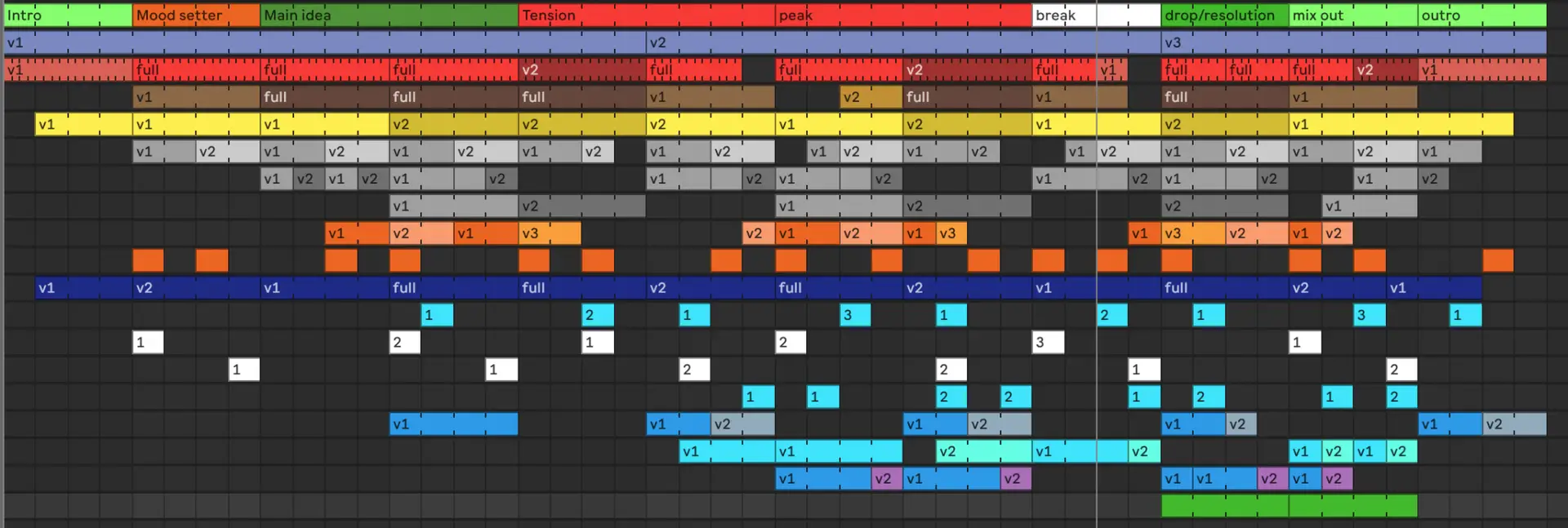
Arrangement template by Pheek as shared on Patreon Track vs Song in Music Production| AudioServices Studio
This template is one I shared on Patreon for members. It is a generic template that explains how an average dance-floor track is made. This is the result of many years of research and analysis across multiple tracks, as well as work on clients’ songs. At some point, you understand that certain formulas are being used abroad. because it works. Once you understand the vocabulary and structure of the average song, you can start deconstructing it, reorganizing to taste, but you first need to know how it works, just like architecture, engineering, cooking, brewing, and painting.
References to songs you consider groundbreaking, masterpieces, or that had a strong emotional impact are worth analyzing.
When clients ask me arbitrary questions, such as whether it’s boring or engaging enough, I’ll always reply with “compared to what?” Because the listener’s brain usually starts with this routine when listening to music.
What Happens in the Listener’s Brain When a Song/Track Begins
When someone presses play, the brain doesn’t just hear sound — it starts a predictive pattern-matching process. There’s automatically a sequence of things the brain puts into play.
Here’s how that tends to unfold:
1. Familiarity Search
The very first thing the brain does in milliseconds is ask:
“Have I heard something like this before?”
This isn’t musical analysis yet — it’s pattern recognition at a primal level.
-
The sonic features (beats, timbres, textures) are scanned against stored memory.
-
If there’s similarity to known music, the brain gets a small reward hit — a sense of recognition.
-
Very early on, this triggers the automatic “oh, I know this vibe” response.
Some people even start thinking of similar artists or genres; that’s the brain trying to anchor the sound to a known map. Comparing is a natural reaction the listener has, mostly because they are observing how the music is impacting the listening experience.
2. Structural Pattern Detection
Once the opening sounds are registered, the brain moves into predictive processing.
This is where the same mechanism that keeps you following a hypnotic slide deck also kicks in with music:
-
The brain starts to segment sections
(intro, verse, chorus, rhythm loops, breaks). -
It looks for repeating patterns
— grooves, phrases, motifs. -
It begins internal timing predictions
— When will the beat change? When will the melody resolve?
This isn’t conscious thinking so much as signal forecasting. The brain is always trying to reduce surprise — it wants a model of the song.
In other words, the listener isn’t passively hearing as they’re actively anticipating.
3. Emotional and Narrative Tracking
As patterns become clearer, the brain starts interpreting meaning and emotional contour:
-
Tension and release in harmony or rhythm
-
Expectations based on where we think the song should go
-
Motivic hooks that latch onto memory
This stage is where the difference between a song that grooves and a song that resonates becomes felt.
Listeners don’t just detect the structure — they predict it, and feel the accuracy of those predictions.
4. Post-Finish Evaluation
When the music stops, the brain doesn’t immediately drop out of the experience. Instead, it enters a reflective state where it compares:
-
How the experience felt while the song was playing
-
How they feel now that it’s over
This is a kind of affective integration: the brain asks:
“Was this satisfying? Did it meet or violate my expectations? Did it leave a trace?”
This comparison — the before/during/after emotional mapping — determines whether a listener will:
-
remember the song
-
want to hear it again
-
Recommend it to others
-
associate it with a mood or memory
In cognitive neuroscience, this is tied to reward prediction errors — when music meets expectations in gratifying ways, it feels good. When it defies them in meaningful ways, it can also feel compelling. When it neither confirms nor challenges, it tends to be forgotten.
Conclusion for Track vs Song in Music Production
Tracks Mindset:
- Explorer of the unknown mindset.
- I’d recommend drawing inspiration from a track you love, compiling a list of its features you like, and treating it as the core of your next experiment.
- Accept redundancy, repetition, imperfection.
- Layer your track over another one to see if it’s too busy.
- Accept it to be slightly uncomfortable on its own.
- Get it tested by DJs.
Song Mindset:
- Storyteller mindset
- Pick your harmonic DNA: Root key, scale, etch.
- Find a hook, a motif.
- Spot a genre, pick a chord progression.
- Decide of your Strophic form. If applicable.
Hybrid Mindset:
- Music that is a mix of both.
- It can be on its own as well as for DJs.
- Find a reference for self-validation and a song starter.
Freeform Mindset:
- If you don’t want to pick a specific mindset, you might end up in no man’s land, for the better or the worse.
- Be an explorer of not controlling the end results.