
How to finish songs
Why most producers get stuck and how a simple model can make finishing music dramatically easier
Creating music is unlike assembling furniture, following a recipe, or building a house. In most creative work, the finished result already exists before you begin.
With music, you’re often trying to create something that has never existed before.
That freedom is exciting.
It’s also the reason many tracks never get finished
Table of Contents
Section 1: The Real Problem With Finishing Music
You’re Trying To Reach A Destination You Can’t See
Imagine trying to build an IKEA shelf without the picture on the box.
You have pieces.
You have tools.
You have ideas.
But you don’t know exactly what the finished result should look like. This is how many producers approach music. They start creating sounds and arranging ideas without having a clear model of where they’re going.
The result is uncertainty:
- Is this enough?
- Should there be another section?
- Do I need more sounds?
- Is the arrangement complete?
- Is the mix finished?
These questions become difficult to answer because there is no reference point.
People persist, adding new ideas to uncover what their final idea will be like. But adding new ideas simply blurs the outcome.
If you wanted to learn a new instrument, such as the piano, where would you begin?
Most people wouldn’t sit down for their very first lesson and immediately try to compose an original piece. They would first learn the instrument itself: how the keys work, how scales and chords are organized, and how other pieces of music are constructed.
Yet when it comes to electronic music production, many people expect themselves to create a finished song before they have learned their software, studied existing tracks, or understood how songs are actually put together.
This often leads to frustration. Not because they lack talent, but because they are attempting one of the most complex tasks first: creating something original without first understanding the tools, the process, or the structure behind the music they admire.
Section 2: Why Reference Tracks Matter
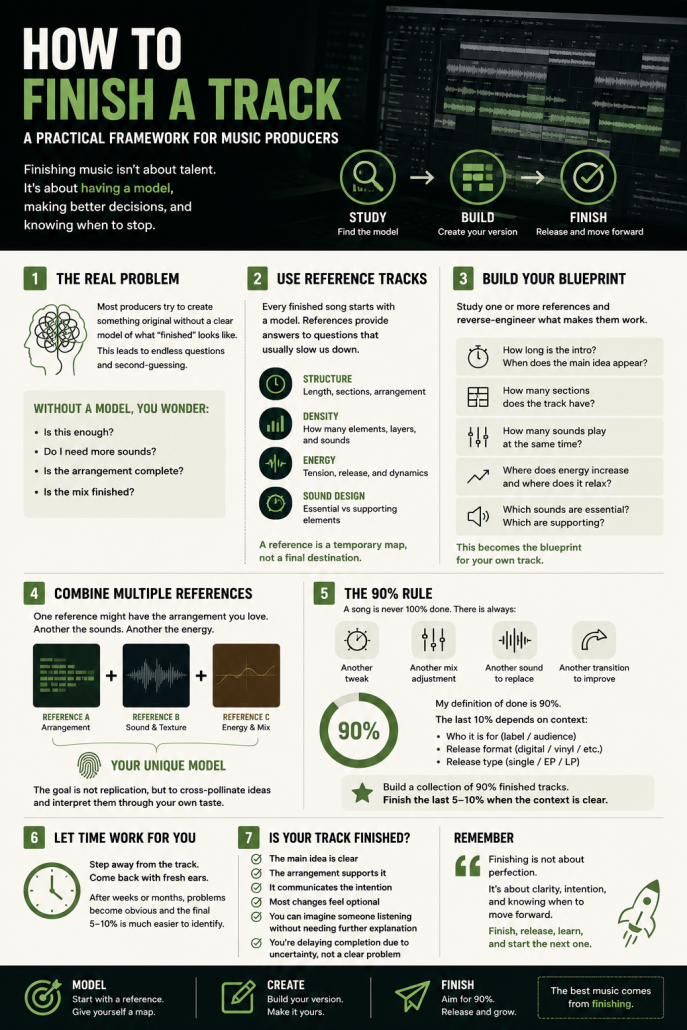
Every Finished Song Starts With A Model
One of the fastest ways to finish music is to work from an existing example.
Not to copy it. To study it.
A reference track provides answers to questions that often slow producers down:
- How long is the track?
- How many sections does it have?
- How many sounds are active?
- How much variation exists?
- How dense is the arrangement?
- How energetic is the mix?
- When are the key moments happening?
Instead of inventing every decision from scratch, you begin with a structure that already works.
A reference track serves as a temporary map. It provides a concrete example of what a finished song can look like and gives you a framework to work from instead of making every decision from scratch.
More importantly, it becomes a study case. By analyzing a track you admire, you begin to understand its blueprint: the arrangement, the pacing, the balance of elements, and the decisions that make it effective. You start to uncover the DNA of the music that resonates with you.
While technical skills and production techniques are valuable, they are only part of the equation. At its core, music making is an expression of taste. Studying references helps you identify what you are drawn to and teaches you how to translate those preferences into your own work.
Section 3: Build Your Own Blueprint
Reverse-Engineer The Finished Product
Before making major creative decisions, spend time studying one or more reference tracks. Every song you analyze expands your understanding of arrangement, pacing, and musical structure. Over time, this becomes a vocabulary that you can draw from naturally when creating your own music.
I often tell producers that their first twenty songs are experiments. Not because they aren’t valuable, but because each one teaches something different about writing, arranging, and finishing music.
Personally, I’ve learned to embrace that process. I know that if I make twenty songs, a few of them will reveal something special. The goal isn’t to make every track a masterpiece. The goal is to keep creating, learning, and increasing the chances of discovering the ideas that truly stand out.
From any song, you can learn a lot.
Ask questions like:
Structure
- How long is the song?
- How long is the intro?
- When does the main hook appear?
- How many sections exist?
- What are transitional sounds?
- What is the rhythmical signature?
Density
- How many elements play simultaneously?
- How many percussion tracks exist?
- How many melodic layers exist?
Energy
- What is the BPM?
- Where does tension increase?
- Where does it relax?
- What makes the peak moments feel bigger?
Sound Design
- What is the root key? What is the scale? Is there a chord progression?
- Which sound is the leader and which are supporters?
- Which sounds are samples and which are synths?
Drag the song in your DAW and using ghost MIDI clips, you can annotate which sounds starts at what time and until when. This will give you visual guiding on how the sounds are distributed.
By answering these questions, you create a blueprint for your own project.
Section 4: The Myth Of Originality
Original Music Doesn’t Start From Nothing
Many artists avoid references because they worry about sounding unoriginal. Ironically, this often makes finishing harder.
Originality rarely comes from inventing every element from scratch. It usually comes from combining influences, making unexpected choices, and filtering ideas through your own taste. Most importantly, it comes from playing with various sources.
The reference provides the framework.
Your decisions provide the personality.
Section 5: When One Reference Isn’t Enough
Build A Composite Reference
This is where things get exciting. Imagine extracting multiple parts or concepts of a song you love and combine it with another.
Technically, this is how pretty much all songs are made. We combine ideas we love
Sometimes one song has:
- the arrangement you love
- but not the sound design
Another has:
- the atmosphere you want
- but not the energy
A third has:
- the mix balance you’re aiming for
- perhaps it has a specific effect that makes you excited
This is where multiple references become useful.
You can build a model that combines:
- structure from one track
- sound palette from another
- energy from a third
The goal is not to replicate existing music, but to cross-pollinate ideas from multiple sources and interpret them through your own perspective. Each reference contributes a different piece of information: an arrangement, a texture, an energy level, a mixing approach, or a mood.
The more observations and insights you extract from the music you study, the more refined your own model becomes. Over time, this process naturally leads to work that feels increasingly personal and original—not because it was created from nothing, but because it is built from a unique combination of influences filtered through your own taste.
Section 6: Why Tracks Still Get Stuck
The Last 10% Is Different
Once the structure is clear, finishing becomes much easier. It is like having a plan in front of you.
At this stage, most major questions have already been answered:
- length
- arrangement
- density
- energy
- overall direction
The remaining work is often about refinement.
This is where taste, experience, and perspective begin to matter more than process. Working on the last 10% can be done after a pause so you can have clarity.
Section 7: The 90% Rule
A Track Is Never Truly Finished
One of the most liberating lessons in music production is realizing that a song is never truly finished.
Once you accept this, it becomes much easier to let go of perfection. You stop chasing an imaginary endpoint and start focusing on whether the music successfully communicates its intention. In a time when technology can increasingly generate polished and predictable results, allowing some imperfection to remain can also be a profoundly human statement.
There is always something more that could be done:
- another tweak
- another mix adjustment
- another sound to replace
- another transition to improve
The list never ends.
Over the years, I’ve adopted a simple philosophy: my definition of done is usually around 90%.
The remaining 10% is contextual.
Many of the decisions that shape the final version of a track depend on information that often doesn’t exist when the song is first written:
Who is the release for?
Different labels have different aesthetics, expectations, and audiences. A track may need subtle adjustments depending on where it eventually finds its home.
What is the release format?
A digital release, a vinyl release, and a live performance version may all require different technical or creative decisions.
What role does the track play?
A standalone single serves a different purpose than a track that is part of an EP or a full-length album. Context can influence pacing, energy, arrangement, and even the emotional direction of the music.
Because these questions are often unanswered during the writing process, I find it far more productive to build a collection of tracks that are 90% complete rather than spending months trying to push a single track to some notion of perfection.
When a label hears a nearly finished track, they may request small adjustments. When a track is still flexible, those changes are easy to make. When you’ve convinced yourself the song is completely finished, making those same adjustments can feel much more difficult.
For me, finishing music is not about reaching 100%. It’s about reaching a point where the idea is clear, the song is strong, and the remaining decisions can be made when the context becomes known.
Section 8: Why Time Helps
Let The Track Sleep
Often the final 5–10% becomes obvious only after stepping away. A track that feels impossible to judge today may reveal its weaknesses immediately after a few weeks or months.
Distance creates perspective.
When a project is revisited later, the missing pieces often become surprisingly obvious.
This is one reason many professional artists revisit older projects before release.
The music hasn’t changed.
Their ability to hear it has.
Section 9: Is Your Track Finished?
Your track may be finished if:
✓ The main idea is obvious.
✓ The arrangement supports that idea.
✓ You know what the track is trying to communicate.
✓ Most changes now feel optional rather than necessary.
✓ You can imagine someone listening to it without needing further explanation.
✓ You’re delaying completion because of uncertainty rather than a clearly identified problem.
Need Help Getting To The Last 10%?
Sometimes the hardest part of finishing a track is gaining enough perspective to know what still needs attention.
Whether you need feedback, production coaching, mixing support, or simply an experienced second set of ears, I can help you identify what’s missing and move your music toward completion.