
Release Workflow
A step-by-step guide to understanding how music releases work — from the final master to streaming platforms, vinyl pressing, labels, royalties, and distribution.
Releasing music for the first time can feel confusing.
Between mastering, distributors, labels, ISRC codes, streaming platforms, Bandcamp, and physical formats, many artists are unsure where to begin.
This page was created to simplify the process and explain how a release actually works in practice.
Whether you are self-releasing your first EP or preparing a label release, this guide walks you through the essential steps and terminology so you can move forward with clarity.
Jump to the checklist:
WHAT IS A RELEASE?
Understanding Music Releases
A music release is the official publication of your music for listeners.
Historically, releases existed only as physical objects such as vinyl records or CDs. Today, most releases are digital, but the overall workflow remains similar: finalizing music, preparing assets, distributing files, and making the release available to the public.
There are two main categories of releases:
Digital Releases
Streaming Platforms
These platforms allow listeners to stream music online.
Examples include:
- Spotify
- Apple Music
- Beatport
- YouTube Music
- Deezer
Download Platforms
These platforms allow users to purchase and download audio files.
Examples include:
- Bandcamp
- Beatport
- Juno Download
Physical Releases
Vinyl
Still highly popular in electronic music culture. Vinyl releases require specialized mastering and manufacturing preparation.
CD
Less common than before, but still used for albums, touring merchandise, and collector editions.
Cassette
Often used for underground or limited-edition releases with a DIY aesthetic.
THE MASTER: THE FINAL VERSION
The Master Is the Final Product
Before music can be released, it needs to be finalized.
The mastered version of a track is considered the official final version that will be duplicated, distributed, uploaded, or manufactured.
Mastering ensures that the music translates properly across systems and meets the technical requirements expected by platforms and manufacturers.
Once approved, the master becomes the version used for:
- Streaming services
- Download stores
- Vinyl cutting
- CD duplication
- Cassette manufacturing
Typical Deliverables
Usually:
- Appropriate loudness based on genre.
- WAV or AIFF files
- 16-bit (most distributors require this format) otherwise for self-serve stores like Bandcamp, 16b or 24b will do.
- Correct sample rate
- Metadata included
- ISRC, ISWC codes
Your mastering engineer should consider all these.
Usually:
- Loudness doesn’t really do difference but we highly recommend not exaggerating as platforms normalize loudness.
- WAV or AIFF files
- 16-bit (most distributors require this format)
- Correct sample rate
- Metadata included
Your mastering engineer should consider all these.
Often requires:
- Dedicated vinyl pre-master. This includes special calibration of the files.
- Careful low-end management
- Side duration planning
- Phase alignement.
- Sequencing per side (A/B)
- Metadata.
Usually delivered as:
- DDP image or WAV sequence
- 16b files.
- Proper track spacing
- PQ coding
- ISRC integration
Requires:
- Side sequencing
- Attention to dynamics and stereo content
- Manufacturing-ready WAV files
DISTRIBUTION & AGGREGATORS
How Music Reaches Platforms
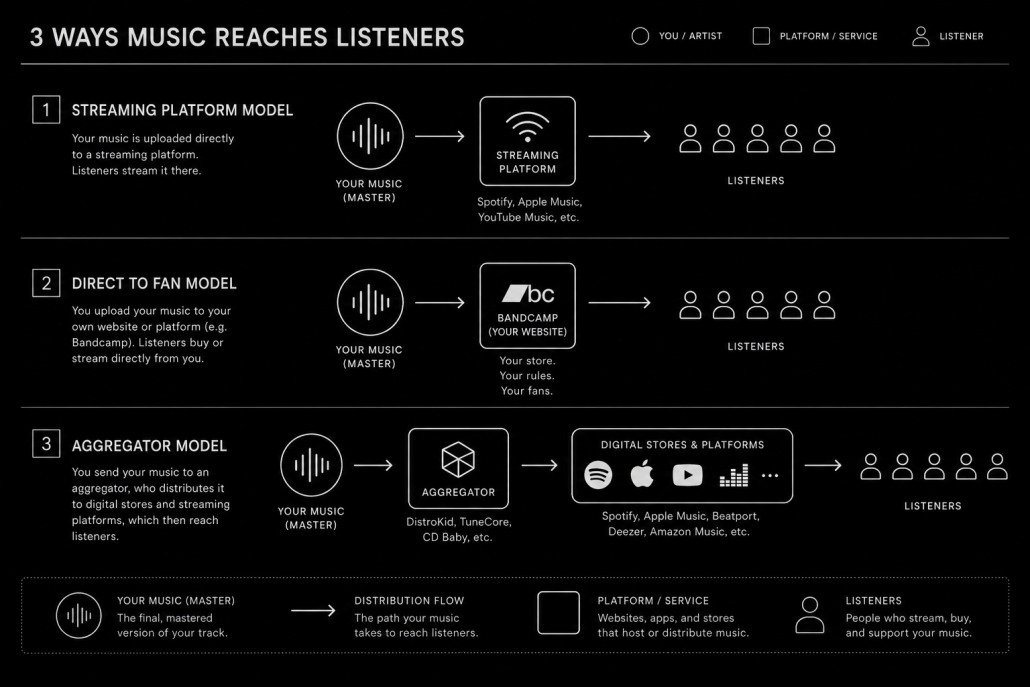
Streaming platforms do not usually accept uploads directly from artists. Instead, artists use a distributor (also called an aggregator) that delivers music to stores and streaming services.
The distributor acts as the bridge between the artist/label and the platforms.
Common Aggregators
What Aggregators Usually Handle
- Delivery to streaming services
- Metadata management
- Release dates
- ISRC assignment
- Royalty reporting
- Territory management
Important Note
Different distributors specialize in different markets.
Some focus on independent artists, while others are more oriented toward labels and electronic music distribution.
Choosing the right distributor often depends on:
- genre
- release frequency
- label structure
- physical distribution needs
- royalty management preferences
BANDCAMP
Why Bandcamp Matters
Bandcamp has become one of the most important platforms for independent artists and labels.
Unlike streaming platforms, Bandcamp allows artists to:
- sell music directly
- offer high-quality downloads
- sell merchandise
- build direct relationships with listeners
- collect fan emails
- offer subscriptions
For many artists, Bandcamp acts as both:
- a storefront
- an archive of their catalog
It is especially important in underground electronic music because it gives artists more control over pricing, presentation, and community building.
Suggested Best Practices
- Upload WAV or AIFF masters
- Use clear artwork
- Write meaningful release descriptions
- Tag releases carefully
- Add credits and collaborators
- Include lyrics or contextual notes when relevant
WHAT LABELS DO
Understanding the Role of a Label
A record label is an organization that helps release and promote music.
Some labels are highly structured businesses. Others are small artist-run communities focused on curation and artistic direction.
A label may help with:
- distribution
- mastering
- artwork
- royalties collecting
- promotion
- PR campaigns
- playlist pitching
- physical manufacturing
- release planning
- audience building
Not all labels provide the same level of support.
Why Would You Join A Label?
Being on a label is like having validation from a specific community that perhaps you enjoy.
You then have access to that community and also a network of people who enjoy that music.
It is positive for your career to be part of a certain community, because from there you’d be discovered by a bubble of people that you wouldn’t necessarily have access to if you were not on that label.
It is not always a good thing, though, just to be on a label for the sake of being on one. It doesn’t really do any justice to your music.
Sometimes it’s better to do things on your own or to work with people that want to work with you.
Some people start a label, but they don’t have the community behind it, and therefore it doesn’t really mean anything to work with them.
Green Flags
Good signs of a healthy label:
- Artists releasing multiple times
- Clear communication
- Transparent agreements
- Consistent release history
- Proper artist crediting
- Promotion efforts
- Respectful relationships with artists
- Organized timelines and planning
Red Flags
Things artists should be cautious about:
- Vague contracts
- No communication or very slow to reply.
- Demands for upfront fees (ex. mastering)
- Promises of unrealistic exposure
- Poor release quality
- No visible audience or activity
- Very little plays on their releases.
- Complicated contracts. No end date to ownership of rights.
Important Reminder
A label should ideally amplify an artist’s work — not create confusion around ownership or rights.
Artists should always understand:
- who owns the masters
- how royalties are split
- what rights are transferred
- how long agreements last
ISRC CODES & ROYALTIES
ISRC Codes & Royalty Collection
An ISRC code is a unique identifier assigned to a recording.
Think of it as a digital fingerprint for a track.
ISRC codes help platforms and royalty organizations identify:
- who owns the recording
- where the track is played
- how royalties should be collected
Many distributors can generate ISRC codes automatically.
Royalty Organizations
Different organizations collect different types of royalties depending on the country and usage.
Examples include:
- SOCAN
- ASCAP
- BMI
These organizations help track public performances and streaming usage.
SIMPLE RELEASE CHECKLIST
Basic Release Checklist
Checklist
- Finish the production
- Prepare the final mix
- Master the music
- Prepare artwork
- Choose a distributor
- Upload metadata and audio
- Schedule release date (Many distributors need 1 month after uploading so plan ahead)
- Promote the release
- Upload to Bandcamp
- Prepare a listening party
- Register royalties if needed
- Share the release with your audience. The promotion usually starts a few weeks before the release date.
Releasing Music Is a Process
Most artists feel overwhelmed during their first release.
That is completely normal.
Over time, the workflow becomes clearer and more intuitive. The important thing is understanding that a release is not only about uploading songs — it is about organizing the final presentation of your work so it can exist properly in the world.
A well-prepared release creates clarity for:
- listeners
- labels
- distributors
- collaborators
- and ultimately for yourself as an artist.
Need Help Preparing a Release?
Whether you need mastering, release preparation, workflow guidance, or help understanding distribution, I can help you navigate the process clearly and professionally.
- I can finalize your music with my mastering services.
- You can also book a consultation for having professional guidance.
- If you want feedback on your music, that is also something I can help with.
- Use our retreats to wrap your songs and get feedback