
MIXDOWN CHECKLIST
A practical mixdown workflow focused on organization, hierarchy, space, and emotional translation.
Mixing is not only about plugins and loudness. It’s about organizing attention, creating coexistence between sounds, and making sure the emotional intention of a track survives across systems.
This checklist is designed as a listening workflow rather than a rigid technical formula. Each phase builds upon the previous one, helping you move from raw material toward a mix that communicates clearly and translates properly.
Why Most Mixes Struggle
The Problem Is Rarely “Bad Plugins”
- too many sounds competing
- mixing while composing
- lack of hierarchy
- loudness hiding issues
- masking mistaken for tonal problems
- over-processing
- no reference points
A mix collapses when too many elements demand attention simultaneously. But it can also be because of a few key points
- Lack of experience
- No vision of the outcome
- lacking how to address specific issues
Use My Experience and book me to mix your project.
Learn by knowing how your music sounds like once mixed by a pro.
Learn Mixing With Me Through Coaching
No one has to learn alone. Working with a mentor can give your music a boost.
Breakdown of Each Phase
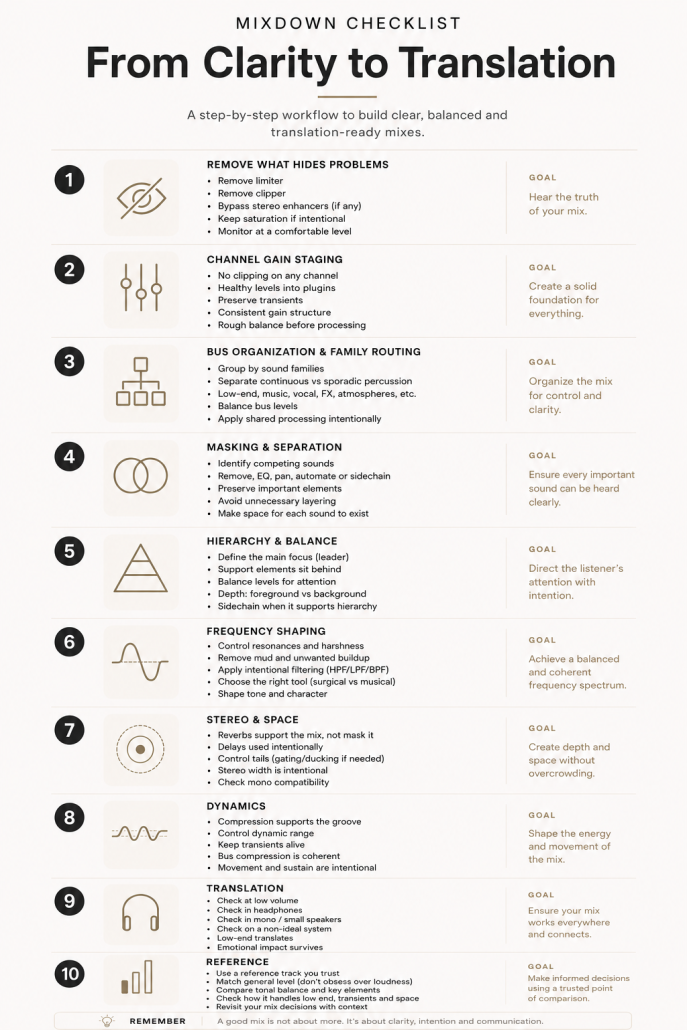
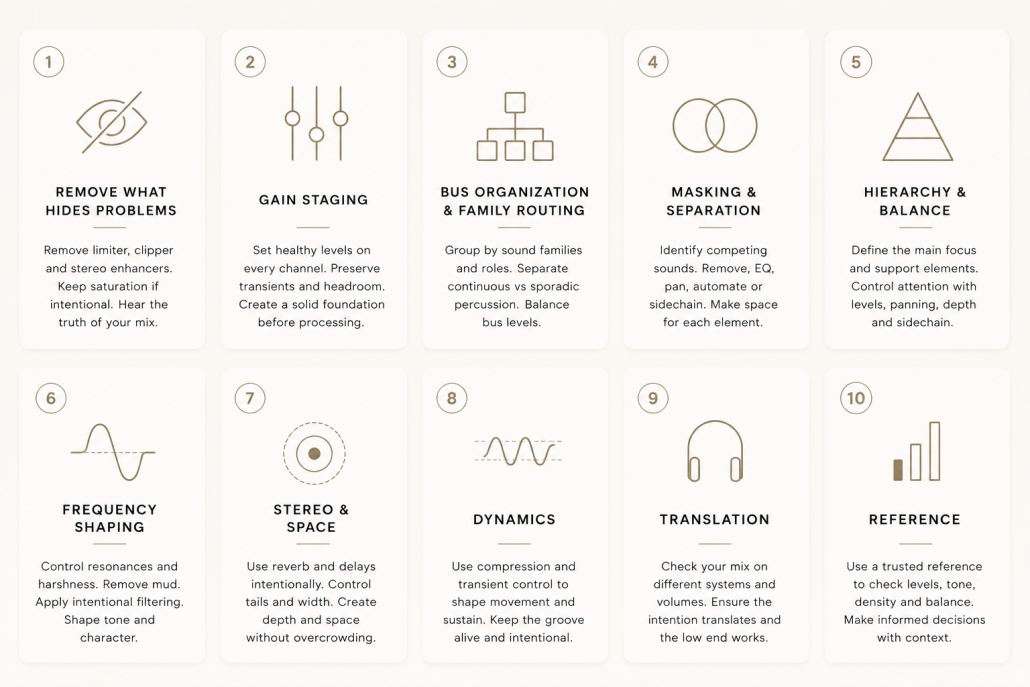
Before making decisions, it’s important to hear the mix clearly. Limiters, clippers, and stereo enhancers can sometimes create the illusion that a mix is more balanced than it really is. By removing what masks issues, you create a more honest listening environment where problems become easier to identify and solve.
Good mixing starts with healthy levels. Proper gain staging helps preserve transients, improves plugin behavior, and creates clarity throughout the session. Rather than pushing everything louder, the goal is to establish a stable and controlled foundation where each sound has room to exist naturally.
Organizing sounds into families helps simplify decision-making and improves control over the mix. Grouping elements such as low-end, percussion, atmospheres, or melodic layers allows shared processing to become more intentional. Separating continuous sounds from sporadic ones also helps maintain clarity and groove.
When multiple sounds compete for the same space, the listener loses focus. This phase is about identifying overlap and deciding how elements can coexist. Sometimes the solution is EQ, panning, automation, or sidechain compression. Other times, the best solution is simply removing unnecessary layers.
Not every sound should demand the same level of attention. A strong mix establishes hierarchy by clearly defining what leads and what supports. Through volume, depth, stereo placement, and dynamics, the listener’s attention is guided naturally toward the most important elements of the track.
Once the mix is organized and balanced, tonal shaping becomes more effective. This stage focuses on controlling resonances, reducing harshness, cleaning mud, and shaping the overall tone of the mix. Filtering and EQ decisions should support both clarity and character without removing the life of the sounds.
Space is not only created with reverb. Delays, stereo width, decay times, and tail management all influence how crowded or open a mix feels. The goal is to create depth and dimension while maintaining clarity, ensuring that effects support the mix rather than overpower it.
Dynamics shape movement, energy, and emotional impact. Compression, transient control, and sustain management help tighten elements while preserving groove and musicality. Rather than flattening the mix, this stage is about controlling motion in a way that feels intentional and alive.
A mix should work beyond the studio monitors. Translation testing ensures the balance, low-end, and emotional impact survive across different listening environments such as headphones, small speakers, cars, or club systems. The goal is consistency without losing the original intention of the track.
References provide context and perspective during mixing. A trusted reference track can help evaluate tonal balance, low-end energy, stereo width, density, and overall hierarchy. The purpose is not to imitate another track, but to make informed decisions using a reliable point of comparison.
Tests and exercises
Use these to test your mix.
If you have many channels, it’s important to group them in families so that, in the end, you can control the entire mix from the least faders possible. If you have only four or five faders, you can control the mix’s ensemble by deciding which parts to lower relative to others. Another exercise that you could do here is to fade in mix in your group one by one to try to find the right level.
Put a mono encoder on the master and then listen to the entire mix in mono. You can also do it per channel or group to see how much impact and work your elements are getting once they are in mono. If their intensity lowers or if the mix becomes blurry, then you’ll know that there is some phasing issue with the elements.
Don’t hesitate to use a reference track for understanding the tone of your track compared to that song, as well as the different levels. The only point that you need to understand is that your reference has been mastered and yours has not, so there is a difference. Level matching will help, and eventually perhaps adding a bit of compression on the master to emulate the reference, but it’s about understanding the levels and the tone.
Listening to your song at a low level is a critical part of mixing, as lowering it will show all the potential flaws that your song has. At a low level, you will automatically see which sound pops out of the mix and if some parts of the track are not blended properly.
Percussion and snare sound often have fast attack, which means that in some cases the transients might be harsh to ears. If you control those transients, you’ll be able to boost the sounds louder, as they won’t hurt the ears anymore.
Pick in advance which sound you want in the background and which you want in the foreground. Creating two distinct categories will let you position the sound at the right place. Using filtering, but also by diminishing the volume of the sound of the background, you can push them lower in the mix, giving the illusion to the listener that they are further in the back. Adding a slight reverb can also do the trick, but if the tail is too long, it will create confusion.
About My Approach
Since 2015, I’ve been running Audio Services and working closely with artists across a wide range of genres and projects. During some of my busiest periods, I’ve handled up to five or six mixes in a single day. Working at that pace pushed me to develop a workflow that is both efficient and deeply focused on clarity, intention, and results.
Over time, one of the strongest indicators that this approach works has been the consistent reduction in revisions. To me, fewer revisions often mean that the mix communicates the artist’s vision more clearly from the start. That efficiency is not about rushing the process but about building a method that makes decisions more intentional and coherent.
This is also why I want to share this methodology more openly. I believe every song deserves a thoughtful, well-crafted mix that lets its emotional impact and identity come through clearly.
What is the best way to learn?
Practicing, just like anything else, will eventually bring results, but it takes time. I like to say that becoming mature at mixing can take years, because there are different challenges, such as understanding mix translation and certain concepts. Working with someone who can provide feedback is a shortcut to accelerating your learning.
Contact
I organize online mixing workshops when multiple clients show interest. Reserve your spot for the next one.