
The Three Pillars of Musical Expression
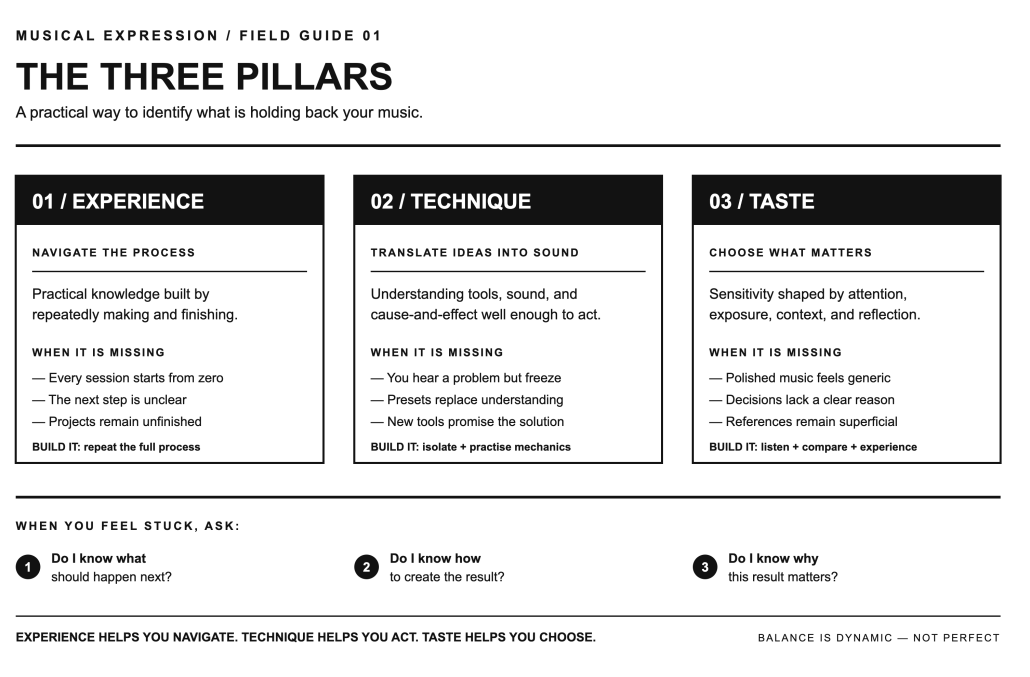
Recently, I came to a conclusion about what creates expressiveness in instrumental electronic music—and perhaps in music in general. From my experience working with different artists, I see three key elements that influence how clearly someone can express themselves through music:
- Experience
- Technique
- Taste
I think of these as the three pillars of musical expression. They affect the decisions we make, the problems we encounter, and ultimately the music we produce. Looking at them separately has helped me understand why both newcomers and experienced musicians can feel stuck, even when they appear to have everything they need.
These ideas are personal observations, not fixed rules. They come from making music, working with other producers, and coaching people through their creative difficulties. My interpretation may change over time. The purpose of this article is to document how I currently understand these pillars and offer a framework you can use to examine your own process.
The point is not to achieve a perfect balance. Every artist develops these areas differently. Someone may have excellent taste but lack the technique to realize their ideas. Another person may be technically advanced but make music that feels impersonal. A producer can also understand what they want and know how to create it, yet struggle to move through a session or finish a track.
When something is not working, we often assume that we need another technique, another tutorial, or another piece of equipment. But the real limitation may be elsewhere. Understanding the three pillars can help you identify what is actually missing.
People have suggested adding consistency or skill as additional pillars. To me, these are not separate. Skills develop through technique and experience, while consistency creates the conditions that allow both to grow. You can be skilled at a task and still lack experience completing music.
In this first part, I will focus on experience and technique. The second part will explore taste and how the three pillars interact.
Experience: learning how to move through the process (with acquired skills)
Experience is perhaps the most complex pillar because it is easy to confuse it with age, talent, or the number of years someone has owned a studio. Time matters, but time alone does not guarantee useful experience. In this context, experience refers to the practical knowledge acquired through repeated engagement in the process of making music. It is what helps you recognize where you are in a project, understand what might come next, and make decisions without having to reconsider everything from the beginning.
Through repetition, you develop better navigation and intuition. You begin to recognize familiar problems, estimate how long a task might take, and recover more easily when an idea does not work. Eventually, this accumulated knowledge makes expression easier because less energy is spent on understanding the process itself. But experience does not always make someone faster or more creative. Sometimes, the more you know, the slower you become. An experienced engineer may notice technical details a beginner misses and spend a long time correcting them. Meanwhile, someone with little production experience may ignore those details, follow an intuitive idea, and make something surprisingly fresh.
This is one of the paradoxes of experience: it gives you more options, but more options can create hesitation. Experience becomes useful when it helps you decide—not when it forces you to examine every possible decision. A newcomer can sometimes produce excellent music because they are focused on a clear idea and are not yet restricted by everything they think they should do. An experienced producer must learn how to keep that directness while using their knowledge selectively.
Focus, commitment, and organization are not experience themselves. They are conditions that determine whether useful experience can accumulate. If you plan to work on music but spend the session checking social media, troubleshooting an avoidable studio problem, or jumping between unrelated tasks, you have technically spent time in the studio—but you have gained less practical experience than you might think.
For the people I coach, one useful step is to structure studio time in advance. This means adding the session to the agenda, deciding what kind of work it is for, and removing obvious sources of friction before beginning. The intention does not need to be complicated. It might be to create several rhythmic ideas, arrange one section, test a sound-design process, or finish a rough version of a track.
I also encourage people to repeat one task many times. Repetition can feel less exciting than beginning a new project, but it is one of the strongest ways to build practical knowledge. If you repeatedly make transitions, arrange short sketches, program drums, or finish rough mixes, you stop treating each attempt as an entirely new problem. You begin to recognize patterns.
Experience is not simply the number of hours you put in. It is what those hours teach you.
Signs that experience may be the missing pillar
- You regularly do not know what the next step in a track should be.
- You return to a project and cannot remember its intention.
- You begin many projects but rarely move them through later stages.
- Every session feels as if you are starting from zero.
- Your studio setup causes recurring interruptions and troubleshooting issues.
- You understand individual production tasks but struggle to connect them into a complete process.
These signs usually mean that you need more repeated contact with a specific part of the process. The solution may be to finish more rough tracks, simplify your sessions, document your next step before stopping, or practise the same stage across several projects.
Technique: translating intention into sound
Technique is where many producers get caught. It is the practical ability to use your tools and your understanding of sound to achieve a result.
It begins with orientation: knowing your digital audio workstation well enough that it does not constantly interrupt your thinking. You should know where the main functions are, understand the basic purpose of your effects, and have a working mental model of signal flow. You do not need to memorize every menu or master every device. You need sufficient familiarity to navigate the environment without losing your musical intention.
From there, technique develops into more specific abilities, such as:
- using sidechain compression
- creating a transition or swoosh
- reducing masking in a mix
- increasing the intensity of a section
- controlling dynamics without removing movement
- routing signals efficiently
These techniques depend on a basic understanding of your environment and the production vocabulary. Once you can name a problem, you can research it precisely instead of hoping that a new plug-in will somehow improve the track.
Learning how something is done is only the first step. The next step is to practise it in different contexts. If you learn a method for reducing frequency masking, try it across several of your tracks. Listen to how the problem changes when the instruments, arrangement, and sound palette are different. A technique becomes useful when it can adapt to the situation rather than being repeated as a recipe.
One sign that you are acquiring a technique is that you begin to hear the relevant problem everywhere. Once you identify masking, poor gain staging, an uncontrolled low end, or an overly sharp transient, it becomes difficult to ignore. You may hear the issue clearly and still need time to solve it. With practice, the connection between hearing and acting becomes more direct.
A common mistake is trying to bypass this process by buying more plug-ins or hardware. A producer may purchase a new compressor without understanding the one already available in their DAW. The new tool may be useful, but it also introduces another interface and more decisions.
Redundancy is especially tempting when someone does not understand their original tools. Marketing suggests that a product will solve a problem that is actually rooted in missing knowledge. In that situation, acquiring more equipment can delay the deeper learning that would make all the tools more useful.
Reading manuals and watching in-depth tutorials can help, but information is not yet technique. Watching countless videos without practising is not skill stacking. It can become a sophisticated form of distraction.
A better approach is to separate practice from songwriting. Dedicate a few short sessions each week to one mechanism. Watch a focused explanation, then reproduce it without trying to make a finished track. Change the source material, push the settings too far, and listen to where the method stops working. The purpose is to understand cause and effect.
The basics remain important even at an advanced level. The more clearly you understand sound, signal flow, levels, frequency, dynamics, and the behaviour of your environment, the less dependent you become on specialized solutions. Many complex problems can be handled with basic tools when you understand exactly what those tools are doing.
Signs that technique may be the missing pillar
- You can hear that something is wrong but have no idea what controls it.
- You freeze when a technical problem interrupts a creative session.
- You depend on presets without understanding why they work.
- You repeatedly buy tools hoping they will solve the same unresolved issue.
- You know production terms from tutorials but cannot apply them in your own projects.
- You can reproduce a technique in one situation but not adapt it to another.
Technique grows through curiosity, focused repetition, and close listening. Its purpose is not technical perfection. Its purpose is to reduce the distance between what you imagine and what you can create.
Experience teaches you how to move through the process. Technique gives you ways to act inside it. But neither one decides which possibilities are worth pursuing. That brings us to the third and most confusing pillar: taste.
Taste and Balance
In the first part of this article, I introduced three pillars that influence musical expression: experience, technique, and taste. Experience helps you move through the creative process, while technique helps you translate an intention into sound. The third pillar, taste, helps you decide which intentions are worth following.
Taste may be the most confusing of the three because it is difficult to measure and impossible to separate completely from personal history. We often describe music as emotional, powerful, or simply good, but these words are subjective. A track that deeply affects one person may leave someone else completely indifferent.
Production, mixing, and mastering all involve taste. Technical knowledge gives you options, but it does not make the decisions for you. How loud should the kick be? How dry should the vocal feel? Should the arrangement resolve its tension or remain uncomfortable? There may be technical limits, but there is rarely only one correct answer.
This explains why someone can have years of experience and excellent technical skills while producing results that do not connect with you. Their decisions may be coherent, but their taste is not aligned with yours—or with the audience they are trying to reach. In that situation, more technical precision will not necessarily improve the music.
Taste can sometimes be the most important pillar. Some artists have a powerful vision before they possess the skills needed to realize it. They may collaborate with producers, engineers, and musicians who can translate that vision into reality. Their role is not less valuable because they did not operate every tool. Knowing what the work should become is a real ability.
Taste is personal, but it can be cultivated
Taste is strongly influenced by our early experiences. The music our parents played, the culture surrounding us, and the music shared by friends all leave their traces. Later, communities, parties, radio, films, clubs, and the internet continue shaping what feels familiar or exciting. Because of this history, taste cannot be installed like a production technique. You cannot watch one tutorial and suddenly acquire someone else’s sensitivity. But this does not mean taste is fixed. It can be cultivated through curiosity, attention, exposure, and reflection.
People who actively research music tend to develop a larger vocabulary of possibilities. They dig through the work of artists and DJs they admire, follow labels, compare different periods, and listen beyond what an algorithm places in front of them. This does not automatically give them better taste, but it gives their taste more material to work with. Curiosity matters because it prevents your preferences from becoming a closed system. If you only listen to music that already confirms what you like, your decisions can become predictable. Discovering unfamiliar work does not mean that you must enjoy all of it. Even a strong negative reaction can teach you something if you ask what caused it.
Going to concerts, clubs, and performances is especially valuable. In a studio, we can imagine how music might affect listeners. In a public space, we see the response directly. We notice when attention shifts, when energy rises, when a quiet moment becomes powerful, or when a technically impressive passage loses the room.
This real-world contact helps develop an understanding of musical psychology. A street musician can show how a simple song stops people in motion. A live performer can demonstrate how repetition creates anticipation. A DJ can reveal that the impact of a track depends not only on the track itself, but also on what happened before it and when it appears.
For producers making dance music, learning to DJ can be particularly useful. Playing music for people changes your relationship with arrangement, timing, density, and energy. You feel which introductions are functional, which breakdowns are too long, and which details disappear on a sound system. You also learn that a track does not exist alone. It enters a sequence and performs a role.
This experience can influence your taste because it connects preference to context. You may love a track at home but discover that it behaves differently in a club. Neither reaction is negative. They reveal different functions of the music.
References are tools for understanding taste
Using references while making a track is one of the most effective ways to understand your own decisions. A reference is not only a target for loudness or frequency balance. It can help you study how another artist organizes time, creates contrast, introduces elements, and manages expectations.
Choose a track that creates an effect you want to understand. Instead of asking how to copy it, ask more precise questions:
- When does the main idea first appear?
- How long does the artist wait before changing it?
- What disappears when a new element arrives?
- Where does the energy actually come from?
- Which sounds carry emotion, and which ones provide support?
- What makes the track feel finished?
This type of listening shapes your vocabulary. It gives you names and structures for things you may previously have understood only as a feeling. Once you recognize the mechanism, you can reinterpret it through your own tools and experience.
It is also worth studying popular music, even if your work is experimental or underground. Popular music demonstrates how arrangements communicate quickly, how repetition creates familiarity, and how certain ideas survive in distracted listening environments. Studying it does not mean imitating it or judging success only through sales. It means being curious about why large groups of people respond to particular musical decisions.
Listening itself can therefore be part of making music. I sometimes invite producers to dedicate a phase of their practice strictly to listening. This is not passive background music. It means listening with intention through headphones, studio monitors, a car system, or a large sound system, and then observing the changes across environments.
Podcasts, radio shows, and DJ sets can also help develop taste by providing context. A good selector does more than collect strong individual tracks. They create relationships between them. Hearing those relationships can teach you about pacing, contrast, surprise, and timing.
Signs that taste may be the missing pillar
- Your music is technically controlled but feels generic or emotionally unclear.
- You struggle to decide which version of an idea is more convincing.
- You add details because the track feels empty, but cannot define what it needs.
- Your references are vague, inconsistent, or chosen only for sound quality.
- You rarely listen outside the narrow style you produce.
- You can explain how you made the track but not why you made those choices.
- You imitate surface features without understanding the underlying effect.
Developing taste does not require replacing your preferences with someone else’s. It requires becoming more aware of what moves you, why it moves you, and how that response connects to the music you make.
How the three pillars interact
The pillars are separated here to make them easier to examine, but they constantly influence one another. Experience changes how you use technique. Technique changes what you are able to hear and imagine. Taste determines which technical possibilities matter to you. At the same time, new experiences can expose you to music that changes your taste, while improved technique can reveal details in music that you previously could not perceive.
This is why creative development rarely follows a straight line. Improving one pillar can expose a weakness in another.
You may develop enough technique to create a clean mix, then realize that cleanliness was never the most interesting quality of the track. You may discover an artist who completely changes your taste, then feel frustrated because your technique cannot yet produce similar complexity. You may know what you want and how to make it, but lack the experience to organize the process and finish reliably.
Different imbalances produce different problems:
- Taste without technique: You have a strong vision but struggle to translate it into sound.
- Technique without taste: Your work is polished, but the decisions feel generic or disconnected.
- Experience without curiosity: You work efficiently but repeatedly arrive at familiar results.
- Technique without experience: You understand individual methods but freeze when they must work together in a real project.
- Taste without experience: You recognize powerful music but struggle to develop and complete your own ideas.
These are not permanent identities. They are descriptions of where your attention may be needed now.
Identifying the pillar that needs attention
When a track is not working, try to avoid solving the problem immediately. First, describe it as clearly as possible. If you know what you want but cannot create it, the limitation is probably technical. Choose one relevant mechanism and practise it outside the project. If you can operate the tools but cannot decide what the track should become, spend time with references. Listen, compare, and define the emotional or functional role you want the music to have.
If you understand the intention and the tools but repeatedly lose direction, look at experience and process. Reduce the scope, plan the session, leave notes for your next step, and practise moving smaller projects from beginning to end.
Sometimes more than one pillar needs attention. The goal is not to label yourself accurately forever. It is to choose a useful next action instead of treating every creative difficulty as a reason to buy something, consume more information, or abandon the project.
Conclusion
Expression does not come only from having ideas, mastering equipment, or spending years in a studio. It emerges from the relationship between experience, technique, and taste.
Experience helps you navigate. Technique helps you act. Taste helps you choose.
An imbalance between them is normal. It may even be productive: limitations can create unusual decisions, and a strong pillar can temporarily compensate for a weaker one. Problems begin when you do not recognize the imbalance and keep applying the wrong solution.
The next time you feel stuck, ask yourself three questions:
- Do I know where I am in the process and what should happen next?
- Do I know how to create the result I am hearing in my head?
- Do I know why this result matters to me?
The answers will not judge the quality of your music. They will show you where to work next. Over time, each pillar can support the others, making the process more fluid and the result more personal. The objective is not perfect balance. It is to become increasingly capable of recognizing an intention, turning it into sound, and knowing when the music finally says what you wanted it to say.