It is often said that music is a form of mathematics. That is, if start wanting to quantize it and intellectualize it. Programming rhythms comes to specific formulas and engineering is also using precise measures to go to precision. While we all agree that music comes from the heart, certain elements rely on numbers. For rhythms, especially in quirky and complex time signatures, drummers will count in their minds to follow a specific structure. You might have done music without thinking about numbers which is absolutely fine but sometimes, using the maths can unlock a whole aspect of exploration you haven’t thought of. Using maths is also a way of detaching yourself from a certain control and letting logic take over. What’s interesting is how in electronic dance music, these complex theories can even create some magic on a crowd.
Some DJs are interested in deciphering the structure of a beat to find a counter song to mix it with. Using maths to build song is also a way to use a vocabulary that reaches people, subconsciously or consciously, on a an intellectual level that balances the emotional ride.
Let’s explore a few theories that can evoke some inspiration as well as how they’re used in music.
Golden Ratio & Fibonacci Sequence
The golden ratio, often denoted by the Greek letter φ (phi) and approximately equal to 1.618, is a mathematical proportion that occurs when a line is divided into two parts such that the ratio of the whole length to the longer part is the same as the ratio of the longer part to the shorter one. This elegant ratio has fascinated mathematicians, artists, and architects for centuries due to its visually pleasing properties. It appears abundantly in nature—in the spirals of seashells, sunflower seeds, hurricanes, and even the branching of trees or the proportions of animal bodies. In art, the golden ratio has been intentionally applied to create balance and beauty, from the compositions of Leonardo da Vinci to modern graphic design. Architects have also used it to structure harmonious spaces, most famously in the Parthenon and other classical buildings. The golden ratio remains a valuable tool for creating natural-looking, aesthetically pleasing structures and compositions across various artistic and design fields.
/indigomusic/media/post_attachments/wp-content/uploads/2025/02/The-Vitruvian-Man-and-the-Golden-Ratio-A-Mathematical-Masterpiece.png)
Leonardo
In music, the golden ratio can manifest in both structure and timing, often contributing to a sense of natural flow and aesthetic balance. Composers have been known to divide musical pieces according to the golden ratio, placing climactic moments or transitions around the 61.8% mark of a composition’s total duration. This can be observed in works by Bartók and Debussy, as well as in modern film scores, where the golden point subtly guides emotional peaks. On a smaller scale, the ratio can influence phrase lengths, chord progressions, or rhythmic development, creating sections that feel intuitively satisfying without sounding formulaic. Some producers and sound designers also use Fibonacci-based sequences (which approximate the golden ratio) to build patterns or modulate effects, subtly echoing nature’s growth logic in sonic form.
If you’re curious to explore the golden ratio in your music-making, here’s a simple experiment you can try in Ableton Live, using both arrangement and sound design. For arrangement, start by setting a clear total length for your track—let’s say 5 minutes (300 seconds). Multiply that by 0.618 to find your golden point: around 3 minutes and 5 seconds. Place a major transition, breakdown, or drop at that moment. You’ll notice how naturally it sits in the overall flow of the song. For sound design, try using a Fibonacci-based delay by setting delay times to values like 3ms, 5ms, 8ms, 13ms, and so on, which approximates the golden ratio rhythmically. You can stack delays or modulate reverb decay and feedback using these numbers to create organically evolving textures that feel alive and non-linear. These small adjustments, when made with intention, can lead to surprisingly coherent and satisfying results.
The Fibonacci sequence is a series of numbers where each number is the sum of the two preceding ones: 0, 1, 1, 2, 3, 5, 8, 13, 21, 34, and so on. Named after the Italian mathematician Leonardo of Pisa (known as Fibonacci), this sequence appears naturally in countless places—such as the arrangement of leaves on a stem, the spirals of pinecones, shells, or galaxies. What makes the sequence particularly fascinating is that as the numbers increase, the ratio between consecutive terms approximates the golden ratio (≈1.618). This connection makes the Fibonacci sequence a practical tool for modeling natural growth and structure. In music, Fibonacci numbers can be applied to define note groupings, bar lengths, tempo changes, or rhythmic structures, helping to create compositions that feel balanced and organic while still escaping rigid, predictable patterns.
Using the Fibonacci sequence in a sequencer is a creative way to introduce natural, evolving patterns into your music. In a traditional step sequencer—whether in Ableton’s MIDI clips, a hardware device, or a modular environment like VCV Rack—you can set the number of steps in a sequence to Fibonacci values such as 5, 8, or 13. For example, using an 8-step melodic sequence alongside a 5-step rhythm loop creates polymetric interplay, where patterns phase in and out over time before looping back together. In VCV Rack, modules like SEQ-3, GridSeq, or Foundry can easily be configured to use these step lengths, and by using clock dividers or logic modules, you can modulate events based on Fibonacci triggers (e.g., send a signal every 13 pulses). Another approach is to apply Fibonacci values to parameter modulation, such as controlling envelope lengths (e.g., attack of 3ms, decay of 5ms, sustain level at 8, release at 13ms), which can result in dynamic shaping of sound that feels organic and nuanced.
Pi (π)
Pi (π) is an irrational number that represents the ratio of a circle’s circumference to its diameter, approximately 3.14159. Its decimal form goes on infinitely without repeating, which has fascinated mathematicians, scientists, and artists for centuries. In art, Pi has been used as a symbol of infinity, chaos, and order—sometimes metaphorically, and at other times, literally. Visual artists such as Roman Opalka and M.C. Escher have explored the theme of infinite patterns and sequences, resonating with the nature of Pi. Some composers and digital artists have also mapped the digits of Pi to musical notes, pitches, or durations, creating generative compositions that are mathematically grounded yet aesthetically unpredictable. Because Pi is tied to circular motion and endless cycles, it becomes a poetic reference point in any creative process involving loops, spirals, or infinite variation.
Here’s a fun and mind-bending exercise to incorporate the mathematics of Pi into your music-making, especially using a step sequencer or MIDI programming environment. Start by mapping the digits of Pi (3.141592653…) to musical notes or rhythmic values. For pitch, assign each digit (0–9) to a note in a scale—for example, in C major: 0 = C, 1 = D, 2 = E, up to 9 = A#. Using the digits of Pi as your input, the first melody becomes: E (3), C (1), D (4), C (1), G (5), A (9), F (2), A# (6), F# (5), E (3). You can input this into Ableton’s MIDI clip editor or a step sequencer in VCV Rack (like Seq-3 or PhraseSeq) to generate a unique melodic line. For rhythm, use the digits to set note lengths or gate durations—for instance, 3 = 3/16, 1 = 1/16, 4 = 4/16, and so on. The irregularity of Pi ensures a non-repeating, organic structure that still retains a mathematical backbone, resulting in patterns that feel alive and unpredictably balanced. You can loop a phrase, then shift the starting point (circularity!) to explore endless variations, just like the number itself.
Fractals
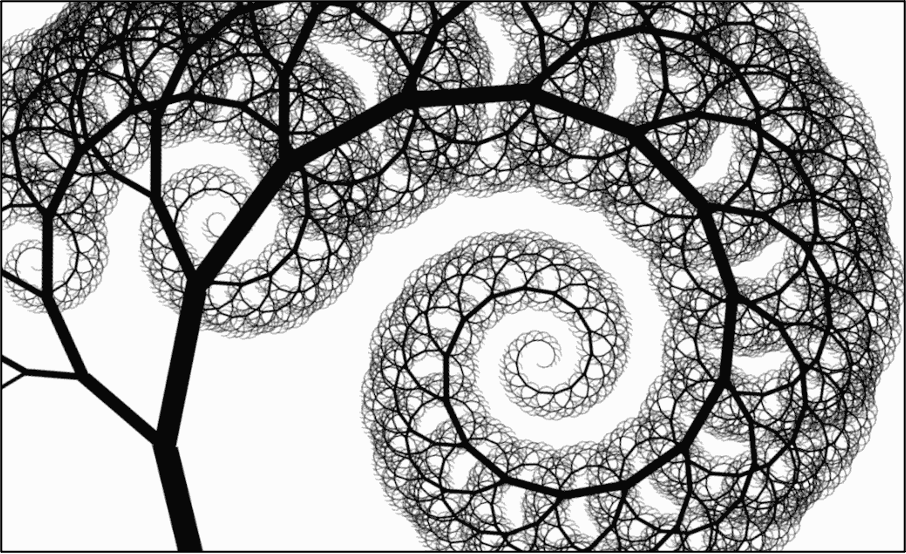
Fractals are complex geometric shapes that exhibit self-similarity, meaning their structure looks similar at different scales—zoom in or out, and you’ll still see the same kind of pattern. Mathematically, they’re created through recursive formulas, where a simple rule is applied repeatedly to generate intricate forms. In art, fractals are frequently employed to create visually rich compositions that replicate natural forms, such as trees, coastlines, or clouds. Artists like Jackson Pollock unknowingly tapped into fractal aesthetics with his layered drip paintings, while digital artists use algorithms to create endlessly detailed fractal landscapes. In generative music, fractal principles are employed to control parameters such as melody, rhythm, or structure, where patterns evolve through iteration, yielding music that is both structured and unpredictable. Tools like Koan or modular environments like VCV Rack with recursive modulation chains allow artists to sculpt evolving soundscapes rooted in mathematical logic. In concrete art, fractals can be found in compositions based on geometric repetition and transformation, such as the work of Max Bill or Josef Albers, where abstract forms echo the recursive nature of fractals through minimalist visual language.
In music making, fractals can be applied by using recursive patterns, where a simple motif is transformed and layered at multiple scales to create evolving, self-similar structures. This is especially effective in generative or ambient music, where looping patterns slowly morph over time. One way to experiment with fractals in Ableton Live is to start with a short MIDI sequence—say 3 or 4 notes—and duplicate it while applying slight transformations to each copy (change pitch, rhythm, or velocity). Repeat this across several tracks, nesting variations within variations. You can use Follow Actions to trigger clips unpredictably, mimicking recursive behaviour. In VCV Rack, try patching a quantized sequencer into a clock divider and then feeding its output back into a modulator or a VC-controlled sequencer. Add layers with random or LFO-driven CV modulating delay times or filters at different rhythmic resolutions. The key is to think recursively—every layer should be a variation of the previous one, creating depth and movement while staying thematically connected.
Polyrhythms and Ratios
Polyrhythms are the simultaneous layering of two or more rhythmic patterns with different pulse groupings. A classic example is the 3:2 polyrhythm, where one rhythm cycles in three beats while the other completes two in the same period. This creates rhythmic tension and resolution as the patterns phase in and out of alignment. Polyrhythms are deeply rooted in African, Indian, and Afro-Cuban musical traditions, where complex rhythmic layering forms the foundation of percussion-heavy music. In electronic and experimental music, artists such as Aphex Twin and Squarepusher have explored extreme polyrhythmic density, utilizing it as a tool to push rhythmic boundaries. At its core, rhythm is inherently mathematical—each beat, subdivision, and repetition can be described as a ratio or time-based equation. These ratios can also be visualized as geometric shapes: a 4/4 rhythm can be represented as a square loop, while a 5:3 polyrhythm might resemble overlapping polygons cycling around a circle. This geometric interpretation, often employed in software such as Polyrhythm Generators or visual sequencers, reveals the spatial relationships between pulses and helps producers explore how rhythmic cycles intersect, repeat, and evolve over time.
To explore polyrhythms in Ableton Live, Max for Live provides several creative tools that enable intricate rhythmic layering while maintaining control and musicality. Some standout patches include:
A powerful rhythm generator that lets you layer multiple sequencers with independent step lengths, clock divisions, and playback modes. You can easily build 3:2, 5:4, or even non-integer rhythm ratios by setting different loop lengths and triggers per voice.
🎛️ML-185 Sequencer
Originally based on the classic Roland 185 step sequencer, this Max patch allows for gate-driven sequencing with adjustable steps, lengths, and gate modes—ideal for creating looping rhythmic structures that subtly shift over time. You can get the Max equivalent here.
This step sequencer allows for independent control of pitch, velocity, duration, and time division per step. You can create layered rhythmical parts that evolve at different rates while staying locked to a master tempo.
Dos for Using Polyrhythms Creatively
-
Set a common clock base: Anchor your sequences to a shared BPM so they interlock instead of drift.
-
Use clear contrast: Combine rhythms with distinct subdivisions (e.g., 3 against 4, or 5 against 2) to create recognizable interplays.
-
Visualize interactions: Use Ableton’s clip grid or tools like Note Grid to see when patterns align or diverge.
-
Assign voices to different instruments: Helps the ear distinguish overlapping patterns (e.g., kick in 4, hi-hats in 5, synth accents in 7).
Don’ts: Avoiding Rhythmic Chaos!
-
Don’t stack without intention: Random polyrhythms without contrast or hierarchy will feel disjointed and overwhelming.
-
Avoid unclocked loops: Unrelated loop lengths can create drift unless bounded by some sync or cycle logic.
-
Skip over Boolean logic unless needed: In VCV Rack or more advanced Max setups, Boolean gates (AND, OR, XOR) are used to determine whether notes should trigger when overlapping conditions occur. While powerful, this can quickly lead to erratic or hard-to-follow rhythms if not well-structured. Use logical gates to filter complexity, rather than increasing it.
If you want to go deeper, a good practice is to assign mute conditions or probabilities to layers. For instance, a rhythm might only play if both a 5-step and a 3-step cycle hit simultaneously, mimicking how logic modules work in VCV Rack. This creates a controlled complexity that sounds deliberate rather than chaotic.
Group Theory and Symmetry
Group theory is a branch of mathematics that studies symmetry, specifically, how objects can be transformed (rotated, reflected, shifted, etc.) without changing their essential structure. A group is a set of operations that can be performed on an object, where doing one operation after another still results in something within the same system. For example, if you rotate a square by 90 degrees or flip it over, it still looks like the same square. These transformations form a group because they can be combined and reversed while preserving the overall shape.
In art, group theory and symmetry are visible in patterns, tiling, and repeating forms. Consider Islamic geometric art, M.C. Escher’s impossible shapes, or mandalas—all of which utilize reflections, rotations, and translations based on mathematical symmetry. Even color schemes or layouts can reflect symmetry operations. Artists may not always know they’re applying group theory, but when they repeat and transform visual elements in structured ways, they are often working within that mathematical framework. This same logic can be applied to music—especially in pitch, rhythm, and structure—which we’ll explore in the next section.

Activity: Musical Symmetry Using MIDI Transformations
Step 1 – Create a Simple Motif
-
Open a MIDI clip and write a short melodic pattern of 4–8 notes in your scale of choice (e.g., C minor).
-
Keep it rhythmically simple for now (e.g., 8th notes).
Step 2 – Apply Group Transformations
Now duplicate the clip a few times and apply one of these musical symmetry operations to each version:
| Group Theory Term |
Musical Equivalent in Ableton |
| Translation |
Shift the whole phrase forward by a few steps (e.g., 2 beats later). Use clip offset. |
| Reflection (Retrograde) |
Reverse the MIDI notes (note order flips, rhythm preserved). Use the “Reverse” button in Clip view. |
| Rotation |
Rotate the note order (move the first note to the end, repeat). Do this manually in the MIDI grid. |
| Inversion |
Invert pitch intervals around a center note (e.g., C becomes G, D becomes F). Do this by hand or with a MIDI effect like “Pitch” or “Scale.” |
Step 3 – Layer and Explore
-
Stack these clips on separate tracks with different sounds.
-
Use Follow Actions or Scene Launch to play different transformations in sequence or randomly.
-
Add delay or reverb to accentuate the spatial feel of symmetry.
What You’re Learning
You’re essentially building a “group” of operations that preserve the core identity of your original idea while transforming its form. The fun part is noticing how the same melody can feel different when mirrored, rotated, or inverted—much like Escher’s visuals.
This exercise is ideal for loop-based music, minimalism, or generative setups, and it fosters a deeper understanding of how mathematical logic can influence musical variation.
Markov Chains
Markov Chains are mathematical models that describe systems which transition from one state to another, where the probability of each future state depends only on the current state, not the full history. In the context of music, this means that a set of probabilities can determine each note, chord, or rhythm based on what came right before it, allowing for controlled randomness that still feels coherent. Composer and Max developer Dillon Bastien has explored this concept extensively in his Max for Live patches, creating tools that generate melodies or rhythms based on Markov-based probability matrices. His patches let you define which notes follow which, and how likely they are to occur, resulting in sequences that evolve in an organic yet unpredictable way. The outcome isn’t pure randomness—it’s guided unpredictability, where musical ideas drift, return, and mutate without feeling disjointed. This technique is particularly effective for generative or ambient music, where subtle variations are key to maintaining interest without strict repetition.
Topology & Modularity
Topology is a branch of mathematics that studies the properties of space that remain unchanged under continuous deformation, like stretching, bending, or twisting, but not tearing or gluing. It’s less about exact measurements and more about relationships and connections between elements. In art, topology has inspired explorations of space and form, especially in modern sculpture and conceptual installations. Artists like Möbius-inspired M.C. Escher, or mathematically-informed sculptors such as Bathsheba Grossman, have used topological concepts to create visual works that challenge our sense of inside, outside, and continuity. In modular art, the concept of modularity—encompassing the assembly of complex systems from interchangeable parts—reflects a topological mindset: each module (or part) maintains a relationship with others through connection points rather than fixed placement. These ideas are not just visual; they inform how we think about structure, transformation, and spatial interaction—concepts that are especially useful when building music systems in environments like VCV Rack or Max/MSP.
Tuning Systems and Mathematical Temperament
Tuning systems and mathematical temperament refer to the ways in which musical pitches are organized and spaced. While most Western music today employs 12-tone equal temperament (12-TET), where the octave is divided into 12 equal parts, this is just one of many possible systems. In just intonation, pitches are tuned using whole-number frequency ratios (like 3:2 for a perfect fifth), which creates incredibly pure-sounding intervals, especially for drones and harmonic content. Pythagorean tuning, mean-tone temperament, and microtonality (which uses intervals smaller than a semitone) are all alternative approaches that shift the colour and emotional feel of music. Artists such as La Monte Young, Wendy Carlos, and Aphex Twin have employed alternative tuning systems to depart from the uniform grid of equal temperament, creating music that feels otherworldly, ancient, or even unsettling, often with rich tonalities that are mathematically precise yet sonically unfamiliar to modern ears.
To experiment with this yourself, try this simple exercise in Ableton Live: load a synthesizer (like Operator or Wavetable) and insert the Max for Live “Microtuner” device. Import a Scala tuning file—many of which are based on just intonation or other temperaments (you can find free libraries online, like the Scala archive). Choose a tuning like “5-limit Just Intonation” and play a simple triad. You’ll immediately hear how the relationships between notes feel smoother, more resonant, or in some cases, completely alien. Try composing a loop using only this scale and observe how your harmonic instincts change. If you’re using a modular setup like VCV Rack, modules like TUNATHA or Scala Quantizer allow you to explore the same concept using control voltage, turning tuning into a creative decision rather than a fixed rule.
Cellular Automata
Cellular automata are mathematical systems where a grid of cells evolves based on a set of simple rules. Each cell’s future state depends on its current state and the states of its neighbours—yet from these fundamental interactions, complex and often beautiful patterns can emerge. One of the most famous examples is Conway’s Game of Life, where pixels appear, disappear, or move depending on how many neighbouring cells are “alive.” These systems have been referenced in digital art, generative design, and video game simulations, and have inspired everything from glitch aesthetics to visual music videos. The appeal lies in their unpredictability that’s still rule-based, like nature simulating itself through logic.
In VCV Rack, several modules harness cellular automata to control rhythm, pitch, or modulation. Modules like Voxglitch Glitch Sequencer, Caudal by Vult, or LIFE can act as evolving trigger sources or CV generators. For example, you can use a CA module to generate rhythmic gates that shift unpredictably but stay patterned, or to modulate parameters like filter cutoff, oscillator pitch, or delay feedback. This brings life and non-repeating behaviour into your patches, perfect for ambient, generative, or experimental music. You can patch a CA’s output to a sequencer clock input, letting the rhythm “breathe” over time, or assign it to modulate pitch quantizers for melodies that evolve based on logic rather than randomness. It’s a powerful way to introduce emergent complexity into your music, where chaos and order coexist in harmony.
Conclusion
Mathematics has long been a silent partner in the evolution of art, not just as a set of cold equations, but as a creative tool for solving problems, organizing ideas, and generating beauty. In music, math helps us go beyond instinct, offering frameworks for structure, coherence, and unpredictability. Whether it’s the balance of the golden ratio, the evolving logic of cellular automata, or the symmetry of group theory, these systems can be harnessed to break creative blocks, introduce fresh perspectives, and expand your sonic vocabulary. This blog post isn’t about making math academic or intimidating; it’s about offering unusual, inspiring entry points to spark the creation of new songs. By applying these ideas in small, playful ways—inside Ableton, VCV Rack, or any DAW—you invite deeper, more dimensional thinking into your workflow.
For listeners, these mathematical structures often translate into patterns and proportions that feel intuitive, even if they go unnoticed at first. But for those who pay attention, they offer codes to crack, hidden architecture beneath the surface of sound. This not only creates a deeper listening experience but also fosters a more intimate dialogue between the artist and the audience. Whether or not you’re a math enthusiast, embracing these concepts opens the door to a new kind of creativity—one that blends logic with emotion, structure with freedom, and chaos with control.

Golden Ratio In Music And Other Maths
/in Blog/by pheekIt is often said that music is a form of mathematics. That is, if start wanting to quantize it and intellectualize it. Programming rhythms comes to specific formulas and engineering is also using precise measures to go to precision. While we all agree that music comes from the heart, certain elements rely on numbers. For rhythms, especially in quirky and complex time signatures, drummers will count in their minds to follow a specific structure. You might have done music without thinking about numbers which is absolutely fine but sometimes, using the maths can unlock a whole aspect of exploration you haven’t thought of. Using maths is also a way of detaching yourself from a certain control and letting logic take over. What’s interesting is how in electronic dance music, these complex theories can even create some magic on a crowd.
Some DJs are interested in deciphering the structure of a beat to find a counter song to mix it with. Using maths to build song is also a way to use a vocabulary that reaches people, subconsciously or consciously, on a an intellectual level that balances the emotional ride.
Let’s explore a few theories that can evoke some inspiration as well as how they’re used in music.
Golden Ratio & Fibonacci Sequence
The golden ratio, often denoted by the Greek letter φ (phi) and approximately equal to 1.618, is a mathematical proportion that occurs when a line is divided into two parts such that the ratio of the whole length to the longer part is the same as the ratio of the longer part to the shorter one. This elegant ratio has fascinated mathematicians, artists, and architects for centuries due to its visually pleasing properties. It appears abundantly in nature—in the spirals of seashells, sunflower seeds, hurricanes, and even the branching of trees or the proportions of animal bodies. In art, the golden ratio has been intentionally applied to create balance and beauty, from the compositions of Leonardo da Vinci to modern graphic design. Architects have also used it to structure harmonious spaces, most famously in the Parthenon and other classical buildings. The golden ratio remains a valuable tool for creating natural-looking, aesthetically pleasing structures and compositions across various artistic and design fields.
Leonardo
In music, the golden ratio can manifest in both structure and timing, often contributing to a sense of natural flow and aesthetic balance. Composers have been known to divide musical pieces according to the golden ratio, placing climactic moments or transitions around the 61.8% mark of a composition’s total duration. This can be observed in works by Bartók and Debussy, as well as in modern film scores, where the golden point subtly guides emotional peaks. On a smaller scale, the ratio can influence phrase lengths, chord progressions, or rhythmic development, creating sections that feel intuitively satisfying without sounding formulaic. Some producers and sound designers also use Fibonacci-based sequences (which approximate the golden ratio) to build patterns or modulate effects, subtly echoing nature’s growth logic in sonic form.
If you’re curious to explore the golden ratio in your music-making, here’s a simple experiment you can try in Ableton Live, using both arrangement and sound design. For arrangement, start by setting a clear total length for your track—let’s say 5 minutes (300 seconds). Multiply that by 0.618 to find your golden point: around 3 minutes and 5 seconds. Place a major transition, breakdown, or drop at that moment. You’ll notice how naturally it sits in the overall flow of the song. For sound design, try using a Fibonacci-based delay by setting delay times to values like 3ms, 5ms, 8ms, 13ms, and so on, which approximates the golden ratio rhythmically. You can stack delays or modulate reverb decay and feedback using these numbers to create organically evolving textures that feel alive and non-linear. These small adjustments, when made with intention, can lead to surprisingly coherent and satisfying results.
The Fibonacci sequence is a series of numbers where each number is the sum of the two preceding ones: 0, 1, 1, 2, 3, 5, 8, 13, 21, 34, and so on. Named after the Italian mathematician Leonardo of Pisa (known as Fibonacci), this sequence appears naturally in countless places—such as the arrangement of leaves on a stem, the spirals of pinecones, shells, or galaxies. What makes the sequence particularly fascinating is that as the numbers increase, the ratio between consecutive terms approximates the golden ratio (≈1.618). This connection makes the Fibonacci sequence a practical tool for modeling natural growth and structure. In music, Fibonacci numbers can be applied to define note groupings, bar lengths, tempo changes, or rhythmic structures, helping to create compositions that feel balanced and organic while still escaping rigid, predictable patterns.
Using the Fibonacci sequence in a sequencer is a creative way to introduce natural, evolving patterns into your music. In a traditional step sequencer—whether in Ableton’s MIDI clips, a hardware device, or a modular environment like VCV Rack—you can set the number of steps in a sequence to Fibonacci values such as 5, 8, or 13. For example, using an 8-step melodic sequence alongside a 5-step rhythm loop creates polymetric interplay, where patterns phase in and out over time before looping back together. In VCV Rack, modules like SEQ-3, GridSeq, or Foundry can easily be configured to use these step lengths, and by using clock dividers or logic modules, you can modulate events based on Fibonacci triggers (e.g., send a signal every 13 pulses). Another approach is to apply Fibonacci values to parameter modulation, such as controlling envelope lengths (e.g., attack of 3ms, decay of 5ms, sustain level at 8, release at 13ms), which can result in dynamic shaping of sound that feels organic and nuanced.
Pi (π)
Pi (π) is an irrational number that represents the ratio of a circle’s circumference to its diameter, approximately 3.14159. Its decimal form goes on infinitely without repeating, which has fascinated mathematicians, scientists, and artists for centuries. In art, Pi has been used as a symbol of infinity, chaos, and order—sometimes metaphorically, and at other times, literally. Visual artists such as Roman Opalka and M.C. Escher have explored the theme of infinite patterns and sequences, resonating with the nature of Pi. Some composers and digital artists have also mapped the digits of Pi to musical notes, pitches, or durations, creating generative compositions that are mathematically grounded yet aesthetically unpredictable. Because Pi is tied to circular motion and endless cycles, it becomes a poetic reference point in any creative process involving loops, spirals, or infinite variation.
Here’s a fun and mind-bending exercise to incorporate the mathematics of Pi into your music-making, especially using a step sequencer or MIDI programming environment. Start by mapping the digits of Pi (3.141592653…) to musical notes or rhythmic values. For pitch, assign each digit (0–9) to a note in a scale—for example, in C major: 0 = C, 1 = D, 2 = E, up to 9 = A#. Using the digits of Pi as your input, the first melody becomes: E (3), C (1), D (4), C (1), G (5), A (9), F (2), A# (6), F# (5), E (3). You can input this into Ableton’s MIDI clip editor or a step sequencer in VCV Rack (like Seq-3 or PhraseSeq) to generate a unique melodic line. For rhythm, use the digits to set note lengths or gate durations—for instance, 3 = 3/16, 1 = 1/16, 4 = 4/16, and so on. The irregularity of Pi ensures a non-repeating, organic structure that still retains a mathematical backbone, resulting in patterns that feel alive and unpredictably balanced. You can loop a phrase, then shift the starting point (circularity!) to explore endless variations, just like the number itself.
Fractals
Fractals are complex geometric shapes that exhibit self-similarity, meaning their structure looks similar at different scales—zoom in or out, and you’ll still see the same kind of pattern. Mathematically, they’re created through recursive formulas, where a simple rule is applied repeatedly to generate intricate forms. In art, fractals are frequently employed to create visually rich compositions that replicate natural forms, such as trees, coastlines, or clouds. Artists like Jackson Pollock unknowingly tapped into fractal aesthetics with his layered drip paintings, while digital artists use algorithms to create endlessly detailed fractal landscapes. In generative music, fractal principles are employed to control parameters such as melody, rhythm, or structure, where patterns evolve through iteration, yielding music that is both structured and unpredictable. Tools like Koan or modular environments like VCV Rack with recursive modulation chains allow artists to sculpt evolving soundscapes rooted in mathematical logic. In concrete art, fractals can be found in compositions based on geometric repetition and transformation, such as the work of Max Bill or Josef Albers, where abstract forms echo the recursive nature of fractals through minimalist visual language.
In music making, fractals can be applied by using recursive patterns, where a simple motif is transformed and layered at multiple scales to create evolving, self-similar structures. This is especially effective in generative or ambient music, where looping patterns slowly morph over time. One way to experiment with fractals in Ableton Live is to start with a short MIDI sequence—say 3 or 4 notes—and duplicate it while applying slight transformations to each copy (change pitch, rhythm, or velocity). Repeat this across several tracks, nesting variations within variations. You can use Follow Actions to trigger clips unpredictably, mimicking recursive behaviour. In VCV Rack, try patching a quantized sequencer into a clock divider and then feeding its output back into a modulator or a VC-controlled sequencer. Add layers with random or LFO-driven CV modulating delay times or filters at different rhythmic resolutions. The key is to think recursively—every layer should be a variation of the previous one, creating depth and movement while staying thematically connected.
Polyrhythms and Ratios
Polyrhythms are the simultaneous layering of two or more rhythmic patterns with different pulse groupings. A classic example is the 3:2 polyrhythm, where one rhythm cycles in three beats while the other completes two in the same period. This creates rhythmic tension and resolution as the patterns phase in and out of alignment. Polyrhythms are deeply rooted in African, Indian, and Afro-Cuban musical traditions, where complex rhythmic layering forms the foundation of percussion-heavy music. In electronic and experimental music, artists such as Aphex Twin and Squarepusher have explored extreme polyrhythmic density, utilizing it as a tool to push rhythmic boundaries. At its core, rhythm is inherently mathematical—each beat, subdivision, and repetition can be described as a ratio or time-based equation. These ratios can also be visualized as geometric shapes: a 4/4 rhythm can be represented as a square loop, while a 5:3 polyrhythm might resemble overlapping polygons cycling around a circle. This geometric interpretation, often employed in software such as Polyrhythm Generators or visual sequencers, reveals the spatial relationships between pulses and helps producers explore how rhythmic cycles intersect, repeat, and evolve over time.
To explore polyrhythms in Ableton Live, Max for Live provides several creative tools that enable intricate rhythmic layering while maintaining control and musicality. Some standout patches include:
🎛️Polyrandom by Encoder Audio
A powerful rhythm generator that lets you layer multiple sequencers with independent step lengths, clock divisions, and playback modes. You can easily build 3:2, 5:4, or even non-integer rhythm ratios by setting different loop lengths and triggers per voice.
🎛️ML-185 Sequencer
Originally based on the classic Roland 185 step sequencer, this Max patch allows for gate-driven sequencing with adjustable steps, lengths, and gate modes—ideal for creating looping rhythmic structures that subtly shift over time. You can get the Max equivalent here.
🎛️MOOR by K-Devices
This step sequencer allows for independent control of pitch, velocity, duration, and time division per step. You can create layered rhythmical parts that evolve at different rates while staying locked to a master tempo.
Dos for Using Polyrhythms Creatively
Set a common clock base: Anchor your sequences to a shared BPM so they interlock instead of drift.
Use clear contrast: Combine rhythms with distinct subdivisions (e.g., 3 against 4, or 5 against 2) to create recognizable interplays.
Visualize interactions: Use Ableton’s clip grid or tools like Note Grid to see when patterns align or diverge.
Assign voices to different instruments: Helps the ear distinguish overlapping patterns (e.g., kick in 4, hi-hats in 5, synth accents in 7).
Don’ts: Avoiding Rhythmic Chaos!
Don’t stack without intention: Random polyrhythms without contrast or hierarchy will feel disjointed and overwhelming.
Avoid unclocked loops: Unrelated loop lengths can create drift unless bounded by some sync or cycle logic.
Skip over Boolean logic unless needed: In VCV Rack or more advanced Max setups, Boolean gates (AND, OR, XOR) are used to determine whether notes should trigger when overlapping conditions occur. While powerful, this can quickly lead to erratic or hard-to-follow rhythms if not well-structured. Use logical gates to filter complexity, rather than increasing it.
If you want to go deeper, a good practice is to assign mute conditions or probabilities to layers. For instance, a rhythm might only play if both a 5-step and a 3-step cycle hit simultaneously, mimicking how logic modules work in VCV Rack. This creates a controlled complexity that sounds deliberate rather than chaotic.
Group Theory and Symmetry
Group theory is a branch of mathematics that studies symmetry, specifically, how objects can be transformed (rotated, reflected, shifted, etc.) without changing their essential structure. A group is a set of operations that can be performed on an object, where doing one operation after another still results in something within the same system. For example, if you rotate a square by 90 degrees or flip it over, it still looks like the same square. These transformations form a group because they can be combined and reversed while preserving the overall shape.
In art, group theory and symmetry are visible in patterns, tiling, and repeating forms. Consider Islamic geometric art, M.C. Escher’s impossible shapes, or mandalas—all of which utilize reflections, rotations, and translations based on mathematical symmetry. Even color schemes or layouts can reflect symmetry operations. Artists may not always know they’re applying group theory, but when they repeat and transform visual elements in structured ways, they are often working within that mathematical framework. This same logic can be applied to music—especially in pitch, rhythm, and structure—which we’ll explore in the next section.
Activity: Musical Symmetry Using MIDI Transformations
Step 1 – Create a Simple Motif
Open a MIDI clip and write a short melodic pattern of 4–8 notes in your scale of choice (e.g., C minor).
Keep it rhythmically simple for now (e.g., 8th notes).
Step 2 – Apply Group Transformations
Now duplicate the clip a few times and apply one of these musical symmetry operations to each version:
Step 3 – Layer and Explore
Stack these clips on separate tracks with different sounds.
Use Follow Actions or Scene Launch to play different transformations in sequence or randomly.
Add delay or reverb to accentuate the spatial feel of symmetry.
What You’re Learning
You’re essentially building a “group” of operations that preserve the core identity of your original idea while transforming its form. The fun part is noticing how the same melody can feel different when mirrored, rotated, or inverted—much like Escher’s visuals.
This exercise is ideal for loop-based music, minimalism, or generative setups, and it fosters a deeper understanding of how mathematical logic can influence musical variation.
Markov Chains
Markov Chains are mathematical models that describe systems which transition from one state to another, where the probability of each future state depends only on the current state, not the full history. In the context of music, this means that a set of probabilities can determine each note, chord, or rhythm based on what came right before it, allowing for controlled randomness that still feels coherent. Composer and Max developer Dillon Bastien has explored this concept extensively in his Max for Live patches, creating tools that generate melodies or rhythms based on Markov-based probability matrices. His patches let you define which notes follow which, and how likely they are to occur, resulting in sequences that evolve in an organic yet unpredictable way. The outcome isn’t pure randomness—it’s guided unpredictability, where musical ideas drift, return, and mutate without feeling disjointed. This technique is particularly effective for generative or ambient music, where subtle variations are key to maintaining interest without strict repetition.
Topology & Modularity
Topology is a branch of mathematics that studies the properties of space that remain unchanged under continuous deformation, like stretching, bending, or twisting, but not tearing or gluing. It’s less about exact measurements and more about relationships and connections between elements. In art, topology has inspired explorations of space and form, especially in modern sculpture and conceptual installations. Artists like Möbius-inspired M.C. Escher, or mathematically-informed sculptors such as Bathsheba Grossman, have used topological concepts to create visual works that challenge our sense of inside, outside, and continuity. In modular art, the concept of modularity—encompassing the assembly of complex systems from interchangeable parts—reflects a topological mindset: each module (or part) maintains a relationship with others through connection points rather than fixed placement. These ideas are not just visual; they inform how we think about structure, transformation, and spatial interaction—concepts that are especially useful when building music systems in environments like VCV Rack or Max/MSP.
Tuning Systems and Mathematical Temperament
Tuning systems and mathematical temperament refer to the ways in which musical pitches are organized and spaced. While most Western music today employs 12-tone equal temperament (12-TET), where the octave is divided into 12 equal parts, this is just one of many possible systems. In just intonation, pitches are tuned using whole-number frequency ratios (like 3:2 for a perfect fifth), which creates incredibly pure-sounding intervals, especially for drones and harmonic content. Pythagorean tuning, mean-tone temperament, and microtonality (which uses intervals smaller than a semitone) are all alternative approaches that shift the colour and emotional feel of music. Artists such as La Monte Young, Wendy Carlos, and Aphex Twin have employed alternative tuning systems to depart from the uniform grid of equal temperament, creating music that feels otherworldly, ancient, or even unsettling, often with rich tonalities that are mathematically precise yet sonically unfamiliar to modern ears.
To experiment with this yourself, try this simple exercise in Ableton Live: load a synthesizer (like Operator or Wavetable) and insert the Max for Live “Microtuner” device. Import a Scala tuning file—many of which are based on just intonation or other temperaments (you can find free libraries online, like the Scala archive). Choose a tuning like “5-limit Just Intonation” and play a simple triad. You’ll immediately hear how the relationships between notes feel smoother, more resonant, or in some cases, completely alien. Try composing a loop using only this scale and observe how your harmonic instincts change. If you’re using a modular setup like VCV Rack, modules like TUNATHA or Scala Quantizer allow you to explore the same concept using control voltage, turning tuning into a creative decision rather than a fixed rule.
Cellular Automata
Cellular automata are mathematical systems where a grid of cells evolves based on a set of simple rules. Each cell’s future state depends on its current state and the states of its neighbours—yet from these fundamental interactions, complex and often beautiful patterns can emerge. One of the most famous examples is Conway’s Game of Life, where pixels appear, disappear, or move depending on how many neighbouring cells are “alive.” These systems have been referenced in digital art, generative design, and video game simulations, and have inspired everything from glitch aesthetics to visual music videos. The appeal lies in their unpredictability that’s still rule-based, like nature simulating itself through logic.
In VCV Rack, several modules harness cellular automata to control rhythm, pitch, or modulation. Modules like Voxglitch Glitch Sequencer, Caudal by Vult, or LIFE can act as evolving trigger sources or CV generators. For example, you can use a CA module to generate rhythmic gates that shift unpredictably but stay patterned, or to modulate parameters like filter cutoff, oscillator pitch, or delay feedback. This brings life and non-repeating behaviour into your patches, perfect for ambient, generative, or experimental music. You can patch a CA’s output to a sequencer clock input, letting the rhythm “breathe” over time, or assign it to modulate pitch quantizers for melodies that evolve based on logic rather than randomness. It’s a powerful way to introduce emergent complexity into your music, where chaos and order coexist in harmony.
Conclusion
Mathematics has long been a silent partner in the evolution of art, not just as a set of cold equations, but as a creative tool for solving problems, organizing ideas, and generating beauty. In music, math helps us go beyond instinct, offering frameworks for structure, coherence, and unpredictability. Whether it’s the balance of the golden ratio, the evolving logic of cellular automata, or the symmetry of group theory, these systems can be harnessed to break creative blocks, introduce fresh perspectives, and expand your sonic vocabulary. This blog post isn’t about making math academic or intimidating; it’s about offering unusual, inspiring entry points to spark the creation of new songs. By applying these ideas in small, playful ways—inside Ableton, VCV Rack, or any DAW—you invite deeper, more dimensional thinking into your workflow.
For listeners, these mathematical structures often translate into patterns and proportions that feel intuitive, even if they go unnoticed at first. But for those who pay attention, they offer codes to crack, hidden architecture beneath the surface of sound. This not only creates a deeper listening experience but also fosters a more intimate dialogue between the artist and the audience. Whether or not you’re a math enthusiast, embracing these concepts opens the door to a new kind of creativity—one that blends logic with emotion, structure with freedom, and chaos with control.
Studio Session Ice Breaker Activities
/in Blog/by pheekMy workflow shifted dramatically in 2024 when I started scheduling my studio sessions like I would any other professional commitment. I now treat each session as a meeting with myself—complete with a start and end time, and a clear intention.
Why does this matter? Because when I honour my time in the studio, my creativity responds with the same level of seriousness. One of the most common patterns I see among artists is a reluctance to plan, combined with a desire for professional-grade results. That dissonance often stems from treating music-making as a hobby, which is perfectly valid, but if you’re looking for consistency, it helps to approach your practice with intention.
As composer Terry Riley once said:
In other words, you can remain playful in your approach, but still be rigorous in how you support that process. That’s where rituals come in.
Terry Riley
Let’s Talk Rituals (Without the Woo)
I want to be clear about my use of the word ritual. I’m not referring to anything religious, spiritual, or rooted in new-age psychology. My interest lies purely in creating a consistent transition—a healthy shift from the outside world into the focused state needed for music-making.
For many artists, this is a vulnerable moment. It’s also where habits like smoking or drinking often sneak in. By designing a simple, sensory-based ritual, you can anchor your body and mind while keeping the session fun and functional.
Think of it as tuning your internal instrument.
5 Playful Studio Icebreakers to Induce Flow
1. The 5-Minute One-Sound Jam
A minimal constraint, maximum reward activity.
Challenge: Use only one sound (a sample, field recording, or synth patch). Modulate it in real-time with effects or automation to build a quick mini-composition.
Why it works: By limiting options, you reduce overwhelm and unlock depth in a single source. You’re not “finishing a track”—you’re discovering textures.
Tip: Use a defined root key if the sound has pitch, and include it in the file name for future use. You’ll thank yourself when browsing later.
2. Draw Then Compose / Daydream Mapping
This abstract, right-brain exercise combines visual and narrative thinking.
Challenge: Take 3–5 minutes to doodle—lines, shapes, textures. Then interpret your drawing musically. Sharp lines could become percussive transients, curves might inspire long pads or legato melodies.
Why it works: It activates your imagination and creates an emotional blueprint before you even touch your DAW.
Twist: Write a short story or “scene” for the song you want to create. What does it evoke? Where is it happening? Who’s in the room?
3. Find the Groove
A classic for finger drummers, but it works just as well with samples.
Challenge: Load a basic drum kit. Program a groove. Then find a single melodic or textural loop that “locks in” with the rhythm emotionally or rhythmically—no EQ or effects, just raw synergy.
Why it works: It sharpens your ear and intuitive feel for groove. Instead of overprocessing, you’re tuning into energy alignment.
Tip: Create a custom hybrid kit: mix a few 909 elements with quirky one-shots or foley sounds. Save it as your go-to warm-up kit.
4. Song Roulette
This one injects randomness—and humility—into your session.
Challenge: Use a random song generator (or ask a friend to send something unexpected). Analyze it: tempo, mood, structure, key. Use it as a loose reference, or try to reimagine it in your voice.
Why it works: It disrupts your default tastes and forces new perspectives. Sometimes discomfort is a portal to innovation.
Tip: If the song annoys you, ask why. Then steal its structure and make it your own.
5. Field Recording Flip
Turn your space into source material.
Challenge: Record a slice of life from your studio using your phone—ambient noise, gear hum, your footsteps, even your voice. Drop the raw audio into your DAW and play with it. Mangle it. Stretch it. Turn it into a pad, texture, or rhythm.
Why it works: It trains your ear to hear music in everything and adds a unique character to your sound palette.
Tip: Water-related sounds (boiling kettle, sink, etc.) make surprisingly rich textures once processed.
How to Design a Grounding Ritual That Works
A ritual doesn’t have to be grand. It just needs to signal: now we begin.
Here are a few grounded tips:
1. Anchor in the Senses
Set the mood with one or two sensory cues:
Switch on a special lamp or light mode.
Burn a specific scent (coffee, essential oils, incense).
Play the same short track before every session.
2. Move Your Body
Stretch. Shake out your limbs. Walk around the room. Movement helps reset your nervous system and clear lingering distractions.
3. Drop the Pressure
This isn’t about creating your magnum opus. It’s about showing up and being curious. The less pressure, the more likely you are to enter flow.
4. Replace the Crutch
If you tend to lean on smoking, snacking, or substances:
Sip tea instead.
Tinker with a piece of gear or patch cables.
Doodle ideas in a notebook.
It’s all about channelling the impulse into something tactile and healthy.
5. Keep It Consistent, Not Rigid
Let your ritual evolve. Rotate through your five favourite icebreakers. Keep it fresh. The goal is to stay present, not to follow a script.
Final Thoughts
Creativity loves structure—not the rigid kind, but the type that supports play. Developing a personal ritual and keeping a few go-to studio warm-ups in your pocket can significantly improve the quality of your sessions.
Next time you walk into the studio and feel that weird tension between “life mode” and “music mode,” try one of these icebreakers. Over time, you’ll train your brain to shift into flow faster, without the need for unhealthy habits or magical thinking.
Your studio is a sacred space. Treat it like one. But more importantly—treat yourself like someone worth showing up for.
Music Making For Everyone
/in Blog/by pheekThere’s no doubt that music has a significant impact on everyone’s lives, unless you don’t like music or are deaf. But even deaf people can feel music through vibration. Loving music is something many people think about, and it can be a passion that takes an essential part in people’s lives. Listening to music, attending concerts, or participating in festivals are some of the activities people engage in to feel that their lives are infused with music.
This evolution created a cultural divide, where music was no longer seen as a tool for everyday expression, but rather as an art form to be consumed by a select few. Instruments became expensive, notation systems complex, and conservatories rigid in their teachings. As a result, the idea of music-making became intimidating to many, something for “geniuses” or “professionals,” rather than a fundamental human right or need. Yet, this historical detour doesn’t reflect the universal and ancient role music has played in shaping identity, bonding communities, and nurturing emotional well-being.
In the early 1900s, music found its way back into everyday life as a central part of the home. Before radios and records became widespread, many families owned a piano, and gathering around it was a typical evening ritual. People would sing together, play songs from sheet music, and take turns performing on stage. Music wasn’t just entertainment—it was a way to connect, unwind, and create shared memories. It was also seen as a valuable skill, especially for young women, who were often encouraged to learn piano as a sign of cultural refinement. This era marked a time when music was once again accessible and social, woven into the fabric of daily life in a way that brought people together through shared experience and expression.
By the 1980s and 1990s, music had taken on a new communal form through underground club culture, with DJs stepping into the spotlight, not as performers in the classical sense, but as curators of energy and emotion. Much like the piano in the living room a century earlier, the DJ booth became a social hearth, but this time in warehouses, basements, and illegal raves. DJs weren’t just playing songs—they were weaving journeys from obscure records, reading the crowd in real-time, and responding to the collective vibe of the room. These nights were deeply ephemeral; most sets weren’t recorded, tracklists were a mystery, and many of the records played were white labels or imports, making it nearly impossible to track them down afterwards. This gave the music a raw, sacred quality—what you heard in the moment might never be heard again. Just as families once gathered around a piano to connect through song, ravers gathered around sound systems to experience music in its most immediate, unrepeatable form.
Desormais live at MUTEK
At the same time, MUTEK appeared in the landscape of Montreal, with the desire to host such events, so that was the perfect opportunity for me to join forces. One focus MUTEK had in mind was to bring influential artists together and build bridges between Montreal and other international scenes.
This is where Robert Henke appeared, participating multiple times to the festival. Befriending Robert, as well as many other musicians, made us realize that we all had the same passion for sounds and performances. He just started his own DAW, which became as of today, Ableton Live. In the summer of 2002, I travelled in Europe to build bridges, make contacts and perform a bit. Through some networking, I ended up at Native Instruments’ headquarters, where I met with several executives. Once again, there was this instant connection as we shared the same passion.
One thing that was also apparent to me was how both Ableton and Native Instruments had a side quest of wanting to democratize electronic music, making it easier to create and more accessible to a broader audience.
Sorry, not sorry for this lengthy introduction, but I thought you needed to understand where I come from as an artist. I feel that in the last few years, my position has become clearer, and I firmly believe that everyone should try to make electronic music.
Why Making Music
Anathol and Moox (Artist retreat 2023)
Starting with the known and studied benefits, there are several reasons why one should consider making music.
Making music has been shown to offer a wide range of cognitive, emotional, and social benefits across all stages of life. For children, learning an instrument or engaging in musical activities can enhance memory, language development, and motor coordination. It also fosters patience, focus, and emotional regulation. In older adults, making music has been linked to improved brain plasticity, delayed cognitive decline, and enhanced mood, sometimes even helping with conditions like Alzheimer’s and depression. For people of all ages, music-making serves as a powerful tool for stress relief, self-expression, and connection with others. Studies show that playing music in groups or singing together boosts oxytocin (the bonding hormone), strengthens social ties, and can even reduce feelings of loneliness and anxiety. Put, engaging in music isn’t just about creativity—it’s a form of mental and emotional hygiene, much like exercise is for the body.
Over the last decade, the electronic music scene has witnessed the rise of numerous artists, including AVICII, who have brought emerging talent to the forefront. As people emerged from the early scene of electronic music, it was not something that was planned or wanted, but it happened nonetheless.
In some ways, the rise to stardom of AVICII was sort of the ultimate goal to make it out there. It had made all the other big shots of DJs that were touring a farce of what popularity could gain. But what can be done more or achieve such a success remained, to me, a dissociation from the original mission and value from what the rave movement started from.
It reinforced the idea/myth that anyone with a DAW can make a hit and be pushed to have a fandom. It also created the concept that if you’re talented enough, you can make it. The gold rush to music making that was predicted in the early 2000s had finally come, but there is also a cost to that.
The whole system of stardom has come to feel rigged:
This is where I, as well as many musicians, feel frustrated: we come motivated and passionate, while some people are simply capitalizing on that force, taking away all the energy involved. It’s easy to get down the rabbit hole if you aspire for stardom, and as long as you have money, some people will offer you options and temporary attention to push you into the illusion that things are working for you.
Returning to my idea of inviting everyone to make music is a way of once again putting aside elitism to focus on community building. Creativity stems from effective communication, collaboration, challenging existing ideas, and being aware of external influences. It’s a dialogue between the one and the many. We think in conversation and create in context. Our creative voices gain meaning and power when they become part of something larger.
If many people make music, this is how the community’s feelings can be restored. It’s not about one person anymore; it’s about co-creating, being resources for others’ needs, and discovering the hidden personality behind everyone’s persona.
There are numerous reasons why I believe it’s essential, but I’ll share a few.
New language
Learning to make music is like discovering a new language: it opens up doors to express things you didn’t know you could with various levels of subtle possibilities. It is widely proven that learning and practicing music have a positive impact on cognitive abilities, stimulating the brain in ways that other activities cannot, while also teaching patience and resilience, and fostering a passion for music.
Listening Skills
Making music begins by developing your listening skills and curiosity. To understand a song, you need to take time to let it unfold. You can’t rush it and have to be in the moment to appreciate the multiple nuances that complex or straightforward songs might have. It requires concentration and listening abilities, which can improve communication, as well as being more mindful of space and layers.
Collaboration
When there was a boom of interest in electronic music, it was primarily because one could turn oneself into a one-man band, being able to achieve it all without help. That was a bit of an illusion. In a way, yes, it’s doable and one can certainly accomplish that, but on the other hand, no matter what material you have, you will require endless hours of practicing to get to an average level. If that same explorer can put their ego aside, they’ll discover the pleasure of collaboration and meeting with other musicians to share skills, ideas, inspiration and general tips. It becomes a side-quest to constantly be interested in the music of others, in the hope of finding the right people who share the same tastes or vision. But when you do, it can open up incredible connections where music becomes a shared vocabulary.
Appreciation for music
Understanding how something is made gives you appreciation for the quality. While music is treated more and more as a commodity, when you know how it is done, but also all the dramas that can come with the making of a song (ex., hard drive crashes, getting lost in the rabbit hole of revisions, etc), you treat it with more respect. It also shapes your tastes for things that aren’t just emotional. Still, you’ll be interested in details, nuances, and technicalities that you ignored before because you lacked the words to use.
Communities
So, where to start?
There are a vast world of possibilities and it can be overwhelming to decide where to start. It mostly depends of your time and budget. I’ve seen for example, some people who are retired who bought a piece of hardware like the Digitakt and then spend their time learning it, playing with it and that alone can do a long run. But if we think of the minimum basis, all you’d need is a device, which could be your smartphone or laptop and find some software. There are more and more free options out there which you can explore.
Testing with free options is a good way to see if you like and enjoy the process of making music that way. Some people prefer the tactile aspect and if you still want to remain within budget, you can invest in a MIDI interface which is still cheaper than a Digitakt, and with that, you can then control your software’s different parameters. But if you think you love making music in that way, using software, I’d recommend that you look into buying a DAW like Ableton, Logic, Bitwig or FLStudio. There’s also Reaper which is affordable but is a visually less seductive for some people. On the end, if you’ve been interested in modular synths and that you would like to explore that, I would refrain to do so until you’ve played with VCV Rack, which is free and lets you test some modules, test concepts and is an incredible tool for understanding synthesis.
You can learn for a while but I’d encourage to invest time and a budget matching your investements, into online classes or some education. One of the best way to learn is to make music with a friend or someone you know that makes music. Seeing someone making music is a great way to get familiar with the process. Turning to Youtube for tutorials and seeing people work is also an option but it can be a bit overwhelming as there are more options than one can imagine.
Basic activities to learn:
These will teach you the vocabulary and some of the essential parts to make music.
Sudden Aversion Towards Your Music
/in Blog/by pheekLet’s go through a complex topic that hits pretty much any musician at one point, which is when they suddenly develop a total dislike towards their music. This commonly happens towards music that people usually work on, but it could also happen with music they released (made) in the past. In both cases, this is caused by the same few points that I will discuss in this article and propose some solutions to ease the tension this can cause.
Is aversion towards your music a writer’s block?
Not exactly, but they’re often connected.
Writer’s block typically refers to the inability to create, while aversion to your music is more about losing connection or affection for something already made. One can trigger the other, but they’re not the same beast.
What Is Writer’s Block?
Writer’s block is the psychological state in which a creator—a writer, musician, or artist—cannot start or continue creative work despite wanting to. It’s not a lack of ideas per se but a disconnect between intention and execution.
Common definitions include:
The mental state of being creatively paralyzed.
A psychological inhibition prevents the production of new work.
A cognitive or emotional barrier that disrupts the flow of ideas.
How They’re Related
Aversion → Writer’s Block
When you lose faith in your current music, it can lead to avoidance. You hesitate to open your DAW, fearing that anything new will be “just as bad.”
Writer’s Block → Aversion
When you’re blocked and nothing sounds good, your existing tracks can start to feel like reminders of failure, creating a feedback loop of negativity.
Common Root: Self-Judgment
Both often come from internal criticism, fear of imperfection, or loss of creative play. You’re evaluating instead of exploring.
Let’s break it down.
The Brain Is Wired for Novelty
When you first start a track, your brain is stimulated by newness. Sounds feel fresh, and ideas flow. But repeated exposure leads to desensitization—you stop hearing the magic. This is known as hedonic adaptation: what once felt exciting now feels bland simply because it’s no longer new. When I make music, I’m always looking for new ideas and by searching through loops, samples and jamming, I will encounter multiple sounds that make me think I want to make a song with it. I’ve come to understand that with time, my music production comes in phases and that I would rather slow down the process by isolating each phase, where I work on one task at a time.
If you’re a regular reader of this blog, you know that one of my focuses on production aims to make sure artists break the emotional entanglement towards their art and be more neutral towards how the songs are. The issue with emotional attachment comes with these thoughts:
A lot of successful electronic music is also quite simple. Simplicity is an art, often accomplished in grace/flow. It was created quickly, and it worked. The issue with these songs is that you can’t go over the details over and over to fix things, as this will ruin the initial spontaneous effort.
This is when I also share a mode with producers who have mastered that way of working, which I call a Spike, inspired by the Agile System.
If working in non-linear mode makes you move through phases, taking breaks between songs and starting a new one to the point where you forget about the previous songs you made, a Spike is more about finding an idea and then quickly shifting it in a mockup, acting as fast as you can. Working fast and putting all doubts, while not aiming for perfection, is another way to counter the novelty envy and bottling down your ideas to move on. Usually, the main challenges people have when they’re doing a spike are:
These challenges usually stall you in the loop stage, where you play ad nauseum the hook you found and end up overexposing yourself to your sounds. This will likely tire you out, while your song has nothing wrong. When you work in Spike mode, you trust the process of having some adjustments later, and you focus on what you can do with what you have. This is also called working in layers, as you put down your main layers and have the option of adding what can emerge in a future session.
Focus: Taking distance from your ideas will be the right judge of their true potential.
New tastes, New influences
I think it’s in any musician’s best interest to appreciate multiple genres. One can’t bring anything new to a genre if they’re not getting inspiration from elsewhere. Imagine you grow up in the countryside and are only exposed to country bluegrass music; it might take a huge opening of your mind to discover new things, and once you do, you might have problems identifying social cues. What I mean by social cues are the ability to pinpoint what works in a song or what will please an audience. Label owners, for instance, have this internal radar for musical social cues because they’re in tune with the market, their audience and perceive the ups and downs of the label’s releases.
Being open to various music genres creates a general understanding of these cues, or the common patterns used within and across multiple genres. This is how the guys behind the Maurizio project translated the essence of Dub into making a new genre named Dub Techno in the early 90s. It was audacious, and it worked flawlessly. Honourable mentions were made to The Orb, who combined multiple genres, influences, and ideas in the same way, creating a genre that has taken over chill-out rooms.
The downside of venturing into different aesthetics or falling in love with a specific kind of track that one wants to emulate, you might have a hard time achieving it, which results into 2 issues:
In the face of new directions and challenges, you have more chances to dislike the music you make. This is common with newcomers to music making, especially people who have been DJs. They’ll know what quality music is and will be impatient with their own development.
In the spirit of using my non-linear approach, I always recommend consolidating your skills slowly and moving on. If you overtake a task that implies no use of the skills you have and requires a new definition of how you work, it will be harsh. I would encourage you to always start with a basis of what you know how to do and build on that, as a solid basis. This will ensure that you have one part of your exploration with elements you love and make room for new ideas that are in progress. Again, this is one reason I encourage using premade samples and loops. It’s to ensure that whatever you do has this basis of certainty, where you can add uncertainty.
Perfectionism Creeps In
As the track evolves, so do your expectations. You start comparing it to your favourite artists or your past work. The “inspired you” made the track; the “critical you” now evaluates it. And that inner critic is never easy to please. That good old internal critic is always trying to save your honour by finding all the faults, missing out on some essential points:
Perfectionism is something I could write an entire post about. It is an issue in many spheres of our lives and can cause mental health issues if not addressed. Some use the term OCD lightly, but that is a serious illness that requires intervention from a healthcare provider. The only thing one can do to address if it stops you from doing what you’re supposed to do is to go through the points I shared and perhaps print them, post them on your desk.
One advantage I shared earlier about working in layers or doing a spike is that you force yourself to be in the writer’s position and then you can revise later.
While you can’t reach perfection, that doesn’t mean you overlook issues. You can fix the obvious and let go of arbitrary things.
Tip: Separate creation from evaluation. Don’t mix these phases. Write first. Judge later. (analogy: right/left brain)
Emotional Projection
Sometimes, it’s not even about the music. You might associate the track with your mood during its creation—frustration, stress, loneliness. When you revisit it, you unconsciously relive that emotional state. This is the same for anyone you ask for feedback about your music; they might not be in the right state of mind to provide proper feedback. A critical point about putting an idea quickly in song form is to capture the intention and mood you had at the very moment of creating the song. While it’s important to take distance to judge the potential of the song, sometimes you won’t be able to jump back into the project because your emotional state has completely shifted from where you were. Making music under any influence can cause this issue, where you’ll feel a disconnection between where you were when you made the song and where you are when sober. It’s not always making sense.
I like to say that I see my songs as a statement or a Polaroid snapshot of where I was at a specific moment in my life:
Once I adopted this way of relating to my music, I tend to be less interested in changing anything since I make a lot of music. Compare it to posting pictures on Instagram, for instance. Imagine you want to constantly retouch past pictures you posted by removing a tree in the background or changing the colour of your t-shirt. Would that alter the intention and context of the moment you captured? How important would it be?
If you can take that approach to your music, you’ll feel more at peace with whatever you create and see it as a milestone, with its flaws, innocence, and soul.
Tip: Change your environment when working. Pair each track with a fresh mindset and clear intention.
Your Skills Evolve
You might dislike your track because you’ve improved. What sounded “good enough” two weeks ago now feels amateurish because your standards have moved up. That’s a good sign. I don’t like to finish my tracks, which always surprises people. My goal is always to aim for a level of completion of 90%. I like to finish my songs when I have a context of release. If a label approaches me to release an EP, I’ll go into my folder of unfinished tracks, pick the ones that would match the label’s direction, tweak them, mix them, and share them. This approach allows me to review specific technical issues I didn’t know how to fix when making the song or perhaps change something I didn’t realize wasn’t working. Sometimes I show the music as is to the label and we both decide of the micro changes. It always works better.
With this mindset, I can trust that my future-me will have the wisdom and resources to do whatever needs to be done when I need to let go of the song to the outside world. I teach new producers this mindset, encouraging them to say “that problem is already fixed, but in the future,” for anything that seems like a decision to take or a technical challenge. What is important to fix in the here and now is more about articulating the hook/idea and selecting elements to support it, to the best they can do.
We always evolve. Each song I make, I try to learn something new or practice a new approach. Something learned can then be applied to past projects, but if you always follow the same recipe and routine, you’re not training your future-you to make better decisions later on.
Tip: Instead of trashing it, freeze the track as a snapshot of your progress. It’s a milestone, not a mistake.
Understanding Arrangements in Electronic Music Production
/in Blog/by pheekWe can agree that a song is an idea, which is developed into a story. The word we use for that is arrangements. As I explained in a previous post, the arrangement phase follows creating a mockup and involves creating a timeline in which sounds come in and out. At least, this is how I approach it. As I work with clients on their production or mixing, I’ve been exposed to a variety of arrangements. What I see is that some genres often recur, and some are also overused. This post will cover multiple questions I get with arrangements, as well as how I teach various techniques.
Common Arrangement Types in Electronic Music
Depending of the genre, arrangements are meant to be adapted to fit the other songs of the same direction. But there is also a factor to take in account regarding the intention, or purpose, of the given song. When I do listening events or provide feedback for clients, I always ask them to answer a few questions:
It’s always surprising to me to see so many artists making music without giving any thought to these points. One can make music freely, without considering the listener, which is a bold move, but this can raise some problematic points when it comes to feedback. But most of the time, people will have at least one idea of where their song is going. These questions, if answered early in the creative process, will help focus the approach to the music, and this will significantly impact the arrangements. There’s a category of clients who have lovely and catchy ideas, but they struggle to bring them to life. This is a common thread amongst newcomers to electronic music.
Good ideas without execution become tiring and unengaging. This is the stuck-in-a-loop syndrome, where people struggle to get out of an idea and turn it into a song.
Poor ideas with strong execution can still be exciting to listen to. Some of my favourite techno tracks feature a handful of sounds and melodies that are only 2-3 notes long.
Who is it for?
This is simply understanding that your music is not for everyone. If you try to please everyone, you’ll end up pleasing no one. Music that works focuses on a single audience and accepts that compromises must be made. Some music manages to reach broader audiences, but this is not an easy task. There is a consensus on what irritates in music that can create aversion. One way to see this is to remove as many divisive ideas as possible, while keeping the concept easy to understand. Divisive ideas are often what gives personality to a song, but they can make people feel uneasy at first. There is a thin line between what pleases and what does not. An example that comes to my mind is Gypsy Women by Crystal Waters. When it came out, 50% of people liked it, and the other 50% hated it. But it was being played over and over on the radio, growing on people’s mind and eventually got the recognition it deserved because it was pretty original at the time.
When it comes to electronic music, being intentional on the direction of the song can help make decisions easier on your arrangements. I like binary questions like these to help find the intention:
I could go on about the various angles one can approach a song. But these main questions will directly influence how the song is built. There’s also the genre, which is not a binary question; even within a genre, there can be various levels of intensity. Some house songs can be mellow while others are bangers. Peak experience songs are meant to leave a profound emotional impact on the listener: they can be peak-time music, but they can also be beautifully written melodies for the closing track of the night.
Where and when should it be played?
As previously described, the moment and context will influence how the song is built. Early on, music usually has arrangements that are less inclined to have punch. Mellow arrangements involve executing the sound progression with more fade-ins and fade-outs, while maintaining a relaxed tone and avoiding tension-building. When it comes to music that is club-oriented, you’ll have some options on hand to make your song exciting, but this is genre-dependent, once again. There is also another point to consider, which is the context of where the music will be played:
While many people listen to festival music at home, there is some home listening music that won’t fit clubs because the context is just not appropriate. Home listening to music is intimate and leaves a lot of flexibility to explore subtle or audacious ideas. The difference between small and big clubs is often related to the intensity of the music. Some underground clubs are more open-minded when it comes to originality, while bigger, commercial clubs require music that appeals to a broader audience, as well as higher-energy, upbeat tracks.
What is the context behind this project?
Is this song an exploration of a genre or trying to emulate a label’s sound direction? Those simple questions relate to the context. We’re referring to the craftsmanship behind the work put into the song. Being aware of the context is sort of the original, or root, of the spirit of the creation of the music. If the context implies that you got signed and want to emulate the label’s direction, you’ll have a completely different context than someone making a song for their next DJ set. Being aware of your context is the first step in executing your idea.
What is the intention or purpose?
This is the fundamental question that will change everything, and it sums up all the previous questions. If you answered all the others easily, then this one will become obvious. Sometimes, the intention is clear and straightforward, but if it’s not, you might encounter challenges in building your song.
Arrangements 101
While I feel I could write an entire book on the topic, I’ll try to remain straight to the point about the essentials one should know right from the start.
The Essentials
Is there a minimum number of elements one needs to start making their arrangements? The simple answer would be no, but…
Once again, be aware that this will be a recurring point: your genre and intention will define what you need to start with. When I teach music production to newcomers, I feel there is an undefined’ level 1′ where one needs to learn how to create arrangements by copying those of references that one finds inspiring. Quite often, people give a lot of importance to the gear they need to make music, but one blind spot people frequently have is the quality of their influences and references. If you train your ears on questionable references, you’ll be building your inner vocabulary of arrangements on material that will lead to lower-quality results.
Studying your references will help you understand various points. It becomes the equivalent of learning how to write a book. There are a few points of interest to note, so let’s go through them here.
Song Form
This is how the song is built, with the number of sections. Also, there’s a concept I call Storytelling Perspectives, which involves dividing a song equally. Depending on your perspective, how you distribute it can yield balanced or unbalanced results. When I import a reference song into the arrangement side of my DAW, I put perspective points first, then check the song’s content to understand its sections. I love to see the correlation between the perspective and the sections. Sometimes it’s unrelated (e.g., unsimilar in the division points), while at other times, it’s almost the same, but with a few adjustments.
Arrangements organized with readability, colour coding and perspectives. Song by Barac analyzed for/with a client.
This example is how I read a song, and then, using ghost MIDI clips, I analyze how the arrangement is made. I place clips when I see a channel starting and draw them until the very end of the song. Sometimes I punch in the MIDI note of the given sound. This exercise provides a lot of information on how to build a song similar to one that I know works. One thing I also notice in songs that work well is a cohesive balance between the first third and the last one. Each has a part that the other doesn’t have, keeping the listener anticipating something to come. When perspectives are equal, the listener will intuitively know that something will happen at a given time, which rewards them for staying tuned. Also from this analysis, we see that this song starts strong with six elements right from the start, no break, and builds up. This type of arrangement is typical of techno, house, and minimal, where you want to provide a bed of intensity for the DJ to blend into their mix.
The main reasons I use MIDI clips are:
Tip: Define a colour coding that you’ll stick with through all your songs. This will allow you to open any old project and quickly get back up to speed.
Going deeper into the hook, we can now also analyze how things we built. This is what we refer to as “form” or, more specifically, “musical form”. Understanding the form will mean that you know the sections, such as these:
Intro / Build / Drop / Break / Drop / Outro (Organized, conventional, predictable)
Interpretation: Focused on energy cycles—build tension, release, rest, repeat. Great for dance floors, but often overused.
Tip: Try muting the first drop entirely and bringing it later than expected for a tension surprise.
Linear Progression / Techno Style (Simple, unconventional, hypnotic)
Interpretation: Evolution through subtle modulation. Encourages hypnotic, immersive listening.
Tip: Try working with 3-4 motifs only, but automate movement through FX, EQ sweeps, panning, or layering.
Loop-based Collage
Interpretation: Stream-of-consciousness or playful. Can feel chaotic or spontaneous.
Tip: Rein in the chaos by picking a key motif and returning to it as a “chorus” or anchor.
Hook Form
A hook in music is a short, memorable musical idea—often a melodic phrase, rhythmic pattern, vocal line, or sound—that grabs the listener’s attention and sticks in their mind. It’s usually the most recognizable part of a song and is designed to be repeated, often in the chorus or intro.
How you understand the hook of a song will give you insights into how to evolve your simple hook into something more. You’ve probably come across specific terms, so let’s go over a few basics.
A/B Structures (Verse/Chorus or Theme/Counter-theme)
Interpretation: Contrasts emotional states—such as question and answer, night and day, etc.
Tip: Instead of jumping A → B, try ABA, or ABAB’, where the last B is a variation to close a story arc.
Hook expressivity
This is about understanding the DNA of the hook to help analyze it. This can be covered with a few simple questions.
Hook’s family
A hook is rarely alone in a song to carry it through the entire arrangement. If that’s the case, it often evolves or morphs, while still having some modifiers that alter its character. But in other cases, the main idea will have a supportive companion. In Jazz, the main melody might be played by the entire band, but sometimes it is one specific instrument that leads the song, while others complement, support, and interact with it. I like to use family terms to describe the supporting roles, but I also encourage anyone to come up with their terms.
Not all songs are suitable for the whole family. Many songs have perhaps only a few elements. One element is the antagonist, which creates tension and generates potential conflict as the music evolves. If the song has tension and builds up, it will need a resolution at some point (often described as the drop), which the mother might provide.
Sound Order
Learning arrangements involve understanding how sounds come in, including their order. The best technique for understanding this is to note down in your arrangements where sounds appear and where they end. This technique is the best teacher for creating effective sound interactions to achieve a desired effect. Starting a song with all the percussion won’t have the same impact as if you slowly began with a pad.
Building templates and Readability
The first thing I do is to organize the channels for easy reading. Arrangements can become a mess as people work on it, and not having organization means missing the opportunity to understand what is happening. I want to be able to read and understand a song even before I press play. To do this, I need to organize the channels from top to bottom, in the order they appear. This means that the first channels that play should be at the top, followed by the others as they appear below. When working this way, arrangements take shape into a structure. You’ll see below a few arrangement examples, along with their names and some notes on the kind of effect they create.
A Classic Stairs Progression example.
This arrangement type is classic with a stair progression. One thing to keep in mind about stair progression is to be conscious of the buildup it creates, and that you’re engaging in what I call climbing to the top. You then need to think about climbing down. Stair progression is easy to understand, evokes a sense of assertiveness, and can build excitement. There’s an importance to keeping a relevant distance between each step. They all should keep the same timing to create a sense of predictability. If you bring a few sounds at once (in this case, Hook and Perc3), one can come with a fade in, but if you want to keep it punchy, that’s your decision. In this example, there is a sense of balance and a moment of tension half way with a rebuilt.
Climbing with the Valley example.
This arrangement is a different take, where the arrival at the top leads to what I call a valley (the open area after the peak). This creates a dramatic effect on the listener, but it also has the drawback of disrupting the energy. This might be appropriate for EDM, where breakdowns are essential, but they could create a moment of stillness on the dance floor. That might be what the artist wants, which depends of the intention.
Donato Dozzy analysis of an ambient techno track of his.
Simplicity always works. If the hook is complex, arrangements can be simple, and if the hook is simple, you could make things a bit more complicated with the narrativity. But in both cases, simple arrangements make it easier for the listener to engage with the song. I wouldn’t be surprised if Dozzy record most of his arrangements from a jam or playing live, and in many cases, he keeps things simple, but it always works. After analyzing his song, I was impressed by the straightforwardness of the arrangements.
DJ Sneak is always effective in every single of his house tracks.
I wanted to know how Sneak always pulls his arrangements because his music is so practical and fun to play. His formula is basically about having a core and then having various elements alternating on top. This approach is helpful for repetitive songs where the listener can focus their attention on a pattern, but then it shifts to the different upper elements that come in and out. That gives the listener an experience of being hypnotized and explains why house music has never gotten out of style since its invention. It’s simple, uses a limited amount of elements but is all about how they gel together. Simpler arrangements invite to analyze the patterns. They’re often over 2 bars long and alternating with variations every 4.
Melchior keeps it linear but introduces long valleys.
Melchior is one of those artists that, just like Sneak, creates an experience when you listen to his music. There is a lot of space in the repeating patterns, and he is not shy about letting sounds play on their own for a while. And it works. I wanted to analyze that song of his because it was so catchy that I wondered how he kept me hooked. The analysis revealed a very unconventional approach to his music, which pleases my brain.
Two techniques: Macro pattern repeat and channel substitution.
This snapshot covers the last two points I will share. The first is macro pattern repetition, which involves taking a pattern and creating a pause of equal duration (see the yellow line). One mistake people often make with music they find linear is not considering adding rests. Having a pause keeps the listener on the edge and gives a sense of slow, evolving progression. While many people feel that their music stagnates and will add more layers, the best solution is usually to subtract parts instead. A negative space creates room for wanting the sound to return. The other technique is channel substitution, which is simple and effective: if you want to remove a sound, add another one to compensate. In this case, the blue line gets a rest but is compensated with the light blue one. This is an excellent way to make swift changes, preventing the energy loss as the listener’s point of view shifts from one element to the new one. They might not even notice the change at first. This can be done with any sounds (ex., percussion for bass, vocals to kick, etc).
Duos, Trios, conversations.
The conversations between the parties are essential. See it like in jazz, where one instrument has a solo and then a duo with another. It’s the same for your elements. I find the perfect balance for a song is to have 3 interacting elements, as this gives you many options, as seen above. The 3 blue lines represent melodies:
This alternating energy creates many different sections you can play with throughout the song.
I hope this was helpful!
The Inner Ear
/in Blog/by pheekThere are multiple definitions of what the inner ear can be, but for this article, I will use it based on my own experience.
In music production, the Inner Ear is the metaphorical space where intuition, emotion, and personal taste converge — it’s the internal compass that guides an artist to create without relying on external references or trends. It’s not about hearing with your ears, but listening with your instinct.
Where the outer ear takes in the world — what others are doing, what’s charting, what plugins are trending — the inner ear listens inward. It pays attention to the subtle spark of an idea, the unexpected resonance of a sound, or a feeling that demands to be expressed.
Cultivating the inner ear means trusting your musical decisions before others validate them. It’s about making art from within — raw, unfiltered, and often surprising, even to yourself.
When I teach newcomers to music production, there are two main points I recommend starting with:
These two approaches will remain useful at various points in a musician’s development, as they will address and resolve specific issues. Quite often, musicians need and want validation or sound like a particular artist, to be part of a label or community. Working with reference is the most effective solution to these challenges. One can argue that a mentor can also do the job, which is true, but that mentor is still an external validation instead of amplifying the inner one.
Some musicians build most of their careers on making music that fits in with others’ projects. What’s interesting is that for many musicians, this is, without a doubt, one of the best ways to survive, as you can follow trends, see what works, and get a piece of the action.
Questioning one’s ambitions is none of their business. Making music, especially if you’re venturing into the professional realm, is a harsh world where it gets easy to become cynical. But at one point, as someone who works in music, I encourage people to drop out of their survival mode or their routine and find their inner voice.
The Inner Voice
I’m bringing a second concept to this post by reflecting on the voice. In any music genre, the voice is not just about singing, but also about how they express their ideas through their music.
To clarify:
Inner Voice is what you say creatively — it’s your artistic expression, your identity, the message or emotional truth that comes out when you make music authentically. It’s what you want to express.
Inner Ear is how you listen to yourself — it’s your intuition, your ability to detect when something resonates or feels honest before external validation. It’s how you decide what’s worth expressing.
Think of the inner voice as the output and the inner ear as the input.
They’re two parts of the same internal dialogue: one speaks, the other listens.
For a producer:
The inner ear helps you recognize when a sound or groove “feels right” without needing a reference track.
The inner voice is what shapes that feeling into a musical idea that’s uniquely yours.
As you understand, the concept of these two goes hand in hand. When one artist starts and works with references, loops, and samples, they are mostly working with external factors, but still practicing being in touch with their inner voice. If I give the same sample pack to multiple people in a room, it will sound completely different in the end, because the participants will all have different inner world that alters the results. After doing that exercise with people, I saw how everyone has their vision of what sounds ok or not, which comes from their preferences in music, but where they have issues is mainly to be able to understand if their music can compare to others: sounding similar or relevant.
The Authenticity Paradox
Now and then, I come across artists who are deeply absorbed in their music-making art form, utterly detached from what is being created. Some of those people are so self-absorbed that they are technically off. This raises some potential issues, but also raises questions.
A good example is a heated email exchange I had with someone I gave feedback on their music. The person basically wanted to be told how good his music was but it had a lot of issues, technically. I provided a list of the issues, with details and how to fix it but that didn’t go down well as the guy took it the wrong way and felt insulted by my details.
If one is supposed to follow their inner voice and ear, does this mean they ignore technical conventions?
The answer is not straightforward. One doesn’t need to follow any conventions or rules, but this might result in issues when played in specific contexts. It might also not fit the music the artist likes. Now and then, I have a client who wants to do their own thing and ignores my recommendations. However, once their music is played in a car or club, compared to other songs, it falls short in terms of power and precision. That is the price to not follow a technical basis but this only happens when people compare themselves to something else. Some people don’t and will remain in their bubble, which is not an issue.
Voice vs. Echo: Creating Without a Reference
Creating without a reference is something many people do, and, as explained, can lead to issues. But when it comes to creativity, it can also be a good thing. The majority of artists I work with are people in the electronic music business. Many are DJS, but not all. For those clients, not working with a reference might be tricky; either you know perfectly how things should sound or have a clear idea in mind of how to set your sessions. What’s interesting for me with clients that I’ve worked for a long time is how they progress through a cycle of different phases. When it comes to the moment where they want to explore on their own, I feel we then enter a fragile but magical step into the unknown.
Working without a reference comes with no playbook. One has to find their way, and when I talk to those who work this way, it’s common to see they all operate through it in different ways. Some prefer starting with the rhythmic part of their song and then creating a melody. Others do the opposite. Depending on the genre, things may tend to go in a specific direction more than others. If you want to venture into that workflow for the first time, here are some points to consider:
I like to keep in mind this workflow:
When you have this in mind, you know that in phase 1, you might have some questionable ideas, but trusting the process will allow you to be patient and accept that your final idea might be something different. The issue people generally have is trying to complete those 4 steps within a session, which results in the four phases being done incorrectly, leading to discouragement. Quite often, music I love has straightforward ideas, but the work around them makes them sound much more elegant, complex and is just a smoke screen.
Regarding effects and movement, I encourage you to keep a notepad (either on your smartphone or in a paper version) to take notes on songs that inspire you. I sometimes hear a song and pay attention to the main melody, noticing a detail like a tremolo. I’ll note that down and apply it to some ongoing projects.
Let’s try some exercises.
Daily Sound Sketches (No Plan, No Pressure)
Set a timer for 15–20 minutes and create a sound or loop without any expectations of finishing or sharing it. The goal is to create something that pleases you, not to impress others. Skip templates and avoid genres. Trust your instincts and explore.
Why it works: It builds confidence in your gut choices and disconnects you from perfectionism or external judgment.
Record First, Analyze Later
Open a mic or MIDI controller, hit record, and improvise — melodies, textures, rhythms. Don’t stop to fix or judge. Afterward, listen back and highlight anything that feels “you.”
Why it works: This bypasses the inner critic, letting your subconscious ideas surface unfiltered.
Use Randomization as a Mirror
Load a random sample or synth patch. Randomize settings. Now sculpt it into something that feels like you. Let chaos be the starting point, and your taste be the sculptor.
Why it works: You’re not starting from taste — you’re arriving there. It sharpens your awareness of what feels aligned with your voice.
No References Rule (For a While)
Challenge yourself: go one month without listening to new releases, genre playlists, or YouTube producer walkthroughs. Instead, dig into silence, field recordings, or non-musical sources for ideas (poetry, dreams, textures).
Why it works: It detoxes your creative input and gives space for your impulses to grow louder.
Assign Emotion > Then Create
Before starting a session, write down a feeling, memory, or concept you want to express. Create sound to express that, rather than chasing a style. Use reverb, distortion, rhythm, or harmony as emotional tools.
Why it works: It reverses the usual flow — instead of emulating a genre, you’re using your emotional language as the foundation.
Tuning In: The Art of Making Music from Within
This is something I covered in a previous blog post, but I’ll share it again because it’s relevant to this one. There’s a weird thing that happens when you make music, where what you do doesn’t always match what you’d like to do. This dissonance can be frustrating for many people, as they feel they lack control over what they want to do. In a way, we shouldn’t have control over our output unless we are truly fluent in musical expression, both in theory and in performance. I like to remind people that whatever comes out of you at a moment when you’re trying to do something else is, in a way, your inner voice. As I explained previously, you can give the assignment to 5 people to work on one song using the same synth, and you’ll end up with different results, despite using the same tool. But if you ask them to do 5 songs, there will be a similar thread throughout the five experiments.
On the other hand, I see some clients who have the opposite problem, where each of their songs is entirely different and lacks coherence between them. I could say that the artist hasn’t yet discovered their inner voice, but that could be debatable. In a way, perhaps their inner voice is just diversified and has a lot to say or explore. Exploring all kinds of aesthetics is not an issue until you feel you want to be part of a community or a specific direction, then it becomes a bit complicated. The remedy for that is to focus on less variable playlist, spend time to understand what you want to emulate, expose yourself to multiple songs and then go back to the drawing board.
Whenever I make music, there’s a moment when I listen to music before creating, which always prepares my creative self to work within a particular aesthetic.
Should you want to explore being more in tune with yourself, here are a few exercises to try.
The One-Sound Challenge
Choose a single sound — a synth patch, a field recording, or even a drum hit — and spend 15 minutes exploring what emotional or musical message you can express using just that. Modify it, stretch it, loop it, layer it — but stay centered around the original sound.
Why it helps: It forces you to lean on your creativity and intuition instead of relying on variety or complexity.
Sonic Journaling
Start your session by writing for 5 minutes: “How do I feel right now?” Then make music as a translation of that mood. Don’t aim for something “good” — aim for something true to how you feel. Save the project and name it after the emotion or moment.
Why it helps: Builds the habit of associating inner states with sound — this is the root of an authentic inner voice.
Listen Without Labels
Pick a random track from a genre or country you have never listened to. Before reading the artist or title, play it and ask yourself:
What do I feel?
What stands out?
What would I change?
Don’t analyze — listen emotionally. Then do the same to your track-in-progress.
Why it helps: Refines your internal filter by separating style from feeling.
The Role Reversal
Ask: “If this track was made by someone else, would I still like it?”
Or: “If I played this to a friend, what part would I defend proudly?”
This shift helps identify what’s truly you, vs. what you added to fit in.
Why it helps: Clears out second-guessing and tunes you into what you believe in.
Unfinished Ideas Playlist
Make a folder of 10 unfinished projects that still spark something. Once a week, revisit them, but instead of finishing, ask yourself: what do these ideas say about me? Look for patterns — moods, grooves, textures — that keep reappearing.
Why it helps: Your inner voice is often hidden in the stuff you leave behind. Reframing these scraps as messages instead of failures can reveal your artistic fingerprint.
Have fun exploring.
The Secret Beauty of Weird Music
/in Blog/by pheekThis is not a conventional post, but I thought I would write it since no one talks about it. I’m often labeled as someone who makes weird music. Perhaps there’s something in electronic music where weird music is more acceptable, or maybe even appreciated, than other genres of music, but why?
What is weird music, and why is it essential are questions that have led me to multiple lovely conversations over the years. I think the first time I had this conversation was in the beginning, when I used to work at a startup where people heard I was doing electronic music. They were expecting me to make something like Daft Punk, which was the mainstream reference of quality electronic music. In Quebec, which has always been a place of folk and Rock music, there has always been a certain disdain towards electronic music, especially in the 90s, and so, if y90s be a weirdo to make that kind of music, you’d keep it to yourself. At the end of the 90s, there was a transitional period where post-rave music emerged as something more refined and thoughtful than standard dance-oriented music. That was due to people having been raving for a decade, exploring the production side of it, getting matured and coming up with something new that wasn’t meant for mainstream music.
I once had that question after one of my albums came out, which wasn’t meant to be played on the popular radio. While I get that person’s point, I offered an answer that I still connect with today: “If you try to please everyone, you might end up pleasing no one as well as yourself.” In other words, I would rather follow what I love, explore it, and, down the road, connect with others who also enjoy that music.
Being passionate about music, going out to many events, whether raves, intimate loft parties, experimental events, festivals or any other performances, I would always leave the place with some personal notes. I’d try to remember what the peak experience of the event (eg, most decisive moment) was, what would stick with my mind in the following days, what made the crowd react, and what was something I loved that perhaps people didn’t. In many cases, as for my experiences, I felt that moments of surprise, where people were slightly caught off guard, were the memories that would stick with me. Many people would react strongly to drops and breakdowns, but it would easily get tiring after a few times. A trick can only be done a few times until people figure it out.
But the WTF moments were intense and stayed with me long. Even 30 years later, some are still on my mind. I think this comes mostly from how the narrative of a musician comes to create a flow with predictable music and then makes a moment of instability, the audience will be looking for the feeling of resolution. While EDM is known for its epic drops and breaks, there are other ways to do things but it’s not for everyone or every genre.
Why is it Essential?
When I used to perform on stage and improvise, I was known as the weird one with the most unpredictable dialogue and actions. Performers who did improv were interested primarily in making the audience laugh. I noticed that once the audience understood you can make them laugh, they would appreciate if you’d move away from the apparent joke routine to propose something else. I made the connection early that if you only serve the people one dish, they would quickly grow tired of it. A dose of unpredictability would always feed expectations of what would come next, such as “What other trick will he pull next?”
In music, I noticed people have some modes when they go out. Some people will attend an event to hear the music they love or know, while others want to discover something new. There’s a zone between the two where there is success, so you feed the audience with what they love and then step out of your comfort zone to educate them. If you start too weird, people won’t connect.
I remember this video of Villalobos sharing a view on this, regarding the first part of his sets:
But when the crowd is warmed up and going, you can throw a few curveballs, and people will eat them.
So why is it essential to celebrate weirder music?
Especially nowadays, there are multiple reasons to share.
Weird is tomorrow’s normal
If you try new things and people love it, you might have discovered some ideas people want more of. In music, many people want to be validated, appreciated and be part of a community of music makers, which will bring them to follow trends, imitate what has success and learn the methods that deliver results. While this works, most of the time, it also brings nothing new to the table. We’re just recycling ideas and numbing people out with what pleases them. There’s no need for any intellectual effort to consume these; there’s nothing wrong with that. But it does not contribute to the viability of a genre.
Innovation is not consistently recognized at first, but it is necessary to bring excitement back. Some innovations never get endorsed, though. What happens is that you’ll be exploring some new techniques that will lead you to new sounds. Moving forward will help you access that zone where you’ll eventually feel at home.
I’m sharing a video I thought was pretty interesting. It shows where things can go based on what music has been offering. But it shows that music is about change and that things should always move forward, sometimes out of where we think it should head to.
One thing I noticed, as a mastering engineer, is that I have some clients who keep doing the same song, but slightly different each time. It feels like they either have fun doing it or they feel they will eventually find the right combination that will provide a hit. But they rarely go out of their way, where a new world of opportunities awaits them. After a coaching session, this client did the opposite of what he usually does. After exploring this new direction, he got some attention from a pretty respected label. Things started from there. I wouldn’t credit myself for that, as he did a hell of a job, but he needed this gentle nudge or encouragement to move on to something else.
Breaking Patterns
As I said in the previous point, exploring new ideas helps you acquire new skills. Venturing into a different genre forces you to break your habits. But where and how does one break patterns?
Here are a few things to explore.
1. Radio Garden
https://radio.garden
Spin the globe and tune in to live radio stations from almost any country. Fantastic for immersing yourself in regional music you’d never find otherwise. Try jumping into small islands or rural areas for unexpected finds.
2. Every Noise at Once
https://everynoise.com
A massive genre map built on Spotify data. Click on any genre (like “Deep Filthstep” or “Zolo”) and get a list of artists. It’s overwhelming in a good way. Use it to explore genres you’ve never even heard of.
3. Aquarium Drunkard
https://aquariumdrunkard.com
A blog and label that curates obscure, psychedelic, folk, ambient, world music and lo-fi gems. Great writing and lots of free mixes to discover long-lost or niche records.
4. Boomkat
https://boomkat.com
Known for leftfield electronic, avant-garde, and experimental releases. Their staff picks and album descriptions are very tuned into the strange and wonderful.
5. Bandcamp Explorer / Randomizer
Bandcamp Discover → use the tag browser to explore things like “ritual”, “glitch”, “field recordings”, “abstract”, “weirdcore”
Or try this random Bandcamp generator: bandcamp-random.com
6. Use Reverse Geography
Pick a country you’re completely unfamiliar with (e.g. Kazakhstan, Angola, or Tuva), then search:
“[country] experimental music”
“avant-garde [language or region]”
Search on YouTube or Bandcamp using that country’s name.
7. Shuffle through a Music Subreddit
Reddit has niche communities like:
r/ObscureMedia
r/ListenToThis
r/Vaporwave
r/ExperimentalMusic
…where people post obscure or genre-bending tracks. Dig through archives and see what sparks.
8. Search Labels, Not Artists
Find a weirdo label (e.g., PAN, Sublime Frequencies, Important Records, Nyege Nyege Tapes, Black Truffle) and go through their catalogues. Labels often curate specific aesthetics more than any individual artist does
9. YouTube Digging
Start with a niche artist or keyword (“Japanese noise music”, “80s Iranian funk”, “French concrete”), then let the algorithm take you down rabbit holes. Tip: Find channels like “Vinyl archaeologist” or “Unheard Music” that post full obscure albums.
10. Ask ChatGPT (or use AI tools) like this:
“Give me 5 artists from Mongolia who make electronic music.”
“What are some weird genres I’ve never heard of?”
“Show me playlists that mix ritual and glitch aesthetics.”
Discovering what you didn’t know you loved
Discovering new music and exposing yourself to it is one thing, but you need to train your brain to like it. As an engineer who works with music of all genres and producers of all levels, I sometimes encounter music that challenges my taste. But I discovered a few tricks that let me appreciate music that I wouldn’t like in some cases. Strangely enough, outside my studio, I let myself to be picky, which is the same when I go out. But for the sake of my work, I need to love the client’s music to showcase its best parts.
But here are some tricks you can try:
1. Pair It With Familiar Habits (Associative Listening)
Your brain loves patterns and repetition, so sneak the new sound in during routine moments.
How:
Play the new music while doing something comforting or familiar, such as cooking, walking, journaling, or gaming.
Over time, your brain starts linking the music to that positive feeling, even if the music itself felt “off” at first.
2. Repeat Exposure Without Pressure (The Mere Exposure Effect)
Science says we like things more the more we’re exposed to them. The key is low-stakes repetition.
How:
Create a playlist of “not sure if I like this yet” tracks and loop it quietly while doing other things. Indirect and background listening can be a good way to expose yourself to music as many people have this relationship with it.
Don’t force close listening—just let the brain soak it in passively over a few days.
Pro tip: Your taste often lags behind your perception. What feels confusing on Day 1 might feel genius on Day 4.
3. Remix Context (Compare It to Something You Know)
Your brain can handle weirdness better when it has a frame of reference. Find a bridge between what you know and the new sound.
How:
Focus on one familiar element in the track (e.g., a beat, instrument, texture, or emotional tone).
Ask: “What does this remind me of?” or “If this were a movie scene, what kind would it be?”
Also, there’s contextual imagining:
1. Contextual Priming
When you imagine a setting where the music is loved (e.g., a sweaty warehouse, a spiritual ritual, a sunrise rave), you’re giving your brain a frame to understand the music.
Our brains don’t judge art in a vacuum—they rely on context to interpret intention.
Simulating a positive environment creates emotional cues that make the music feel more meaningful.
2. Mirror Neurons & Social Enjoyment
When you witness others enjoying music—even if it’s just in your imagination—your mirror neurons fire in response.
This system evolved to help us empathize and learn from one another socially.
Seeing joy or connection in others activates your reward circuits, and your brain starts linking that feeling with the sound itself.
3. Predictive Processing & Reframing
The brain constantly tries to predict what will happen next in sound. With unfamiliar music, it struggles at first. But when you reframe the music in a positive setting, you lower resistance and allow the brain to explore the sound with curiosity instead of defence.
Opening to new ideas
As I was relating how genres and techniques are tied together, I thought I would give you a few ideas.
1. Dub (Jamaica)
Signature Technique: Live mixing with tape delay and spring reverb
Originating in the 1970s, Jamaican sound systems.
Producers like King Tubby and Lee “Scratch” Perry would take reggae tracks and strip them down, using the mixing desk as an instrument.
They’d drop out vocals or drums, and blast snare hits into space with delay and reverb.
Heavy emphasis on spatial effects and repetition.
2. Glitch / IDM
Signature Technique: Micro-editing, granular resampling, and digital “failure” artifacts
Pioneered by artists like Autechre, Alva Noto, and Oval.
Often embraces “errors” like buffer underruns, bitcrushing, clicks, and skips.
It uses tools like Max/MSP, Reaktor, and destructive audio editing.
The music plays with the texture of malfunction and fractured rhythm.
3. Detroit Techno
Signature Technique: Machine sequencing with swing and analog character
Driven by hardware like the Roland TR-909, SH-101, and MPCs.
Often emphasizes cyclical loops, groove by timing shifts, and a futuristic aesthetic.
Producers like Juan Atkins and Derrick May fused precision with warmth, using step sequencers to build hypnotic momentum.
I find there’s some homework one should do by exploring all genres to see how they approach their music. By understanding it, you won’t necessarily be qualified enough to make some music that would fit that community but you will have some material to explore to bring some depth to your art.
Guidelines for Introducing Weirdness Without Losing the Plot
1. Respect the Core Identity, Warp the Details
Stick to the genre’s structural skeleton (tempo, instrumentation, mood, or rhythm).
Pick one element to swap or distort—like replacing a standard hi-hat with metallic noise, or a pad with a vocal texture.
Example:
House music track with a 4/4 kick and bass groove, but all percussion is made from heavily processed field recordings.
2. Alter Time Signatures Surgically
Maintain an accessible pulse, but inject odd time signatures or polymeters in short bursts.
You can also fake complexity by shifting note groupings, swinging subdivisions, or nested rhythms.
Example:
A 16-bar loop where bar 8 briefly switches to 7/8 before returning to 4/4—creates a jolt without derailing the groove.
3. Treat Weird Sounds Like Spices, Not the Whole Dish
Use unconventional sounds (granular bursts, detuned drones, glitch textures) at low volumes, or layer them beneath familiar elements.
Timbre management is key: use EQ, transient shaping, or saturation to blend weird elements into the mix more organically.
Example:
Replace a background riser with reversed vocal murmurs—weird, but texturally similar and easy to absorb.
4. Keep Arrangement Familiar, Play With the Microstructure
Follow a typical arrangement (intro → drop → breakdown → rebuild) to anchor the listener.
Get strange in transitions, fills, and layering rather than in the overall structure.
Example:
An ambient techno track with standard phrasing, but each drop introduces one new disorienting texture, like an LFO-warped chord or sample slicing.
5. Introduce a Motif and Mutate It Over Time
Repetition gives listeners trust and memory—once they know the motif, you can gradually twist it.
Use pitch-shifting, reverb morphing, stereo movement, or envelope manipulation over time.
Example:
A melodic hook starts clean, and over 3 minutes, becomes a distorted ghost of itself.
6. Balance Predictability and Surprise
Think of your track like a journey with tension and release.
Introduce a surprising element after a moment of familiarity. People are more open to new ideas once they feel safe.
Example:
After a recognizable chorus or groove, introduce a full drop into an abstract ambient break—then bring it back.
Bonus Trick: Start with a Reference Track, Then ‘Corrupt’ It
Take a standard genre structure, recreate it as a template, then substitute one part at a time with something unexpected—like:
A modular synth patch instead of a piano
Foleys and texture in place of synths
Spoken word snippets as rhythmic elements
Live Recording Of Electronic Music
/in Blog/by pheekIt’s one thing to make songs by assembling them in the arranger of your DAW but playing your song to life is another thing. I have nothing against spending time in the arranger to make your song, but when I got interested in playing my music, I realized it was a totally different energy. When Ableton Live came out, we were crazy about using the given software in a live context. The software was still in BETA at version 0.5b. It was stable because it was pretty simple, but still, I feel it was a side of myself that was more adventurous than I am now.
In the early 2000s, I played live a few times a month, and I had this way of working that involved not doing the same set twice. I decided to force myself to find ways to be swift enough and count on my improvisational skills to juggle what I had into spontaneous performances. It wasn’t always the best, but it was impressive for that period. This meant that when we first realized we could play live from a laptop, that was a game changer.
Portability was one of the challenges we had. Imagine carrying a table full of gear to each gig. It was impossible without owning a car, and there wasn’t a single event where we forgot something or something went wrong. But it was part of the performance: if something was off or not working, that was a self-imposed limitation we had to cope with.
But that made me fluent at expressing myself out of the blue. If at one moment, at home, you’d figure out a nice loop, you’d stop for a minute, arm the recorder and then jam the song away. Sometimes 2-3 times but the first would always be the best.
Recording jams as songs was a way of creating, and much later in life, I rediscovered the pleasure of working that way. With the current state of technology, it’s easy to have too much gear, ideas, and material. All you need is a loop to start with.
I’ll cover a guide to how I prepare my sessions as well as my favorite piece of gear and soft tools.
Preparation, Organization, And Idea Gathering
This section is critical for the success of the recording and also for the fun aspect of the exercise. Some people don’t like organizing and prefer being spontaneous and wild, but good preparation will make things more fluid. There’s also the argument that organization comes as you rehearse, and I have to say this will happen indeed, but having a minimum done in advance will be a leap forward. One of the critical points related to recording your live song is that you kill two birds with one stone: by the end of the activity, your song will exist as a performance set and a song. I have many clients who only make songs in the arranger, and having in mind to do a live set makes it a bit unintuitive as you’ll need to deconstruct your song into a performance setup, which might not help. The solution people take is to play live with the side launcher, playing one scene at a time and basically replying to their song as it is.
I like to spend my studio time by always starting with a live jam that leads to a song. This way, you’re in the moment and’ll play the music as you feel it. The limitations of playing only certain things all at once help make the song focused and help you avoid adding too many elements and layers.
If I would guide you like a step-by-step method based on how I do it, here how it would go:
1- Focus on creating a 1 bar loop idea from MIDI material as your hook
Recently, I’ve been having a lot of fun with Navigator, a tool from Manifest Audio that lets you browse various MIDI phrases. I usually load a synth and browse various ideas that work with that sound. This usually turns into multiple ideas that are fun to work with and add content to support. From one bar, you can after duplicate it to 4 where bar 2 and 4 have variations, while bars 1 and 3 are the foundation. This is a suggestion, and you can explore combinations, but this method is an approach I see in multiple songs.
Navigator allows you to browse midi patterns
Duplicate it to 4 bars
2- Driving and Rolling Idea
The problem with Navigator is that it might generate random ideas that help find a sound or sound sequence, but since it’s a bit random, there might not be much rolling feeling. By rolling, I mean that it doesn’t naturally groove on its own, so adding a supportive idea for this works best if you have a percussive/rhythmic idea that can go on its own.
Either you punch it in, or you can use Euclidean patterns to have solid energy. If you want that idea to be expressive, you can start by putting down where you want the notes and then use a tool like Draw or Fluctuator to randomize the note values. This would be translated into a modular setup by having a sequence set to a step programmed like the ADDR.
3- Lower support
Once you have your main ideas programmed, you can add the steps in the lower end to fill that void. This can be done by adding a sub-oscillator to your main synth, which will then result in using the main melody but pitched down. But if you want your low end to not follow the main melody, you may have two choices: use the rolling method for energy or invert the main idea to create an answer.
4- Percussion
You can get carried away by adding too many layers here, so I usually approach it from two sides: Define the foundation and then set the decoration. You may not be used to these terms, so I will explain them. Your foundation should be the kick, snare/clap and hats. Depending of the genre and time signature, the foundation of a kick within one bar might also be where the accents are. The snare, which, for instance, typically falls on beat 2 and 4, will consolidate the groove and accent of the kick. The hihat might follow 1/4th of notes to 1/16th, where you can add a swing to give it a flowing or broken flow.
The interaction of these 3 can be seen as the foundational elements of your song. In other words, you define precisely how you want your first idea and the rolling one to flow on the given percussion that can help with the articulation.
Decorations are sporadic and sparse interventions that don’t take over the foundation but create subtle movements and accents by following it or embellishing it. They are also helpful for marking transitions, marking the end of sections, or filling space.
5 – Working with loops
If you have started your core making using some premade loop, you can start with the same approach as explained. I wouldn’t hesitate to follow the order of the previous steps. But once you have worked on your idea, you should now have a row of ideas that can be played. You will want to duplicate this row 3-4 times to have variations of the main loop. The idea is to alternate between variations to give depth and excitement to the initial core.
Some variation ideas:
You can also slice your loop or idea in a sampler and reorganize. I recommend that before jamming your idea, you have some main ideas and not get lost in fixing them while playing.
You might want to avoid following the session’s primary quantizing mode regarding variations. This setup means that when you press play on a loop, it will start at the beginning of the quantized position. By default, it should be 1 bar, which is helpful because it resets the loop’s position to the beginning of the bar, helping you have coherence should you be slightly lost. But for the variations, you could switch that to 1/4th, 1/2 or other, which means that when you press play on that clip, it will start on the following quantized note. This means that if you have a fill-as-one variation, you can introduce interventions that aren’t going to be starting at the beginning of the loop. But to do this effectively, you’ll need to activate the Legato mode. This means the loop’s playing point will continue where the previous clip was. It will give continuity.
The way I set this up is to define my base loop. That loop is where you will come back to as the core idea of your song or should things get too silly. Ideally, that base loop should follow the session’s global quantization at 1 bar. The variations will be set depending on your needs.
6- Modulations
This is my favorite part of the preparation. It consists of activating the modulation record button and then clicking on the arm button on the channel you wish to modulate.
I will then add modulation to every channel and clip, but I will also have one clip without any so it doesn’t get too crazy.
Another option is resampling. This means you can solo one channel and then apply all the changes you want while resampling. This will give you longer clips you can play as is or chop them into smaller clips for variations to jam with.
7- Follow Actions as Randomizer
The Follow Action is fun when jamming or just when preparing. One way I like it is to have fills or melodies that play independently (aka generative melodies).
If you want your clips to remain short and play briefly before jumping, you’ll need to turn off the link and set the duration to something like 0.1.0 so that it plays only a note or so.
5- The Exciting Loop Method
The EL Method is about finding the simplest loop possible that excites you. Press the record button, then start jamming without a goal other than seeing if it’s fun. The recorded jam will be helpful as you can jam with the jam as if you have a partner leading the song, and then you can add new layers.
One suggestion is to start with your foundation, main idea and low end. This is the core of your song, and you can add the other layers after.
The idea is to jam your idea multiple times, recording every moment. You can then keep the best parts and edit the less-than-best.
That’s pretty much how you do it.
Bonus part: Gear
It’s common that when I teach beginners how to play electronic music, they think that it is only possible if they have a lot of gear and expensive material. Not having much often proves to be more productive, as you can focus on what matters. Even when performing live, I tend to focus on having as little as possible so I don’t lose myself, but if something goes wrong, I won’t have to look through a list of potential issues.
After performing live for almost 30 years using multiple setups, I would say that if you don’t have much, one good MIDI controller I recommend is the Novation Launch XL. This compact controller represents a mixing board where you can fade in and out elements or play with effects. As you jam using this, you’ll soon feel that automation and modulation with that tool give a much more organic movement than a mouse will. DJs who dive in production often miss the hands-on option that DJ mixing gives them. This is an excellent option for them to be able to add movement or play with levels, in a human way.
Stripped Down Tracks Guide
/in Blog/by pheekLast year I got back into the art of DJing and was digging for music to play in a gig. As I blended a selection of music from clients (who allowed me to use their music) mixed with findings on Bandcamp, I focused more or less on minimal techno/house, genres often associated with my artist identity. As I asked for suggestions on my Facebook artist page, people were sharing and observing that my tastes weren’t just into minimalism but also fit under the umbrella term of stripped-down music. I knew that term and have clients who make that kind of music, but for some reason, I wasn’t aware how much I enjoyed it. Stripped-down tracks are an acquired taste, which is not for all, but through this post, I want to reflect on what it is and give tips on how to create it.
Definition: What is Stripped Down Music?
Stripped-down music is a bit difficult to explain to someone who is not versed in DJing. I think anyone who would come across that music and not be familiar with electronic music in the first place would automatically describe it as simplistic or alienating. If you’re familiar with the music I make, which, weirdly enough, is often labeled as minimal, it would be considered maximal compared to stripped-down tracks. What characterises that genre is the linear aspect of its structure, the focus elements used, and the low occurrence of changes. More than often, they would feel like it’s a simple loop repeating ad nauseam, but if you pay close attention, you’ll notice that some patterns change subtly or swap predictably. But never too much.
Honestly, it is one genre I find hard to make because if you spend too much time on those tracks, you’ll quickly ruin it by adding unnecessary elements. Someone once asked me if it was underproduced music, to which I replied:
Strangely enough, within that genre, there are a lot of producers who have a lot of experience and will relate that this genre of music induces whoever makes it into a state of perpetual doubt and let go. I like to believe there is some poetry in its making. You could easily compare it to modern art where the focus is simple, but the artist also had balls to go for a statement or simplicity over complexity. I worked a few times with artists making that music, and each time, it would boggle my brain with how simple the arrangements were. More than often, the number of channels was under the count of ten. Sometimes, it would be a live improvisation from a few machines, where the raw recording often made me feel it was perhaps just two machines and a long loop.
What is the point?
Some pop artists are anxious if they don’t have vocals and effects (swooshes and crashes) at every bar of their project, where the arrangements constantly go up and down, making it, in my opinion, annoying more than exciting. They’re the opposite, and I once tried to explain to one of those artists what stripped-down music is and its purpose. That didn’t go down too well. The artist could not get it, and listening to 30 seconds of it made them feel profoundly uncomfortable. To get what it is and why such music is made that way, you’ll need to understand for which context it is meant to be played and how it is intended to be used.
Context
I’m not an expert enough to relate where it came to be and when it started, but I wouldn’t be surprised if Detroit were where it first gained traction. Looking back at artists like Robert Hood, his early works were stripped-down techno. Linear, no bullshit and made to hypnotize the audience. To appreciate that genre of music, you need to be exposed to a form of listening that requires patience. But Hood’s music is fast-paced and hard, a form of minimal techno/house that is different from minimal techno/house. If you ask DJs about that genre and why it is what it is, they’ll agree that those tracks are DJ-friendly and meant to be used in a performance context. Being linear songs, one can play them on multiple decks, craft them into a new song using EQs and adjust them to tastes for the crowd’s needs.
In other words, if you listen to them as is, not much will happen, but when you start layering them, they give the DJ much creative output. If you’re not a DJ listening to a set played with those tracks, you might never guess that the sources are pretty simple in the first place. By keeping your tracks to only a few elements leaves room to layer other ones on top.
Living the music
I find it interesting that some people really developed an appreciation for stripped-down music on its own, without being mixed in a track. Those people are rare, but I’m one of them. How I live that kind of music in a club/party context is far different as an experience compared to how I would listen to it in my studio or at home. While some people would quickly call it boring or energyless, to me, stripped-down music brings me a lot of energy for the space it opens to move into. As I love to dance to it, I find it liberating and giving me a sense of freedom. I find it’s one of the rare kinds of music where time seems to stretch beyond what I expect, creating a moment suspended in time.
I remember explaining that to someone, and that person rolled their eyes as if I was too spiritual. Before getting upset, I showed that person a video about David Lynch explaining his music view. He’s the only person who has said how I feel about it. He sees it as an element, such as fire or water and relates how much power it has, making it almost magic. Just like our ancestors, we are mastering the art of controlling it, and if we let ourselves be open about how much it can change us, beyond wanting to control it, we can see how much emotional bounding we can create with it.
Years ago, I did a score for a dance troop that was performing in a show. The choreographer rejected the first presentation of the score I proposed. She explained that there was not enough negative space for the dancers to explore. That view impacted me as it was the first time I dealt with someone who was just as interested in the silences as the music itself. Miles Davis emphasises that silence usage is what makes music.
Considering that stripped-down music is based on repetition and the use of negative space, it makes me think that it’s a genre that commands more respect than we can initially give it. There’s a maturity to it that is overlooked by many.
While there is a genre named Spiritual Jazz, stripped-down music is a bit on that side of things. I think it is more aligned with that mentality than some other genres pretend to be, but this is purely from a personal view.
On the other end of the spectrum of stripped-down music, there are people like Petre Inspirescu (who I often mentioned as a model of creativity). The few sets recorded for the Japanese Youtube channel Dommune are pure masterpieces worth watching because they are calmer than Hood’s music yet have some hypnotic energy that makes his fans dance.
How to Make It
Perhaps you have jumped to this part because you want to have bullet points on creating that music. While I can provide some ideas, tips and techniques, it is evident that if you’re going down that rabbit hole of music making, you’ll need to first listen to a lot of it. If you’re unfamiliar with the genre, I would say it might be easier to start by asking some DJ friend of yours to the rescue because finding quality stripped-down music can be challenging mainly because you’ll need to train your ears on what is quality and what is amateur or under-produced music. The line between the two is blurry, and in some cases, people who are new to music will do this kind of music because their skills aren’t too sharp to venture into complicated techniques. But this is also good news because it means that some beginners might come up with a very simplistic idea that works, making a simple track but nothing else is required.
Many people also struggle with this. They compare themselves to the wrong references and spend too much time on the song, ruining the fresh initial idea.
Here are a few points if you want to explore the genre:
1—Listen to a lot of similar music: While this is a tricky point, I list it first because having models will help you make critical decisions and understand that you need simplicity.
2—Limit your number of channels/sounds: Keep it low. I would encourage you to try to limit yourself to a maximum of 10 to start with. You can do a lot with that number! One channel can have variations, which makes it feel like it’s progressing and captivating. This is where many people fail; they’ll add layers instead of variations to what they have.
3- Work fast: I often encourage people to do speed sessions where they’ll blitz through working on multiple tracks within a 1 hour of studio work. Taking the time to do just 3 to 5 changes to a song on what’s apparent stops you from altering what doesn’t need to change.
4- Limit the voices: I mean the melodic elements. You won’t need much, perhaps even one loop, with variation, might be enough. If it feels incomplete, remember that it’s meant to be layered with something else; therefore, negative space is needed.
5- Be OK with repetition: As it says, you can grab your starting loop, stretch it to the last moment of the song, then slice it into sections of 8 bars and add some variations here and there. You don’t need to articulate it or make it “interesting” by adding bells and whistles.
6—Test in context: Mix it as a DJ or ask a friend to (pick wisely). If you don’t DJ, you can do it within your DAW, beatmatch, and then layer two songs. Is the combination of the 2 songs complementary? If not, create space or adjust it based on another song’s arrangements.
7—Work with loops: I’ve said it multiple times, but using loops is a key asset in getting the job done quickly. You can also recycle all your unused sounds, ideas, and loops from other songs you’ve done. It’s also a way of seeing some of your ideas from a new angle without any pressure.
8- No rules: This genre can be as experimental as having a repetitive loop playing with some effects. There are virtually no rules, and that can be unsettling. But if you understand that what you’re creating is a tool for another artist to pick and layer in their set, you’d be surprised that some artists are looking for simple ideas. I did some songs in the past that were ridiculously simple but ended up being some of my most popular material, being played in podcasts and radio shows. It’s weird but quite exciting.
The Key Point
What makes a track successful is based on multiple points worth sharing. However, the key point comes down to a listening technique I love practicing and sharing: Deep listening. It consists of listening to your song with your eyes closed and paying tight attention to all the elements, going from one to another. If you have fewer elements, your mind will automatically go from one to another circularly. I’m unsure where I read that, but we can’t listen to more than three sounds simultaneously. Yes, you hear many elements, but you can’t deeply connect with more than 3 at once.
Finding the perfect dosage of the right amount of sounds to use is where the art starts. This requires a certain level of experience, maturity, and understanding of how music is perceived in various contexts. I can’t explain it easily. Perhaps listening to music will reveal things you like, which you can explore. But I’ll share that polyrhythms and polyrhythmic modulations unlock that hypnotic effect. A good way to explore this is to remove the host synchronisation on your modulators, such as LFOs, and to go off the clock, which will give an analog feel.
Why Making it
You might wonder why I encourage you to explore this. There are multiple reasons behind that encouragement. The first one is that it forces you to review how you deal with simplicity and patience, which are skills music producers often struggle with. It also teaches you to work fast, make critical decisions, and let go of expectations.
It’s also quite fun.
The Anti-Loop Method vs The Writer’s Block
/in Blog/by pheekMaybe you came here with the idea that I’d be discussing techniques to break the loop issue; I’m relating to the problem many have where they are stuck in a loop and can’t get out. As you can see, this comes on two levels. The first relates to working on a song, finding a loop you love, and deciding how to turn that into a song. Still, another level is a bit more meta, where your studio sessions feel like a loop as well, as you have the same habits forcing you to do the same things.
I often said that making music was the most therapeutic experience. I’m not referring to the fact that one might feel better after a session due to the release of endorphins generated by a productive studio exploration. Therapy, just like meditation, is not necessarily all about feeling good; it’s more about why you feel bad so that you can make room to feel better. When I gave some meditation workshops, there would always be someone who would say they couldn’t meditate or that they were meditating wrongly, to which I invited them to be curious about what successful meditation is. Interestingly, there is no right way to meditate (Mindfulness, MBSR). It’s more about being curious of what the brain does to you when you try to do it.
It’s the same analogy with music production/exploration. In a way, there is no right or wrong. The source of writer’s blocks and frustrations often come from your interpretation of what is a good session, as you’ll compare any session to that reference.
So far, this introduction might feel unsettling, and perhaps you’re wondering where I’m heading with this, but this is the basis of understanding the core of many issues regarding how one might get stuck with their music. While there are multiple approaches to getting out of a slump, you’ll always be pulled down towards your bad habits if you don’t attack the core of the problem.
Stepping back on your practice
If you’re experiencing a loop and are wondering whether your practice is trapped in habits, the first thing to ask yourself is whether it is. While this question may seem unrelated to music making at first, trust me that it is more accurate than you think. When I ask clients that question, I often witness them taking a long pause to think about it, and every time, they realize they are stuck.
Signs that one is stuck in their workflow can be:
As explained in a previous post about how one can use their studio time, most of the people who fall into a slump often do so due to a lack of understanding of their own workflow. This results in studio sessions that is mostly focused on making songs alone. Creating songs is exciting because there is tangible development where you see your project evolve and reach its end. It feels like something productive was done. But like I described in this article, it is more fruitful to organize your sessions into different activities so you’re not relying on the success of one activity to dictate how well your session was.
As someone who focuses on just a few activities in the studio, where making songs is the central one, it’s easy to conclude that you have been trapped in a series of habits that once worked for you, but it’s now time to review what you’ve mastered to give a few more options. This starts by breaking the loop.
Curiosity as your antidote
I came across a video with Anne-Laure Le Cunff, who explains how we grow and evolve using cognitive scripts, which can be useful but can also lead to misguided slumps.
One element that caught my attention was the critical role of curiosity in overcoming a negative mindset. The video covers the Escapist, Cynic, and Perfectionist mindsets, which are common mindsets we can fall into while exploring music production. While those happen, triggered by an event or multiple ones, it remains possible to rely on curiosity to step out of the mindset. It’s easier said than done, and it’s not a blog article that will entirely change how your brain is wired. But I could propose some activities that can stimulate your curiosity.
But before I do, let’s see how the three negative mindsets might be present in the music producer. It’s important to understand that one common trigger that can bring these mindsets is more than often related to the feeling of uncertainty. If you’ve been making music for a little while and did some releases (or not), you’ll be exposed to multiple confusing situations, such as whether people like the music or not, whether it sold, if people played it, and perhaps why no one is relaying it to social media. Pair that with the adversity of working with abusive streaming sites like Spotify or seeing pirate websites selling music illegally, and your mind will go down the rabbit hole. Our human mind doesn’t deal well with uncertainty.
Part of the problem with uncertainty comes from the perspective that we expect success to be linear growth, while it is not. If we see someone having success, we are tempted to think they’ve been growing towards that, but we forget that this person went through cycles where there might have been more failures than happy moments for a while. Competition feeds the uncertainty.
Music-Making Mindset
Knowing all this, how can it affect one’s music-making sessions, or how can we step out of that cycle?
What makes someone get caught in the loop syndrome is that they spent time tweaking the loop to perfection, and now, with the idea to expand that to a song, it feels overwhelming: both in the time to pay and in the potential failure it could represent to turn something perfect into something less than ideal. It could be multiple other things, but in general, tweaking something small will narrow your understanding of how to make it bigger.
Quite often, some people come to me with a loop and ask me if it’s “good.” I always reply, “I need a structure to know how you want to develop that idea.” Loops aren’t songs. They’re small, self-contained ideas. Perhaps they are perfect as they are, but that doesn’t mean they are a song. I like the imagery that it’s similar to someone showing me a very nice tomato and asking me if it will be a nice salad; I’m missing a lot of data to understand, and I don’t have access to the person’s imagination.
As said previously, curiosity can help.
The first part is thinking of ideas in variations before making a loop that supports it. Thinking of a concept for the song will help break it over multiple minutes. For instance, perhaps you have the motif of a few notes over one bar, so start by finding variations and complementary elements that can appear, then think of a call and answer, chorus, breakdown… before you know it, you have a whole arrangement for a song that needs to be assembled. It’s not possible to just be caught in a loop anymore. Plugins like Scaler 3 now have scenes that can help you do this job by breaking down chord progression and suggesting potential variations. I also like Instacomposer if you’re on a budget.
I know it sounds simple, but thinking globally is the first part of coming out of a loop. In past articles, I also discussed using a reference track to understand its structure to populate your song with the elements. Song Sketch also does a nice job at this, covering different genres.
I also suggested studio activities here that you can do in rotation to keep yourself rolling.
But now, let’s dive into some activities to keep yourself curious.
Randomize & React
Use random LFOs or MIDI generators to modulate parameters on your loop. I love working with randomized midi patterns to come up with new ideas and in this mode, the idea is to act quickly where you search for ideas, resample everything and then just either layer clips all together.
Challenge: Commit to using whatever the system spits out for 1 minute of arrangement.
The result can be a little 2-minute blurb or a more extended improvisation. But where the fun is, this is up to you to figure out.
Oblique Techniques
Write down verbs like “stretch,” “reverse,” “break,” “filter,” “chop,” and “double” on separate pieces of paper. Pick randomly one of the words when in front of a specific sound.
You can also create a small deck of these as part of a creative toolkit. That can be used with plugins, effects, and techniques.
Deconstruct & Rebuild
Bounce your loop to audio and chop it into individual hits or micro-samples. Carsten Nicolai once made entire songs based on one sound. Perhaps explore that.
Create a new groove or section using only the bounced audio.
Create a Mini Sound Story
Imagine your loop as a scene. Ask:
“What happened before this?”
“What happens after?”
“What enters and what leaves?”
Let these questions shape the intro, build, or breakdown.
Speedrun Arrangement
Set a timer for 15 minutes. Copy your loop to fill out a whole 3-minute track.
Don’t worry about transitions—move elements around instinctively.
The speed forces you out of perfection mode and into playful discovery.
Role Reversal
Make your drum loop the melody.
Use your melody to trigger drums.
Recast sounds in new roles to see the project from a new angle.
Use AI or External Input
Ask a friend to suggest a weird transition or send you a sound to work in.
Or use AI text prompts to ask, “What could happen after this loop?” Get abstract ideas, then interpret them musically.
Play a Movie Scene Over It
Import a muted scene from a film or a short video and play your loop under it.
Let the visual action guide the arrangement—timing, tension, and release.
Parametric sequencing
This concept is a bit more advanced, but the idea is to use snapshots or parameter sets and then morph between them. This kind of exploration produces very different sounds than what you might usually do.
Sound design is an endless field of exploration if you’re curious. Whenever I feel out of inspiration, I go back to that sphere and rediscover myself.
Polymetric arrangements
Polyrhythms are a vast field of exploration. It can be in the way you program your beats, but it can also be in how you modulate. If your modulation doesn’t match the length of your loop, it will give the illusion that your loop evolves over what it’s set for, giving it automatic expansion.
Music Curation And Tastes
/in Blog/by pheekI was working with a client, and after I went through the basics of making a song, which he picked up pretty quickly, he commented, “So, in the end, it all comes down to music tastes.” What he meant by that is that technicalities are always a part of what anyone can learn, but if you don’t have good tastes, your music can’t be saved. If you’ve been working with me, you will know that one thing I coach students with is to avoid using words like good, extraordinary, cool, weird, or anything else that is an arbitrary term to refer to a sound. Besides being arbitrary, I avoid those terms because they don’t point out what one refers to; is it the punch? The clarity? The width? What does the student find cool, exactly?
Returning to music tastes makes an artist make or break it. But perhaps it is a bit more complicated, too. It fuels conversations and debates online, such as why some artists whose music we intensely dislike get much attention and praise. Is the problem the masses or our tastes?
This raised the question: can tastes be shaped or developed? Can we still strive if our tastes don’t match what the average listener wants to hear?
Or should one’s tastes adapt to the mass and lose their individuality?
Let’s examine tastes, where they come from, and how musicians become who they are.
Where Do Music Tastes Come From?
Music taste is shaped by a mix of psychological, cultural, and neurological factors. It combines exposure, emotional associations, personal identity, and cognitive processing.
Exposure & Familiarity: The Mere Exposure Effect
The first point regarding tastes and how they develop comes from what you’re exposed to. As a kid, your parents will be your first influences, as will the context in which you grow up. Countries like Brazil have a strong musical culture because people practice and grow up with music. I remember going there and seeing people singing or constantly listening to music. As I grew up, it was common to have the radio turned on, and it would either be talking shows or music that would play. Wherever you’d go, music was pretty much coming from the radio, often in restaurants or in shops. This is less common now as streaming has changed our surroundings, with people deciding what to play in their commerce.
We tend to like what we hear often. The more we’re exposed to certain sounds, the more we prefer them. This method was an aggressive method by commercial radios that could play the same songs over a rotation of a few hours. If the radio plays, people will get used to the same songs, and new ones will be introduced shyly until they become popular.
In this system, people are dictated to what they should appreciate. If I think of the average person not intentionally exposing themselves to new music, their tastes would be pretty rigid, and venturing off wouldn’t be an option. It’s the same for some people who go to a club and expect a specific musical direction not to change too much, as predictability is an element that can be reassuring if you have particular tastes.
Since exposure breaks the taste, some songs one might not like can grow on them. As a label owner, there are songs that I automatically flag as something that can win me over after a moment, and I listen to them a few times before deciding if I like them.
TIP: If you’re a musician, exposing yourself to random radio stations and visiting clubs you usually never go to is undoubtedly necessary to help nurture the plasticity of your music tastes.
If you read this blog, you’ll know that one thing I share about what people are looking for in music is familiarity but with a novelty twist. It is related to how we consume music as well. When there is a craving for music, more than often, we have a go-to genre or song we will go for.
Emotional Associations & Memory
Like scents, music can teleport you back to the past, bringing back certain moments or events with which it was associated. It is known that the brain releases dopamine when we listen to music that emotionally moves us. If we relate to events, festivals, or clubs, we can become interested in a new genre or song when seeing it in context, surrounded by a crowd of people who all move to it, creating momentum.
I have enjoyed going to festivals and loving to dance to music in the company of friends. I have vivid memories of spending quality time with people. We look at each other and are excited by appreciating a special moment where the music fits the mood perfectly. While I’ve been going to the MUTEK for 25 years now, there are people I exclusively see there and have been seeing them for that long, every year. After you meet people a few times and enjoy the music in their company, there will be more sharing and getting to know them, which leads to deeper friendships than just listening to music.
It’s one of the reasons I love the music I love today, which is partly linked to memorable moments of joy. Nowadays, I like to see people Shazaming music at events. It tells me they want to know more of the exact song they wish to bring to their life afterwards.
TIP: One exercise I give people I coach is to keep a journal of music that brings back souvenirs and emotions. Being in touch with your musical world is a way of reconnecting with periods of one’s life. As a musician, you are the sum of all the moments you collected, music-wise. To have your own glossary is also a way of getting inspiration.
Cultural Influence & Social Identity
The urban tribal music of today could be punk/Goth, techno, hip-hop, or ambient, as they gather people for community events of celebration. Those events have their codes, sometimes their dressing standards and habits, which is a way of creating culture and developing identity. People want to find their way to find their purpose in the eco-system, either by wanting to create events, be musicians, have a venue or any other way to contribute.
Music is the common thread that brings everyone together, which means it needs specific characteristics to fit the codes. If one is not a contributor in some ways, they are music lovers who are there for the atmosphere and a certain quality of sound. Seeing your community appreciating the music can shape your tastes. Seeing the crowd enjoying the music is a form of validation that one can go for.
Since each community follows specific music directions, while two places might enjoy the same music, they might also have different appreciations. Imagine two clubs enjoying the same music but one having a more extensive, more precise sound system. It might educate the crowd to be more attentive to details. Some venues with lesser-quality sound might rely on the friendliness of the attendees as their community glue. Having lesser quality sound might mean that artists who are selectors of a specific type of sound might work better.
This shapes the culture of the clubgoer.
TIP: Are you aware of the places and venues you attend for music and what makes it unique? Sometimes, thinking about what you love about it can reveal much about your music needs.
Cognitive Processing & Pattern Recognition
For instance, if challenging music is your thing, there are fewer chances that you will listen to complex music in the background. While one might consume music in that way, it might also be mushed entirely up because if played at a low volume, all the textures might disappear.
Others prefer simple, catchy structures because their brains prioritize immediate emotional connection. The “Predictability vs. Surprise” balance is key: we enjoy music that surprises us just enough without feeling completely random. Your understanding of music makes you appreciate different aspects of music that one who doesn’t know much about it might not perceive. This is the same for any art or food. The more you know, the deeper the connection can be.
Regarding the various levels of music listening, here are some that come to my mind:
Deep Listening (Intentional, immersive, full attention)
Technique for Musicians: Try “blind listening”—close your eyes, take notes on timbre, structure, dynamics, and spatial depth.
Critical Listening (Technical, analytical, mix-focused)
Analytical Listening (Structural, theoretical, compositional)
Focused Listening (Engaged, but not hyper-analytical)
Background Listening (Passive, environmental, secondary)
Emotional Listening (Nostalgic, mood-driven, cathartic)
Physical Listening 💃🔊 (Bodily, dance-oriented, rhythm-focused)
Algorithmic Listening (Streaming, AI-influenced, discovery-driven)
Ritualistic Listening (Spiritual, ceremonial, trance-inducing)
Personality & Mood
While how your brain works can influence your tastes, it is the same for your personality. It is almost cliche to relate to how specific demographics of people tend towards certain types of music, but you can also get a few hints of someone’s personality based on the music they enjoy. Based on your mood, you might be tempted to complement your emotional state by combining a specific genre.
Studies suggest that certain personality traits correlate with music taste:
TIP: Is your music craving based on your current mood, or is it to induce yourself into a different one?
Since many musicians are neurodivergent, they tend to worry that people will be bored by their music. The truth is that they often overexpose themselves to their music, trying to fix anything that might be boring.
Sound & Timbre Preferences
Our ears get trained over time. Producers and engineers often develop a taste for sound design and mix quality. However, non-musicians might also develop an interest in music with a specific tone or aesthetic. A good example is dub techno, where the common thread is the washy pads and reverb.
Some people love EDM music for the intense sound design modulation on synths and the predictable drops. Eventually, some characteristics of one genre might cross over to another, which is one reason people might jump from one genre to another. Overexposure might also create aversion.
Also, If you spend years tweaking synths, you may become hypersensitive to modulation depth, harmonics, and spatialization, influencing what sounds “good” to you.
TIP: Developing your vocabulary on specific sounds that are interesting can help you understand these.
Algorithmic Influence & Reinforcement Loops
Streaming platforms (Spotify and YouTube) subtly shape our taste by reinforcing what we already like. Their recommendation engines push us toward similar sounds, reducing exposure to new styles. Some say that some YouTube channels are a modern take on what labels used to be because they might publish music from certain artists. One strategy these guys have is blending their music with the recommendations YouTube will propose to people, gaining more traction and followers. Each streaming sites
Some people “fight back” by deliberately seeking obscure or challenging music to avoid getting trapped in a musical bubble. The recent surge in the popularity of vinyl records is another way for people to drop out of the algorithmic influence.
🔹 Example: If you mainly listen to ambient techno, your recommendations will continue reinforcing that unless you intentionally explore different genres.
TIP: Releasing music is not the only option for your music. You could also simply give it to a Youtube channel.
Final tips
Your music tastes might be internally rooted or be influenced by your surroundings. Creating a community and attending music that offers music to your tastes are essential, as well as following people known to have unique tastes. BBC Radio 6 have selectors known for their tastes, but you can also count on some DJs who run radio shows or have been playing for a long time to be references and educators. For a while, I remember that when we would play sets, we would always test the crowd with challenging music between crowd-pleasers. We’d look at each other, saying, “That one is for the education.” If the crowd slowed down, we knew we were probably opening new interest, but it takes time.
Music Discussion: Iridescent by Pugilist & Pod
/in Blog/by pheekThis post marks the beginning of a new type of blog article. I’ve been missing the days when music journalists would take the time to listen and come up with an article about albums or songs. For musicians, getting validation is not something that can quickly be done. Some find it through being signed to a label, but even then, it doesn’t fill that need, primarily because of a lack of significative appreciation. One can appreciate your music, but does that mean the song is well-produced?
With the ever-coming release announcements, finding music we can relate to becomes harder. As an artist, there was a period when you’d find music in batches for a genre, and it would take a moment to create a new bunch. This would leave you time to appreciate and digest it. Nowadays, there is constant work to do, digging through the waves of published music and checking an artist’s back catalogue or a label to find more of a specific sound you can appreciate.
As an audio engineer, label owner and artist, I often feel overwhelmed by the music I’m exposed to. Some music I find fascinating is not getting any attention, while some music that gets all the media press leaves me unimpressed. What do I love in the end?
I decided to team up with my partner Jan (somebody3lse), who’s constantly digging and unearthing gems, exposing me to music that is not exactly what I would listen to at first but that I always appreciate. We decided to open music discussions on songs we like. I never understood why the media would negatively review some music; I feel it is missing the chance to expose us to music that needs to be heard, and while one person might not like an album, why do I need to hear about it? It’s not like they’re saving me from an eminent problem.
We also don’t feel like we want to do reviews, but more likely, open conversation about music we like from two different angles: from a DJ’s point of view vs an audio engineer/producer.
In 2024, we started an event in Montreal named Sweet Spot, where we’d invite artists to share a song they made to have a real-time feedback experience from people who would listen to it in a very attentive approach. The idea is also to give the artist a moment to share their knowledge of making the song so that non-producers can raise awareness towards that reality.
These days, when Spotify is abusing artists’ reality, and people are still using it, perhaps there’s a disconnection between the two realities. Somewhat similar to people buying clothes made by people who are making them in slave conditions; if we were closer to those sweatshops, we’d care more.
That was my long introduction to why I’m starting a new branch of posts on my blog. TLDR;
Our first post.
Iridescent by Pugilist & Pod
Words by somebody3lse:
Iridescent is the title track from a debut collaborative LP by Australian producers Pugilist & Pod released in November 2024. I chose this track to share with Pheek because it’s a bit different to what I usually play and I wanted to step outside each of our comfort zones to explore something new. As a downtempo track its a lot slower than the majority of music I play for others.
There is a clear intention from the start, with a percussive movement joined by the kick after 16 bars. From a technical perspective I appreciate the definite intro that allows me to beat match. I feel a warmth in the dub sounds and a gentle drive giving energy and direction.
It builds into a transition point around 3 minutes, where the mood changes and takes on more of an edge. A metallic call that feels like a submarine alarm brings some urgency and shifts the pace. Just before the 5-minute mark, we lose percussion and get lost in a swirling underwater tide. When the kick comes back, it’s more metallic and feels like we’ve been scooped back up out of the ocean again.
The intensity decreases over the last minute or so, which makes for a smooth transition. It also breaks down elements that would close out a set nicely.
It is very well-phased and structured, not in an obvious way, making for a track that is kind to the DJ playing it. I would love more opportunities to play slower, more expressive music like this. I can imagine this played at a festival with the sun rising at an alternative stage where people seek refuge from the intensity of it all.
Pheek’s view (transcript from audio):
The texture starts cold to me regarding sounds, which I have a different feel than somebody3lse, and I wouldn’t be surprised if this artist used the Elektron, the same machine I have. I could recognize the effect. So this is where I’m getting nerdy a little bit. I could hear that, and it was distracting me. As a producer, my mind constantly goes from listening to trying to understand how it was made. If I pinpoint how it was made, my mind relaxes a bit.
Anyway, the song felt nice because it was inspiring, and I liked it overall; I loved the track and bought it right after the first listen. Initially, I thought the arrangements were unsettling as I was a bit thrown off because he was using three voices, which is a bit of a risk. When you build a song, you start with your three voices; it can be challenging to keep them engaging. But the way he morphed and made the sound evolve, and alternate is very clever and flows well. It’s hypnotizing, and I like arrangements to be that way. I felt that the sounds were crunchy, but the stereo didn’t feel wide; it didn’t feel like it was open, but the frontal density worked as is, too. I guess it’s typical of that genre.
Some sounds fell before me, metallic and like those of Transformers. Moving and shaping are repetitive but constantly changing at the same time. It made it pleasant. The pace is slow and takes time; this is a slow tempo but intense mood. That’s not easy to execute in production because you might be tempted to go in one direction or another, resulting in flat results or overwhelming. They nailed the balance just right. Finding the right moment to play that kind of music as a DJ can also be challenging.
By the end, I couldn’t grasp an evident emotion out of it except for maybe something dark and mischievous but not in a playful way. It felt like there was a bit of danger or uneasiness. My synesthesia was not really triggered, but it doesn’t mean it’s bad or anything. Sometimes, when I hear music like that, I see geographic shapes and textures but in this case, it felt more like images, but blurry.
Conclusion:
We love this song because it’s well-crafted and builds energy, even if it’s slow. There’s a journey where we feel the direction is clear, and the journey to get there is emotive. The textures and sound design are lovely and aligned with our tastes because of the engaging craft put into them.
We’ve been thinking of making this into a podcast. Would this be something you’d be interested in?
My Favorite Sampling Techniques
/in Blog/by pheekIt’s quite ironic that after spending a year studying sound synthesis, I came back to becoming increasingly interested in sampling as one of my favourite ways to make music. But I need to say that while studying synthesis, we also looked into how sampling can be used in many ways to create simple to complex sound sources, so it is ironic that sampling came strong as an inspiration.
When I dove into music production and exploration in the late 90s, the first piece of hardware that became a favourite was the Yamaha SU700, a sampler with an internal sequencer. People like Gez Varley and Speedy J used it creatively to make music and for live performances. While its audio quality and converters were not the best, you could turn an austere sound into a synth-sounding source using the polyvalent internal LFOs. It was wild and would be pretty versatile when performing live by morphing simple sounds into melodic synth sequences. Someone told me it was a “mind-warping experience” after one of my sets.
With modern DAWs such as Ableton, sampling has been integrated thoroughly. Many have bells and whistles, with so many options that it can take a while to understand how to incorporate them into your music. I’ll cover some basics and more advanced ideas for you to explore.
Basic Sampling In Ableton Live
Let’s start by covering the definition of sampling.
Definition:
Sampling is taking a portion (or “sample”) of a sound recording—such as a drum beat, melody, vocal phrase, or any other sound—and reusing it as an element in a new composition. This technique can involve chopping, looping, pitch-shifting, or manipulating the sample to fit the new track. One tool that people who resample use is a “sampler.”
Initially developed in the late 1970s and popularized by hip-hop producers, sampling has become a core technique across various genres, such as electronic, pop, and experimental music.
The Most Basic Sampler
Whether you like it or not, dragging a sample or loop is a form of sampling but doesn’t involve a sampler. When you have imported a sample in Ableton, you’ll have access to some basic controls over that sound.
The goal of this post is not to be a tutorial for the basic features of Ableton, but for some people who are using the software, they tend to forget that a simple sample dragged in is wrapped into a limited sampler with features:
One thing that is hardwired in the clip is the envelopes that allow you to change completely, through time, specific parameters, bringing the mangling possibilities to mind-boggling options.
I’m opening with these points to remind you that we can start with fundamental points and then complicate them. If these are clear enough, the rest of the other points will always point to them.
Resampling
This method, in general, whichever tool you use, implies that you’re going to sample (record) the output of your tool. An example of resampling would be that you have made a complex design for one sound and would like it to be recorded statically; you would resample it to be able to replay it as is each time. This is partially useful if your design is complex and gives you different results each time you trigger it, and you’d like your sounds to be more stable.
One use of resampling is to change a sound to personalize it to your tastes. In past posts, I often encouraged people to use premade samples, and this implies one risk: someone else might have used it before you, which means you might recognize it in other songs. Altering the sound and resampling it can help make the sound personal and unique.
Resampling is one of the first beloved techniques I’ve always used in every song. Sometimes, generating random material, resampling it, then slicing it, reusing it and resampling all over again. Another use would be to record myself tweaking a sound in real-time and recording the outcome, mainly the tweaking as a new file, which gives it odd modulation. I name this process “Generation,” where the first resampling is Generation 1 and when I resample again, it becomes a sample Generation 2, and so on. Complex-sounding samples are usually Generation 6 to 10 on most of my productions.
Other techniques
Micro-Sampling (Granular Approach)
What is Granular Sampling?
Granular synthesis is a sound processing technique that breaks an audio sample into tiny fragments called grains, typically ranging from 1 to 100 milliseconds in length. These grains can then be rearranged, layered, time-stretched, and pitch-shifted independently to create new textures, ambiences, or rhythmic patterns.
Unlike traditional sampling, which plays back audio linearly, granular synthesis allows you to manipulate sound non-linearly and fluidly, making it a potent tool for experimental and atmospheric music production. You can imagine it as a delay, looper, or real-time sampling.
Standard Controls in a Granular Sampler/Synthesizer
Most granular samplers include the following parameters:
Grain Size – Determines the length of each grain.
Grain Density (Rate/Spray) – Controls how frequently grains are triggered.
Grain Position (Scan/Offset) – Sets the playback start position of grains within the sample.
Pitch & Tuning – Changes the pitch of each grain independently.
Time-stretching allows the sample to be slowed down or sped up without affecting the pitch, which is helpful for drone and ambient sound design.
Envelope/Shape (Window Function) – Controls how each grain fades in and out.
Grain Spread (Stereo Width/Spatialization) – Determines how grains are panned across the stereo field.
Randomization (Jitter, Chaos, Modulation) – Introduces unpredictability in pitch, position, and timing for organic movement.
Tools: Ableton Simpler/Granulator II, Kontakt, Pigments, MGranular, Tasty Chips GR-1, Paul Stretch, GrainDad.
Use Cases in Sampling
Chopping & Rearranging
Historical Context: From Musique Concrète to Hip-Hop
The technique of chopping and rearranging samples can be traced back to Musique Concrète, a 1940s experimental music movement led by composers like Pierre Schaeffer. Musique Concrète manipulated recorded sounds (from everyday noises to orchestral instruments) by cutting, splicing, looping, and reassembling tape recordings in new, non-linear ways.
Fast-forward to the 1970s and 1980s. Hip-hop producers, particularly those working with samplers like the E-mu SP-1200 and Akai MPC series, revolutionized this idea by chopping drum breaks, basslines, and melodic phrases from vinyl records. Producers like DJ Premier, J Dilla, and RZA became known for their intricate chopping techniques, turning old jazz, soul, and funk records into new, rhythmically compelling beats.
Today, chopping and rearranging are standard sampling techniques across multiple genres, from hip-hop to electronic music, glitch, and experimental production.
How Chopping & Rearranging Works
At its core, chopping means slicing a sample into smaller segments and rearranging them to create something fresh. The process can involve:
Case Scenarios: How to Use Chopping & Rearranging in Production
Recreating Classic Drum Breaks with New Energy
Flipping a Melodic Sample
Chopping Vocals for a Unique Hook
Glitch & IDM Experiments
Drum & Bass Rechopping (Jungle-Style)
Last year I bought the Digitakt II and this is a beast of a machine that I will write more about in the future but I now use it mostly for slicing.
Follow-Actions
One of my favourite ways of working with samples is to use the “Follow Actions” feature in Ableton. This method lets you chain multiple clips and give them “behavioural orders” for how they work. For instance, you could tell a clip to play, but jump to another clip once it’s at the end of the sample’s length. This allows you to duplicate the same clip multiple times, modify each clip with different parameters and then let the chain of effect jump between clips, perhaps randomly, to give you different sequences. But the fun happens when you play only parts of the clip, such as 1/4th of the clip and then jump to another random 1/4th, which is a way to deconstruct a clip into different patterns.
This is when you can use resampling to capture moments when random ideas propose new patterns, which can be used to create variations, fills, and happy accidents.
Layering for Hybrid Sounds
What is Timbre and Why Layering Matters?
Timbre (pronounced tam-ber) makes a sound unique, even when two notes have the same pitch and loudness. It’s a sound’s tone colour or character, shaped by its harmonic content, envelope, and dynamic response.
You are essentially sculpting a new timbre when layering samples by combining different sound sources. The goal is to create a hybrid sound with each layer’s best qualities while maintaining clarity and balance.
For example:
Two Main Approaches to Layering
Frequency Splitting Approach (Stacking by Frequency Ranges)
Envelope Shaping Approach (Stacking by Dynamics & Transients)
Key Considerations When Layering (Common Mistakes to Avoid)
Stereo Width Conflicts
Root Key & Tuning Issues
Frequency Masking (Clashing Frequencies)
Envelope Mismatch (Cluttered Attack or Release)
Overcompression (Killing Dynamics)
Recommended Tools for Layering
Creating New Instruments by Layering Samples
This technique is widely used to create unique, custom instruments that don’t exist in the real world. Some famous examples:
Practical Example: Layering a Hybrid Lead Sound
Time-Stretching & Pitch Warping
Slowing down a vocal sample can transform it into an eerie pad, while extreme pitch modulation can create glitchy textures. You can pitch down your sounds and ideas by 2-3 octaves and then discover a whole new concept. Or down-pitch it randomly, and you’ll have the same idea but with a different key. This also works lovely on percussion if you want to unlock a dose of fatness and a feeling of old-school sounds. As explained above, another fun tool is the Paul Stretch plugin that slows down music to extreme levels, creating incredible scapes, odd melodies and textures.
Tools: Ableton Warp Modes, Ableton Shifter, Ableton Autoshift, MicroPitch, Elastique, and Pitchmap (for next-level ideas).
Vinyl & Cassette Resampling
Resample sounds by recording them onto a vinyl simulator or an old cassette tape. This adds warmth, pitch inconsistencies, and noise, giving the sample a nostalgic, lo-fi character. People have also been experimenting with VHS tapes, where they record their sounds externally to a tape and then resample them. This technique is a good way to convert your sounds into a new outcome, blurring the lines of digital perfection into a retro feeling. While this is not available for everyone, some plugins offer some emulation of that process. You can lower the sample rate and add some noises and inconsistencies, giving your sound a new edge. For some reason, when you take a sound that has received a Lofi treatment and pitch it down, you’ll automatically gain some ear-pleasing fuzziness (or at least, for me).
You can search on your local marketplace to find old tape players and explore some options.
Tools: RC-20 Retro Color, Super VHS, Klevgrand DAW Cassette, recording to the actual tape
Contextual Sampling (Field Recordings & Found Sounds)
You might have heard about field recordings before, or perhaps not, but that activity is a form of sampling. Picking up recordings of your environment is a fun hobby that has some valuable music uses. You can use field recordings to create lush pads, do percussion, or add a background to a dry song, but in any case, it will always bring an organic feel. But where things get fun is when you explore various types of microphones. Sennheiser MKH’s series offers high-end recording and picks up high frequencies you can’t hear. What’s the use, I hear you ask. You’ll listen to mysterious melodies and sounds if you down-pitch high frequencies.
Another type of microphone will pick up electromagnetic signals, discovering weird noises from your world.
There is also a microphone to pick up low sounds from the Earth with the Geophon.
Another type of microphone to explore is the contact microphone, which you can use to pick up little percussive sounds and turn a shoebox into a reverb space.
Tools: Zoom H5, Tascam DR-40, iPhone Voice Memo + FX processing
Music Mockups
/in Blog/by pheekAs I was recently revising a client’s workflow, I explained to them that mine had changed much in over twenty years. It has changed just a few times in the last few years, and if I were putting a number into my workflow, I think I would easily be at its 20th iteration. I recently realized the need for a phase in how I work on music. When working with clients, there is a part where we conceptualize an idea, and it becomes a bit tricky for them to imagine the end product. Perhaps my background as an engineer and label owner taught me to imagine how things should be in the end, so it’s never a problem to know where I’m heading when working on a song.
For a while, the phases of making a song would look like this:
With this new phase, I’m adding a part called Mockup. It’s similar to a mood board, but a song is closer to what it will be like. This is important in electronic music as we can access so many sounds and effects that a song could be anything. The concept itself is simple and pretty self-explanatory. The faster you know your destination, the easier it is to decide what to do to get there.
The advantages I’m experiencing when using mockups:
By watching how people, clients, and friends work with music, I notice a lot of time invested in searching for sounds or trying to recreate something they heard in a song or their mind. This often leads to long sessions of unproductive noodling around, trying to figure out what is happening and how to make sense of it. There’s no direction or destination in mind, which I greatly encourage people to keep as a mindset. But this also has some downfalls, mainly for those new to music making. The lack of results makes it difficult to make decisions, and decision fatigue can impact energy and motivation.
I came up with a new phase because I needed to fix an issue with my production, which is about getting some results faster than just being explorative.
Research & Development of Ideas
There are two main modes for the early R&D (Research and Development) phase.
Explorative mode: Find some ideas, work and play around them to see how they develop. In this mode, the musician is invited to remain open and not try to control the outcome so much as it would limit the potential happy accident that can bring an unexpected twist. I usually encourage people to spend more time in this phase mode than in song-making. When you work on songs, you bring to term an idea that you thought made sense, and when that song is finished, it will be time to work on the next one. Since the ratio of gem ideas is very low, it is worth giving a lot of time to create new ones. Clients who consult me spend 90% of their time making songs and the rest on research, an unbalanced ratio that makes it tiring to keep going. Having exciting ideas makes it fulfilling to finish a song and work on the next one.
Goal-oriented: This state gives importance to finishing something. You’ll have a vision, and you will work in that direction. Sometimes, you might have compiled many sources or found something you love. I might want the desired outcome when working on an album or a specific project. Working with clients forces me to find precise ideas to fulfill their vision, so if I spend too much time in the explorative mode, I might not get anywhere, and if I only work towards a goal, I might lack originality. This is when the combination of both can bring some solid results. You need to control this phase to feel like your ideas are being appropriately honoured.
While the R&D phase allows musicians to gather ideas freely without the pressure to finish or release them, you can come up with a hook, but this raises specific questions that one can’t quickly answer early on.
Is this idea catchy?
What does it need to be supported?
How many variations does it need to remain riveting through the song’s duration?
In my previous workflow, I’d go from R&D to Hook and then jump to Structure. Now, I bring in the Mockup phase between the Hook phase and the Structure. Working on the mockup can also replace the structure phase if that works.
Before diving into the how-to-mockup of your next song, I think it’s necessary to cover the search for hooks in more detail because we will rely on references and samples when working on mockups. We need to reflect on how we want to build a song with a prominent sound. Some songs have no hooks, and others have something similar to songs of the same genre.
I invite you to think about this because of the decision one might take regarding using a reference. Copying it would make your song a cover. There’s nothing wrong with that, as there are countless covers of popular songs. There are even covers of covers. In techno and house, some songs have the same structure and more or less the same sounds, which is quite the same for pop music. You can take all the hits of a year and find similar critical points.
If something works, someone will try to repeat the formula to get to the same place. It rarely achieves the same results. To see the viability of an idea, I’d encourage you to first make a miniature out of it. I covered the concept of miniature songs in this article, and to refresh your memory, the idea of a miniature comes from the principle of making a tiny song (30 seconds to 2 min) with one or two sounds alone. If your idea can work on its own as is, you know you have something you can develop into an elaborate idea.
Now, let’s see how we can streamline your next session.
1. Start with the Hook: Capture the Core Idea First
Prepare your mood board and load in a reference song to narrow down your direction and outcome.
Goal: Identify and record the central theme or hook quickly—this will anchor the rest of the Mockup.
How-to:
Example:
2. Lay Down a Simple Rhythm: Establish the Groove
Your song’s groove relies on its accents, which determine its energy. Dilla would always say that the second note determines everything. This video here explores 5 different rhythms that you can also explore.
Goal: Create a basic drum pattern that gives the hook context and movement.
Example:
3. Build Harmonic Support: Bassline and Pads
You might want to adjust your melodic content to the primary key and scale if your song has a key. One thing that music has is a background or atmosphere that will be tuned to the root key. Sometimes, it will have a chord progression, but sometimes, it won’t.
Goal: Add depth and context to the hook with a bassline and simple pads.
Example:
4. Mockup the Structure: A Rough Blueprint
Goal: Sketch a quick arrangement (Intro → Verse → Chorus → Bridge) without worrying about transitions. This might not apply to some electronic music genres, such as techno, where sections are more fluid. In that case, think of variations or scenes you move through.
Example:
5. Placeholder Sounds: Fill the Gaps Quickly
Goal: Use temporary sounds to fill out the arrangement without getting stuck.
Example:
6. Live Play and Jamming: Test the Energy
Goal: See how the Mockup feels as a performance.
Example:
7. Export and Listen Away from the DAW
Goal: Get perspective by listening outside your studio setup.
Example:
8. The Lynch Twist: Capture the Mood, Not the Details
I’ve always been inspired by how David Lynch taps into ideas to create movies. One approach is to write scenes on paper; when he has several, he knows he has a movie. I think of the same with music.
Goal: Focus on making the Mockup feel emotionally complete, even if it’s rough technically.
Example:
9. Deconstruct the Mockup: Rebuild from the Core
Once the mockup is ready for its next phase, you can rebuild it to taste.
Goal: Replace placeholders with original sounds and refine the arrangement.
Example:
10. Final Check: Does It Still Resonate?
This is where things get delicate. You might still not feel the song, but it might still be good. Leaving it alone for a while can help make the best decisions. Asking for validation from a friend is also helpful. You can make different versions for a song too.
Goal: Make sure the track still feels fresh after listening multiple times.
Example:
Digital Hoarding and The Electronic Music Producers
/in Blog/by pheekIf you enjoy this blog because it doesn’t have pop-ups or ads, I want you to know I use affiliate links to cover its running costs. If this blog is helpful for you, I’d ask you to help me by using the links to buy the following tools.
If there’s one thing I miss from making music in the ’90s, it is how my choices for making music were limited compared to now. What we saw as a limitation was an opportunity to be creative and get the most out of what you have. In the 80s, as kids, it was also the same thing: we would get some toys, but it was limited. Being forced to be creative with what you’d have was the perfect training to jump-start my electronic music exploration. I remember going to the music store, where there was a section in the back where they would sell synths, samplers, and effect units. The selection was pretty small, and if you wanted something special, such as a 909 or 808, you’d have to search because stores couldn’t get them at all.
Softwares were also limited in terms of selection and what they’d do. I remember getting some software, and we’d discuss our wishes and options. It was both frustrating and, in hindsight, liberating because the lack of options meant you’d be done quickly when you ran out of possibilities. In my latest album, I tried to get back to that state because after following numerous classes online, I realized that I was doing some digital hoarding and had to focus on the essentials to decide of a direction on how I would do things for my project.
So, what would be digital hoarding?
Digital hoarding for electronic musicians tends to accumulate a vast collection of digital resources—such as plugins, samples, presets, and templates—without fully integrating or mastering them in one’s creative workflow. This behaviour often stems from the constant influx of new tools and content in the electronic music scene, leading to a cluttered digital library that can hinder efficiency and focus. Instead of exploring a few tools in depth, the musician has an overwhelming array of options, which may result in creative paralysis or a diluted artistic identity.
Some symptoms or actions that could indicate you’re tending to do hoarding would be:
For hardware, the GAS (Gear Acquisition Syndrome) syndrome is often pointed out as a problem musicians have because it is apparent that hardware physically brings new material to the studio. It is less evident for software and digital tools because they are within your computer and so easy to lose/forget.
This doesn’t only refer to digital tools but also to skill hoarding. Some people spend hours watching tutorials or buying classes to learn how things are done but without putting what they just learned into practice.
Hoarding impact on one’s workflow
This leads to some pitfalls. Let’s discuss some. I will also propose ways to address the issue with practical tips.
Shallow Mastery vs. Deep Expertise
Mastery of a skill or a tool comes from hours of practice. Having too many options divides your time of practice between multiple tools. One thing in electronic music that can pose a problem is when a musician decides to do everything by themselves. This means they’ll be set to become a jack-of-all-trades. The DIY culture within electronic music has gone a long way since the early ’90s, but in today’s competitive market, aiming to do it all means you’re not maximizing your output’s quality. The positive side of having multiple tools means you’ll have the proper material to go through the various phases of song development. But you’ll still need to sit with the tools and learn them, before adding new ones to your toolkit.
Some essentials for each phase can be a game changer. If I had to start all over, I’d focus on the minimum tools per phase. This lets you organize yourself better.
The phases I teach to newcomers are:
I like to make buying decisions based on two things:
If my tool is creative, I usually will ensure I finish a few projects before buying a new one.
Overwhelm and Decision Fatigue
This is a topic I have covered before, but decision fatigue is something tangible that can impact a person more than they imagined. I have been teaching newcomers lately, and one of their first comments about making music was about how tiring it was to work on music. Each time you have to make a decision regarding your song, a chunk of your mental energy dissolves. If you also need to think about how to solve a problem and have multiple options, this is another chunk that is taken away. If you have various tools for numerous issues, you’ll be draining yourself down faster, and what was supposed to serve as leverage will tank you down.
There are ways to solve this, though. One is to keep a notepad with :
Fine-tuning your workflow comes from decluttering tools and habits that slow you down. Keeping simple notes is a fast way to get your answers. The more you have tools, this can not only drain you but also make you lazy. Tools with tons of options are the combination of multiple existing tools but with an interface that makes it easier for you to use. For example, a compressor could be replaced by an Envelope follower and a utility unit, but the compression has a few more options. Having less forces you to understand the nature of the problem and the tools you have to work around it.
Clutter and Inefficiency in Workflow
As mentioned previously, a workflow works best with a minimum of tools. The more you add to it, the slower you get because you have more parameters to handle. This is an issue someone with much experience, like myself, faces when starting to work on a new song because I already see the long list of all the things to take care of. One thing about being a helpful beginner is that by knowing less, you work with what you know alone. It might be less perfect, but at least it progresses quickly. Collecting tons of samples and libraries is also something that slows you down, mainly because there are not so many tools that will help you organize everything properly. Even some DAWs will let you face chaos if you’re not organized. Ableton has recently added tags in version 12, which can help you categorize your samples and tools. However, if you do it halfway, you’ll quickly lose control over your digital environment.
Just like plugins, whenever I buy new samples, I ensure I use them on a specific project before adding new ones. Some people stick to presets, which can get messy if you collect many of them. In Ableton, I haven’t found the best way to organize all my macros properly, which sometimes forces me to redo a patch that I did previously.
Financial Drain and Resource Misallocation
Constantly chasing the latest plugins or sample packs can quickly add up financially, diverting funds from investing in quality tools or learning resources. The temptation to acquire “free” tools often leads to a glut of subpar options that may not integrate well with a streamlined setup. There was a time when the number of plugins coming in was limited, but nowadays, multiple ones have been added. A site like KVRaudio is quite handy for following up on what is coming in, and they recently added a plugin manager to keep track of your installed plugins. Plugin Boutique has also been quite helpful if you have to reinstall all your tools because it is a portal to all the plugins you bought. Both have user reviews that come as applicable when you want to know how to invest correctly.
But if you are obsessed with the latest options and buy anything fancy that gets released, knowing which plugins are helpful for your workflow will be challenging. Considering how much money one gets from their investment, it is worth buying carefully. Using trials is undoubtedly something to consider.
Stunted Creativity Through Overexposure
The barrage of new sounds and tools might lead to analysis paralysis, where too much inspiration prevents a focused creative direction. I see this with people who have difficulty finding their own sound signature or identity as a musician. Instead of nurturing a unique style, producers might mimic trends or switch approaches too frequently. This means that if you don’t know how one tool works, you’ll be using the first few presets instead without going deeper into the options your tool is providing you. With an overabundance of content, listeners might find it hard to develop a personal taste or to follow an artist’s evolution, as the constant turnover of music can blur the lines of musical identity and innovation.
Each time you add a layer of tools to your kit, you are also potentially distancing yourself from your natural self-expression. One might have a challenge of not sounding like others or professional, but there are always simple ways to get there. If you always rely on audio cosmetics, you will be limited to the outcome of the tool’s options.
When I teach newcomers, I insist they work with the minimum possible. This limitation might be frustrating at first, but if you’re curious, it pays off quickly.
Reduced Value of Curated Experiences
The art of crafting a coherent track or album can be compromised when the production process is scattered across too many tools and ideas. Well-developed sounds tend to create a more cohesive and impactful musical narrative than a collection of half-explored ideas. If you go back to the 90s when the acid house or early techno had similar aesthetics, you may understand this was not a choice but because of the limitation of tools. Not having all the necessary tools might be a good thing for you. Perhaps organizing your ideas in batches of material where you can plan your next round of song exploration based on what you just acquired can direct how you want to use them.
Digital Hoarding can happen even if you don’t realize it. You are officially hoarding if you find yourself overwhelmed and disorganized and gathering more tools than songs being produced. The more you are conscious of this, the more organization you’ll have for your next studio session.
Guide To Templates
/in Blog/by pheekSome links will provide a commission to maintain this blog free, so consider supporting this way. I have not been requested to make this blog and all suggestions are based on what I use for my work.
I’ve recently finished an album. The tracklist has 19 tracks, which means I had about 40 songs and discarded half of them. For some, this feels like much, but when I work on an album, there’s a point where the more I make songs, the more new potential ideas emerge. This motion feels like a force where all falls in place with ease, and the efforts become less intense.
But there’s a secret weapon that makes it all easier and fun. Well, a few tricks come together when I work on multiple tracks at once because, speeding through the ideas, I have to save macros that fix an issue; the same goes for presets and eventually, I create templates where I can pick up tools.
I thought I’d write a post about templates. People overlook this tool and don’t see the point of exploring it. It deserves some attention because it could bring you speed and efficiency.
Productivity, Speed and Organization in Creation
I’m not sure where I read this, but this person said something like:
While I understand and relate to it, I also see the benefits of having some tricks when working on more significant projects, whether mine or a client’s. There are things in art where your intuition will guide you to make decisions, and that will get you to take steps towards zones that aren’t controllable. However, regarding electronic music, we have multiple steps towards the end of the projects, and some are purely technical. Frequently, I get clients who come to me because they’re on the verge of giving up. Once you go through the multiple layers of everything to be handled, you get to overhear your music and, perhaps, start changing things that were working in the first place. This is why if you can use some tricks, tools and organization, you’ll cut out some time from the wrapping part.
That said, you can have the best of both worlds: You want to remain intuitive and explorative, but you want to achieve results rapidly when it is time to conclude.
Being organized solves multiple issues, such as:
Regarding templates, if I look at what I do, I have multiple templates categorized according to the tasks and needs. There are also various ways to use them, which I will cover. Let’s go through the categories and how they can be done and review the tools I use regularly.
One Template Per Need
The point of making a template is to turn something that worked into a tool you can reuse. If you think of any tool you have, such as a stove, hammer, drill, or MIDI controller, they are all the results of people having to solve an issue they wanted to address and turn it into something that can be used repeatedly. Using someone else’s template could be a shortcut for your workflow but it’s essential to keep in mind that it was made from someone else’s trial and failures. I believe it’s essential that you develop your templates so you can learn and tweak tools to your needs. Other people’s needs will never be precisely adapted to what you do.
I want to share some template ideas and tips for turning your work into future shortcuts. My work approach involves multiple phases, so I have made my templates based on that to avoid having to redo the same repetitive tasks.
Default Template
The Default template in Ableton is where your day starts. It’s helpful to have a few things ready, so you don’t have to prepare your environment each time you open your DAW. There are a few things I want to set up my Master/Main channel, the default audio and midi channels, and organize your sidebar properly to avoid searching.
Master/Main Channel:
While stock plugins will do for a while, you can get some third-party plugins, some for free.
The King of Metering is free and offered by Voxengo as SPAN. It covers everything you need to understand what’s happening. Make sure to configure it properly using Dan’s tutorial. I also love T-Rack Meter. It is visually appealing and has a waterfall/spectrogram analyzer. You can also use this one for free if you want to add it.
For Utility, you can also look into other plugins, such as Track control by DMG and Melda’s own MUtility. Both are free.
For Limiters, the one in Ableton got a lovely upgrade with v12 and is now very powerful. You can achieve solid results with it. If you’re looking for something with a bit more bells and whistles, you could check Smart Limit, which is not too expensive, versatile and easy to use.
Send/Returns
I’m always baffled by how people don’t use return channels that much, but they’re efficient in many ways. One of those is global effects, which means you can route multiple channels towards them and have a more coherent result. It also saves CPU. I believe the default ones in Ableton are a reverb and a delay. Those 2 effects are common in electronic music production and other genres, so it makes sense. The stock plugins usually do the trick; you don’t need much more. But there are an extra 2 return channels I would encourage you to add:
Why do this?
Some sounds might need to be sent towards the stereo return to increase presence in that zone. You can also add “side” effects, where the effects will only affect the side part of the channels routed there. The mono channel is in the same logic, but this one is focused on the mono signal. Many clients focus on getting width for their music and forget the importance of the mono signal, which is critical to impact multiple contexts (e.g. phone, car sound system, headphones, etc.). If you use premade loops, there may be some imbalance between the stereo and mono. Using sends is a fun way to control that because once you have multiple channels routed there, you can adjust the entire track simultaneously.
Default Audio
Some plugins can be added automatically each time you open an audio channel. This saves some time, but if you add many, it will hog your CPU drastically. In theory, you don’t need much but if you think of general needs to its bare minimum, I would recommend adding the Channel EQ as well a Utility. These will let you control the tone of your signal and its input gain and stereo adjustment. If your CPU can handle a bit more, I would also suggest a few:
Default MIDI
This one comes with a few options that I would recommend.
Sidebar
Organizing your sidebar will speed up your searches. You can use the colours to tag anything and have quick access. Mine has been a bit of a mess until I discovered a new feature on Ableton v12. You can now add custom folders on your sidebar with any content you have, but it will be essential to tag your plugins properly. To add a custom folder, you need to search and then click on the “+” to add that search as a dynamic folder. If you made a side folder for compressors, the folder will be automatically updated each time you add a new compressor to your library.
R&D Template
I have a template dedicated to research and development (ideas, theories, concepts, tutorial exploration, etc.). This template aims to have quick tools to test whatever is on my mind. The way my mind works is perhaps similar to other people’s. I often have an idea of a sound based on something I heard in a song playing (maybe I’m driving or walking and not in my studio), and then I reverse-engineer what it could be. Being on the Mac ecosystem, I either use Notes or Voice Memos to write down what I have in mind and then I will try ideas in the studio later on.
Here are some ideas for an Ableton template dedicated to research and development. You could start with the default template and then build this one since some needs overlap.
Signal Analysis & Visualization
The first channel would be for sound inspection, and the second for testing. Therefore, these analysis tools are needed for both channels.
Visual feedback is key since the goal is to deconstruct and understand sounds.
I would drop Shaperbox on both channels to modify and analyze. That alone will be very useful.
Sound Deconstruction Track
The third track will be about making tests from a song.
Reverse-Engineering Tools
This channel will explore some sounds from your reference or sound to analyze. This one is optional and not necessarily one to use de facto. Instead, you could prepare this as a series of macros you import when needed.
Synthesis & Rebuilding Section
This channel is also optional but comes in handy.
Possible Enhancements
Song Structure Template
These templates are from a different mindset, and they’ve been explored in my blog numerous times, but it comes down to deconstructing a song you love for its arrangements. This implies dragging the song in Ableton’s arranger side, matching the tempo to the project, and then looking at the waveform.
This can be saved as a template for later use. Once you have a solid loop and want to turn it into a song, you could import a structure you previously made and know works. This can validate a structure and the number of sounds you need to complete a song. Some people can never pinpoint whether they have enough or too many sounds.
Mixing Template
While I offer a mixing template here for you to check, I can explain how to create one.
The logic of a mixing template is to rely on groups you can import into an ongoing project. Then, you can drag your project channels into the imported group. I would do a group per family of sounds:
I hope these were useful!
Where Do I Go Next?
/in Blog/by pheekIn case you missed it, I recently recorded a video announcing I wanted to make more YouTube videos and shared that I’m working on a series of courses. Making videos came from the need to stop repeating the same information to new people I coach. The first few hours of my coaching cover multiple aspects of music production, mainly focused on organizing your workflow, which will help set what to practice next. In the video, I invited anyone wanting to create and learn to get in touch so I can connect with others about where they’re stuck in their journey, but mainly, to understand why they are blocked.
There has never been as much help, resources, tutorials, plugins, and tools as now, yet people are still blocked. They are told and sold that this solution will fix their needs, yet it doesn’t. My meetings with these random people aimed to see how they’ve been surfing the waves of music-making, mainly electronic music. In the end, the same stories come up over multiple connections.
It seems the main issues people face aren’t technology-based. Yes, some technicalities will be a hurdle in the race to a goal, but people can find solutions with some research.
This will manifest in multiple ways, and while each participant had different issues, the underlying problem was that, whatever they did, they felt the next phase was unclear.
Let me explain more. Based on 2 main categories, I will explain contexts and solutions.
Photo by Wes Hicks on Unsplash
The Hobbyist
This type of musician usually has a job, perhaps a family and makes music a hobby. Maybe that person had a moment where they’d party and go to concerts more, but at some point, they felt like they’d also want to make music. One common need the hobbyist will have is to balance their busy life with some activity that is fun and creative, and this leads to finishing some music. If you work 30-40 hours a week in a corporate job (or anything not so creative), you might find your life redundant and lacking one passion. The call to have a purpose self-imposes, and if music is something you live with, it becomes clear that it can be an exploration. But working full time comes with one challenge: spending more time in front of your computer after a full day of screen isn’t super exciting.
Making music has multiple uses other than spicing up your life:
But these also can backfire in certain conditions. For instance, if you need a studio session and, within the first minutes, you run into technical issues related to technology failing you, that can impact your need to create. One of the challenges the hobbyist faces is a lack of time to dedicate to his art. If most sessions are organized in the time left, they have, not only is their mental energy isn’t sharp but their patience as well.
Successful hobbyists usually set studio sessions in the “green zones.”
Everyone has moments during the day when they have more energy. These are considered “green zones,” followed by”yellow” or “red” zones, which are different levels of energy.
Setting your studio session at the best time is essential, but you can set a session’s activity based on what you can do during that moment.
Most hobbyists who struggle with music face a contextual issue: they either don’t go out to music or/and don’t have friends with the same interests. Perhaps one of the key points of my meetings relates to the lack of social validation.
For the hobbyist, some have songs, but what are their options?
Having a few songs, you might want to push it to the world because the need they want is related to validation and a feeling of belonging. There’s some desperate need to connect with someone who will get it, and putting it out to the world seems like the best option. But since the person doesn’t go out and perhaps has a restraint network, reaching people might most likely end up being lost in a sea of noise where millions of people also want to be heard. I’m not sure where I read that, but there was a quote that said:
So, for the hobbyist, one strategy and activity to consider is listening to other people’s music and being curious. Connecting with those who share your views can provide potential artistic connections. I coach hobbyists and tell them to spend time digging for music on Soundcloud and Bandcamp. Knowing music and exposing yourself to new ideas is essential to expanding your vocabulary, but you might also come across another musician who, just like you, is waiting to connect.
With too many options, we disconnect from them and tend to focus on our little habits, tastes, and routines. It makes it hard to see potential possibilities for where we can go next. For hobbyists, having a few friends who are also making music will undoubtedly answer many of their questions—not just about what they can do with their music but also about getting updated on trends, tools, and techniques.
Where can they go then?
This is a bit of a puzzle for everyone, honestly. If I take Montreal as an example, I will speak on behalf of a city I know and share some ideas that come to my mind. Montreal is a very special city, but you might be able to find similar resources locally.
Record stores: If you’re a music lover and rely only on digital for listening, diving back into record stores might be interesting to get out of the algorithm bubble. We have multiple vinyl stores that also sell some cassettes and CDs. There’s a market for that still. You might see other people digging and listening to music in a store. This is always a good opportunity to talk with the clerk and ask for music recommendations, but perhaps venues. If you’re not going out to clubs, there might be alternative indie places that are intimate and worth checking out local talent.
Music instruments stores: Similar to record shops, those places might have some gear you could consider picking up. You might want to buy basic percussion instruments to spice up your music with interaction. Talking with the staff, they might even suggest some ideas to try. Adding just a few acoustic options to the studio already makes it more playful, and sound-wise, it becomes personal. Someone like Bruno Pronsato would always record his claps and egg shakers manually. A little touch like that gives your music colour. In both cases, those places are spots to meet up and expose yourself to other music lovers of all ages.
Exhibits, activities, cafes and random places with DJs: Montreal always have DJs playing in random places, such as a street festival or presentation in a park. Again, befriending DJs is an excellent step in building a network, and perhaps someone can play your music in the sets or podcasts.
Independent Radio events: If you can find your local community radio that plays the type of music you listen to, you’ll perhaps hear about events when shows are related. It’s always a form of promotion we overlook, but local radios have a good reach in communities.
Follow local artists on Instagram: Instagram or other social media are places where artists usually share news about their creative activities, events, and recommendations. It’s also a place where you can send direct messages; in most cases, people will interact with you. Don’t expect much news back if you reach out to artists with many followers who are often on tour. But following your artists on multiple platforms, even streaming services, is a resource to find venues for the following shows.
Production Groups on Social Media: Many groups exist on Discord or Facebook. You might have to search the web a bit, but you might be able to find a community focused on a specific genre or DAW. Of course, you can be in multiple communities.
We have places in Montreal with an open mic concept where everyone can showcase a song. The format changes frequently, so a bit of research is worth it. However, playing your music publicly requires preparation. Releasing music is, in fact, the worst approach to getting attention and a network compared to the ideas I shared above.
The Semi-Pro
I have another category of people I work with: artists who have found a way of releasing music, perhaps also DJs, and, in some cases, are making revenue out of their exploration. This kind of artist is usually pretty aligned with what they want to do; they have perhaps an alias, a music direction, maybe a few releases on specific labels, and a taste of the different aspects of production. Music making might be one of the main activities of their lives and also takes an essential amount of their free time that overlaps work. Some have a part-time job that might be in the creative realm, but sometimes, the money income is purely functional.
For these people, music has benefits similar to the hobbyist’s but also:
For the semi-professional musician, making music is not necessarily only for the sake of releasing, as there are various nuances of self-accomplishment. While many want validation from a broad public, some have focused that need on a close circle of people, which makes it easier to be attuned to where they want to go. But now and then, I see people’s mood tanks when they’re not getting attention or if they’re not releasing music. It might be seen as validation; doubt will creep in if that source isn’t fulfilled.
At some point, that category of people will also encounter a moment of not knowing where to go next. This usually happens when the routine of releases/gigs/social media exposure does not provide what the person was hoping to get. It’s easy to think that a release will be the catalytic moment where you imagine one song getting traction and giving you exposure, and then things unfold themselves. While this can happen, it is more from wishful thinking than an actual domino effect leading you elsewhere.
The Role-model Problem
I see how people spot an artist they like, then look at what they released, what they did, and where they’re playing and then put this information as milestones that made them who they are. For instance, for a while, people would look up to Perlon because of its lineup of talent and think that this was the angular piece of the puzzle that was the doorway to being validated. I know a few people who did everything imaginable to get on that label, and it never worked. Some got signed, but 10 years later, they’re still waiting for the release, which will probably never happen.
The main reason one person succeeds over another artist is mainly related to the network of people they know. But this also raises a few issues. One is the buildup of cliques and closed circles of people where some intrinsic system of politics and approval is mostly unstable. Any group that is impermeable and exclusive can most likely come to a quick end when gossiping and fights erupt. With the lack of new people, it is not set to strive healthily. The second issue with exclusive groups is the lack of open opportunities but cutting networking, and ultimately, you see members leave as soon as they succeed elsewhere.
I’ve seen many scenes where people get cynical and bitter in those situations.
Seeing how others succeed will not be your path to success. While it can inspire, you might find yourself in situations that have nothing to do with your hero’s journey.
What are the options to explore?
For anyone who has hit a wall on where to go next, there are multiple things you can look into.
Change of scene, genre, alias. Expanding and exploring other genres are fun. Artists rarely limit themselves to one genre, so it might be time to step out of your comfort zone to see what awaits you.
Releasing hiatus. If you are fueling on releasing to manage your ups and downs and your music validation, I strongly encourage you to take a hiatus. A pause from releasing is like taking a break from social media or smartphones. It improves your mind, and you can focus your energy on other things. Try supporting a friend in their first release or study reference tracks.
Go to a festival abroad. Find a festival of your choice and go on a vacation to participate. Try to go far and be somewhere you’ll know no one. Experiencing the feeling of being new again can spark fun and inspiration. Not only is going to a different city and seeing other people healthy and inspiring, but sometimes we also discover micro-communities that resemble ours. That was one thing that was constantly surprising me when I toured. I would meet doppelgangers from my Montreal crew in various places, and people who would love the same music as me would connect easily with me on a personal level.
Listen to music from clubs you’re new to. This is the same as above, but locally. I name clubs, but if your music is for any other context, you need to visit those places and hear your music, leaving it up to the people there. Very often, artists are studio hermits and forget about the outside world. Hearing certain songs you love in context gives a better understanding of how you can translate your ideas out there.
Spend time in Record Stores. Just like the hobbyist, this activity explains why we’re making music. To see records and people shopping gives an outlook to a passion. I like to see this as someone who grows crops and then can go to a restaurant where they use it for their meals. It connects the dots. Sometimes, you might even be able to play your music to the shop owner and see people’s reactions.
Collaborate. As it says, opening up a project with someone else, perhaps someone who is not a musician, to see what happens can lead you to unexpected places.
Take a class. Learn anything. It can be visual design, coding, or electronic soldering. Having another hobby is very welcomed by the brain that will appreciate the new information, and this is proven even to feed your ongoing desire to learn.
Music is more than releasing. It comes and lives in various ways. I hope this article inspires you to try something new.